Band 5.0 IELTS Writing Task 1 Model Answer
Overall Band Score: 5.0 · Cambridge IELTS 17 · 2026-11-23
IELTS Writing Task 1 question
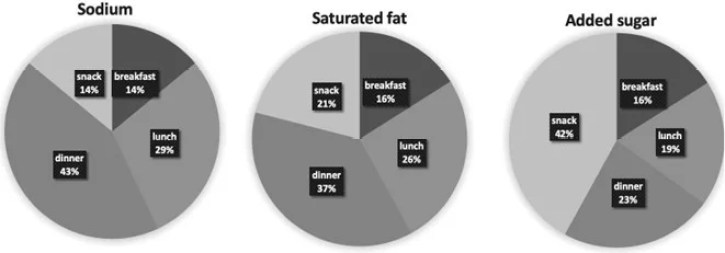
The charts below show the average percentages in typical meals of three types of nutrients, all of which may be unhealthy if eaten too much.
Summarise the information by selecting and reporting the main features, and make comparisons where relevant.
Average percentages of sodium, saturated fats and added sugars in typical meals consumed in the USA
Student answer (Band 5.0)
The following pie charts gives information about the average percenatge in three different types of nutrients, all of which may be unhealthy if we eaten too much and the nutrients types are such as sodium, saturated fat and added sugar.
Firstly, in sodium pie chart the higher percentage is in dinner which is around 43% and the lowest value in both breakfast and snack whereas lunch is containing 29% which is the second highest value recorded.
Next, saturated fat reached its peak at also in dinner which is 37% and the lowest point is in breakfast which is roughly 16%. Moreover, lunch and snack is almost contaning same value which is above 20%.
At the end in added sugar, Snack is enclosing 42% whereas breakfast is on same percentage as in saturated fat.
Overall, in all three pie charts, breakfast is on lowest percentage and dinner and lunch is getting maximum percentage.
AI examiner evaluation
| Criterion | Band |
|---|---|
| Task Achievement / Task Response | 5.0 |
| Coherence and Cohesion | 5.5 |
| Lexical Resource | 5.0 |
| Grammatical Range and Accuracy | 5.0 |
| Overall | 5.0 |
Task Achievement / Task Response: Band 5.0
You identify several key figures accurately, including dinner as the highest source of sodium (43%) and saturated fat (37%), and snacks as the largest source of added sugar (42%). However, the overview is misleading: breakfast is not the lowest category in every chart, and dinner and lunch are not the maximum categories across all three, since snacks lead for added sugar. The comparison of lunch and snacks for saturated fat is also imprecise: 26% and 21% are not almost the same. Added sugar is only briefly described, with several useful comparisons omitted. The response is also 8 words below the 150-word minimum. Include a clearer overview and report the main contrasts across all three charts.
Coherence and Cohesion: Band 5.5
The response has a basic sequence, moving from sodium to saturated fat and then added sugar, and signposts such as “Firstly,” “Next,” and “At the end” help show this order. However, the organisation is mostly a list of chart-by-chart observations rather than a developed comparison, and the final overview does not accurately summarise the data. Some links are awkward or unclear, such as “Moreover” introducing the lunch-and-snack comparison without explaining its significance. The added-sugar paragraph is especially brief, so the discussion feels unbalanced. Grouping the main patterns—for example, dinner’s prominence for sodium and saturated fat versus snacks’ prominence for sugar—would create clearer progression and stronger cohesion.
Lexical Resource: Band 5.0
You use some relevant chart vocabulary, including “percentage,” “peak,” “lowest,” and “recorded,” so the reader can generally understand the topic. However, the range is limited and several choices are inaccurate or unnatural, such as “the higher percentage,” “reached its peak at also in dinner,” and “snack is enclosing 42%.” There are also spelling errors, including “percenatge” and “contaning,” which reduce accuracy. Repetition of basic terms such as “value” and “percentage” limits precision. Use standard reporting language such as “accounted for,” “stood at,” and “the largest share,” and check spelling and collocations when editing.
Grammatical Range and Accuracy: Band 5.0
The response communicates its basic meaning, but it relies mainly on simple sentence patterns and attempts at more complex structures are often faulty. For example, “The following pie charts gives” has subject–verb disagreement, while “all of which may be unhealthy if we eaten too much” has an incorrect verb form. In “lunch and snack is almost,” the plural subject requires a plural verb, and “the lowest value in both breakfast and snack” is an incomplete clause. These errors occur often enough to make parts of the description awkward or difficult to follow. Practise accurate comparisons using complete sentences, and check agreement, verb forms, and articles before submitting.
See this exact question answered at other band scores. The same prompt compared across bands.
Browse more IELTS Writing model answers or get your own writing scored by the same AI examiner.