Band 5.5 IELTS Writing Task 1 Model Answer
Overall Band Score: 5.5 · Cambridge IELTS 17 · 2026-11-23
IELTS Writing Task 1 question
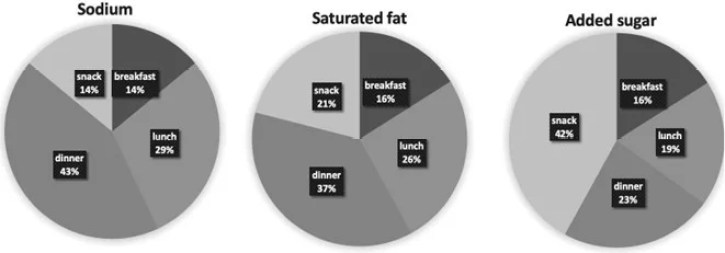
The charts below show the average percentages in typical meals of three types of nutrients, all of which may be unhealthy if eaten too much.
Summarise the information by selecting and reporting the main features, and make comparisons where relevant.
Average percentages of sodium, saturated fats and added sugars in typical meals consumed in the USA
Student answer (Band 5.5)
The pie charts illustrates the approimated allowed proportions of 3 types of different nutrients in distinct meals.Every chart represents each nutrient with the amount of proportions to consume along the day in the USA.
Overall, the sodium has the highest proportion intake in dinner and the saturated fat could be consumed in higher percentage during the dinner. For the added sugar it could be intake in form of snacks and it makes the highest percentage all over all meals.
Firstly, for the breakfast only 14% could be consumed in the form of sodium nutrient while the saturated fat and added sugar could be intaked with a higher proportion than sodium with 2%.Also for the snacks people could eat more added sugar compared to other nutrients as it contain the highest percentage allowed which is 42%. Then saturated fat contain the second highest limit for snacks and it makes 21% from the 4 meals. sodium could be consumed in lower proportions as allowed in snacks with 14% only.
considering the lunch a higher amount of sodium is allowed making 29% of total although for saturated fats only 26% is allowed and much lower proportion of added sugar is permitted.
AI examiner evaluation
| Criterion | Band |
|---|---|
| Task Achievement / Task Response | 6.0 |
| Coherence and Cohesion | 5.5 |
| Lexical Resource | 5.5 |
| Grammatical Range and Accuracy | 5.0 |
| Overall | 5.5 |
Task Achievement / Task Response: Band 6.0
You identify the main pattern accurately: dinner has the largest shares of sodium and saturated fat, while snacks lead for added sugar. Several figures are also reported correctly, including breakfast sodium at 14%, snack sugar at 42%, and lunch sodium at 29%. This gives the response a relevant overview and covers the charts. However, the dinner figures themselves are not stated, and the final lunch comparison is left incomplete: the added-sugar share is described as “much lower” without giving its 19% value. Some wording, such as “allowed proportions,” also presents the figures as recommended limits, although the charts show percentages in meals. Include the key dinner values and describe the data neutrally to make the comparisons more complete and precise.
Coherence and Cohesion: Band 5.5
The response has a recognisable structure, with an introduction, an overview and paragraphs discussing breakfast, snacks and lunch. The overview helps the reader identify the main contrasts, and sequencing words such as “Firstly,” “Also” and “Then” signal movement between points. However, the progression is not fully controlled: the discussion moves from breakfast to snacks and then lunch, while dinner—the most prominent meal for two nutrients—is not developed in the body. Some links are mechanical, and the final paragraph ends abruptly without a concluding comparison. Organise the details by meal or by nutrient, and use clearer links to show how each comparison relates to the overview.
Lexical Resource: Band 5.5
You use relevant chart vocabulary, including “proportion,” “percentage,” “higher” and “lower,” and the reader can generally understand the comparisons. There is also an attempt to vary phrasing rather than repeat only the chart labels. However, several word choices and collocations are inaccurate or awkward, such as “approimated allowed proportions,” “could be intaked,” and “it contain the highest percentage allowed.” “Distinct meals” is also less natural than “different meals.” These errors sometimes make the intended meaning less precise, particularly when the figures are described as amounts people are permitted to consume. Choose standard reporting language such as “accounted for,” “share” and “represented,” and check spelling and word forms.
Grammatical Range and Accuracy: Band 5.0
You attempt both simple and more complex sentences, including comparisons joined with “while” and “although,” and the overall meaning is usually recoverable. However, errors in sentence structure and agreement occur across the response. For example, “The pie charts illustrates” has a plural subject with a singular verb, while “it contain” also lacks agreement. The sentence beginning “For the breakfast only 14%...” is awkwardly constructed, and punctuation is often missing after sentence boundaries, as in “2%.Also”. Some clauses are joined without a clear grammatical relationship, especially in the overview. Practise accurate subject–verb agreement, articles and sentence boundaries, then use a few well-controlled complex sentences to express comparisons.
See this exact question answered at other band scores. The same prompt compared across bands.
Browse more IELTS Writing model answers or get your own writing scored by the same AI examiner.