Band 5.0 IELTS Writing Task 1 Model Answer
Overall Band Score: 5.0 · Cambridge IELTS 17 · 2026-11-24
IELTS Writing Task 1 question
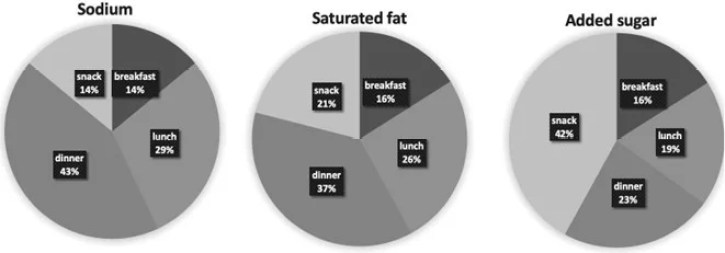
The charts below show the average percentages in typical meals of three types of nutrients, all of which may be unhealthy if eaten too much.
Summarise the information by selecting and reporting the main features, and make comparisons where relevant.
Average percentages of sodium, saturated fats and added sugars in typical meals consumed in the USA
Student answer (Band 5.0)
Here, three piecharts and given which explains about three types of nutrients, which are not healthy if eaten too much. Sodium, Saturated fat and Added sugar are compared and they are consumed in USA.
Average percentage of snack is less in sodim, moderate in saturated fat and high in adeed sugar. On the other hand, breakfast seems equal and balanced in saturated fat and added sugar but it is slightly less in sodium.
Talking about, lunch it varies slightly in every types, Sodim has the highest percentage of lunch which is 29% whereas, adeed sugar has lowest percentage which is 23%. Dinner also had contributed more percentage in sodim and less percentage im added sugar but, saturated salt remains moderate.
In sodium, most percentage is covered by dinner which is 43% then, In saturated fat also huge area is consumed by dinner about 37%. At last, hightest area covered by typical meals in added sugar is snack which is 42%. It varied from both types.
AI examiner evaluation
| Criterion | Band |
|---|---|
| Task Achievement / Task Response | 5.5 |
| Coherence and Cohesion | 5.0 |
| Lexical Resource | 5.0 |
| Grammatical Range and Accuracy | 5.0 |
| Overall | 5.0 |
Task Achievement / Task Response: Band 5.5
You identify the three nutrients and report several relevant comparisons, including dinner as the largest sodium and saturated-fat meal and snacks as the largest source of added sugar. However, some figures and comparisons are inaccurate: added sugar at lunch is 19%, not 23%, and sodium is not the highest lunch figure (saturated fat is 26%, compared with sodium at 29%). The overview is also unclear: saying snack is “less” for sodium and “moderate” for saturated fat does not clearly establish the key pattern that dinner leads for sodium and saturated fat, while snacks lead for added sugar. The response therefore covers the charts only partially, with some important details under-developed or misreported. Prioritise an accurate overview and select a few precise comparisons.
Coherence and Cohesion: Band 5.0
The response has some organisation: it introduces the charts, then discusses snacks and breakfast, lunch, and dinner. This gives the reader a basic route through the information. However, the progression is not consistently clear, and several transitions feel mechanical or confusing, such as “Talking about, lunch” and “At last.” The discussion repeats dinner comparisons after already mentioning dinner, while “It varied from both types” does not make clear what is being compared. Grouping the information around the main patterns—dinner for sodium and saturated fat, and snacks for added sugar—would create a clearer progression. Use linking phrases to show meaningful contrasts rather than simply moving from one meal to another.
Lexical Resource: Band 5.0
You use some relevant chart vocabulary, including “percentage,” “consumed,” “highest,” and “contributed,” and the reader can generally identify the nutrients and meals being discussed. However, the range is limited and several word choices or collocations are inaccurate or unclear, including “average percentage of snack,” “huge area is consumed,” and “hightest area covered.” Spelling errors such as “sodim” and “adeed” also make the writing less precise. In addition, “moderate” and “balanced” are vague when describing numerical differences. Use standard terms such as “proportion” or “share,” and describe the figures directly with “accounted for” or “was highest.” Check spelling of key chart labels carefully.
Grammatical Range and Accuracy: Band 5.0
You attempt both simple and longer sentences, and some comparisons are understandable, for example, “Sodium has the highest percentage of lunch which is 29%.” However, the longer structures are often faulty or incomplete. “Here, three piecharts and given which explains…” lacks a clear verb structure, while “Talking about, lunch it varies…” has problematic punctuation and sentence construction. There are also errors in articles, agreement, and tense, as in “Dinner also had contributed” and “three types of nutrients, which are not healthy.” Commas are frequently placed where a full stop or no punctuation is needed. Build accuracy with clear subject–verb sentences first, then add subordinate clauses only when their structure is controlled.
See this exact question answered at other band scores. The same prompt compared across bands.
Browse more IELTS Writing model answers or get your own writing scored by the same AI examiner.