Band 6.0 IELTS Writing Task 1 Model Answer
Overall Band Score: 6.0 · Cambridge IELTS 17 · 2026-11-24
IELTS Writing Task 1 question
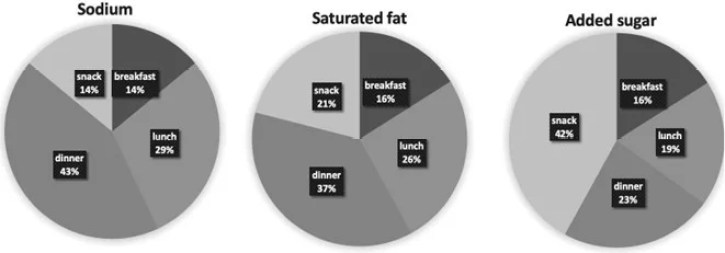
The charts below show the average percentages in typical meals of three types of nutrients, all of which may be unhealthy if eaten too much.
Summarise the information by selecting and reporting the main features, and make comparisons where relevant.
Average percentages of sodium, saturated fats and added sugars in typical meals consumed in the USA
Student answer (Band 6.0)
The three provided pie charts compares the
average percentages of sodium, saturated fats and added sugars in different meals used in the USA.
Overall, added sugar is most used in snacks while saturated fat and sodium were used limited. Furthermore, saturated fat and sodium were widely used in dinner meal. In breakfast meal, all the three sodium, saturated fats and added sugars were used at very small scale.
On the one hand, sodium is accounted for 43% in dinner which is highest among all three charts by following lunch meal at 29% while in both breakfast and snack 14% is used.
On the other hand, Saturated fat and added sugar were least used in breakfast of almost 16% . 21% saturated fat is consumed in snack while in lunch and dinner it is used at the rate of 26% and 37% respectively.
Added sugar is 42% used in snack which is also a higher amount of average percentage. In contract, it is less used in lunch , dinner and breakfast at 19%, 23% and 16% respectively.
AI examiner evaluation
| Criterion | Band |
|---|---|
| Task Achievement / Task Response | 6.5 |
| Coherence and Cohesion | 5.5 |
| Lexical Resource | 5.5 |
| Grammatical Range and Accuracy | 5.5 |
| Overall | 6.0 |
Task Achievement / Task Response: Band 6.5
The response identifies the main pattern accurately: sodium and saturated fat peak at dinner, while added sugar is highest in snacks. It also reports the key figures correctly, including sodium at 43% for dinner and 29% for lunch, and added sugar at 42% for snacks. This gives the report a clear overview and relevant comparisons. However, the overview is partly unclear: “saturated fat and sodium were used limited” does not clearly state that both are highest at dinner, and describing all breakfast figures as “very small” overlooks that breakfast is tied with snacks for sodium. Some comparisons are presented as lists rather than interpreted. The task is well covered overall, but clearer, more precise synthesis would strengthen it further.
Coherence and Cohesion: Band 5.5
The response has a recognisable structure, moving from an introduction and overview to details about sodium, saturated fat and added sugar. The contrast markers “On the one hand” and “On the other hand” help signal shifts, and the figures are generally grouped by nutrient. However, progression is not consistently smooth: the overview repeats information later, and the two “hand” paragraphs do not form a clear contrast. The final paragraph returns to added sugar after the preceding paragraph has already discussed it, while “In contract” is an inaccurate linking phrase. More deliberate grouping—for example, comparing dinner and snack peaks across all three nutrients—would create clearer progression and reduce repetition.
Lexical Resource: Band 5.5
The response uses relevant chart vocabulary, including “average percentages,” “consumed,” “highest,” and “least,” and the nutrient names are generally clear. This is enough to communicate the main data, but the range is limited and several word choices or collocations are noticeably inaccurate. “Used limited” and “used at a very small scale” are awkward, while “In contract” appears to be an incorrect choice for a contrast marker. Repeated use of “used” also makes the description less precise. Aim for natural reporting language such as “accounted for,” “made up,” and “the largest share,” and check that each phrase fits the relationship being described.
Grammatical Range and Accuracy: Band 5.5
The response attempts both simple and more extended sentence forms, and the main figures remain understandable. However, errors in agreement, articles and sentence construction are noticeable. The opening says “charts compares” rather than “charts compare,” and “in different meals used in the USA” has an unclear grammatical relationship. Phrases such as “sodium is accounted for 43%” and “21% saturated fat is consumed” are not formed accurately. There are also inconsistent capitalisation and spacing around punctuation, as in “Saturated” and “16% .” These issues do not generally prevent understanding, but more reliable sentence patterns—such as “Dinner accounts for 43% of sodium”—would improve accuracy while preserving variety.
See this exact question answered at other band scores. The same prompt compared across bands.
Browse more IELTS Writing model answers or get your own writing scored by the same AI examiner.