Band 5.5 IELTS Writing Task 1 Model Answer
Overall Band Score: 5.5 · Cambridge IELTS 17 · 2026-11-24
IELTS Writing Task 1 question
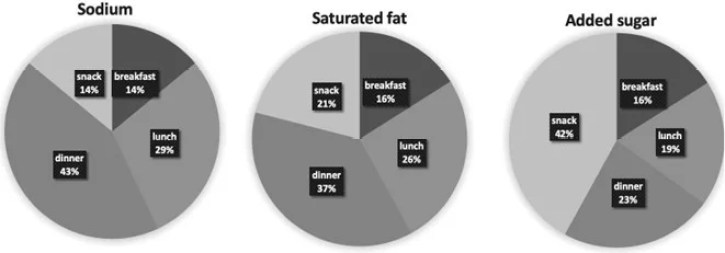
The charts below show the average percentages in typical meals of three types of nutrients, all of which may be unhealthy if eaten too much.
Summarise the information by selecting and reporting the main features, and make comparisons where relevant.
Average percentages of sodium, saturated fats and added sugars in typical meals consumed in the USA
Student answer (Band 5.5)
The given pie charts illustrate proportions of three catagories of harmful nutrients in eating habit of USA with the further classifications of sodium, saturated fat and extra suger.
Overall, dinner meal contributes the most amount of sodium and saturated in USA citizen's body whereas most amount of suger is found in snack items. However, these three elements are least found in morning meal.
Looking to details, sodium contains in dinner and lunch food almost three-fold number of the chart which are 43% and 29% respectively. Meanwhile, snack and breakfast equally share ratio for having sodium nutrients which is 14%.
On the other hand, saturated comtain 26% in lunch compare to more in breakfast (16%) and snack 21% less than dinner 37%. Besides, added sugar have most in snack which is 42% whereas least in breakfast 16% and
AI examiner evaluation
| Criterion | Band |
|---|---|
| Task Achievement / Task Response | 5.5 |
| Coherence and Cohesion | 5.5 |
| Lexical Resource | 5.0 |
| Grammatical Range and Accuracy | 5.0 |
| Overall | 5.5 |
Task Achievement / Task Response: Band 5.5
You identify the main contrast correctly: dinner has the highest shares of sodium and saturated fat, while snacks lead for added sugar. Several figures are also accurate, including sodium at 43% for dinner and 14% for breakfast and snacks, and added sugar at 42% for snacks. However, the report is incomplete: the final sentence stops after “and”, so the lunch figure for added sugar is omitted, and the saturated-fat comparisons are expressed unclearly. The overview also says all three nutrients are least in the morning meal, but breakfast is not the lowest for saturated fat or added sugar; snacks are lower for saturated fat, and lunch is lower for added sugar only if compared with breakfast? In fact, breakfast is 16%, below lunch at 19%. The response is 13 words below the required minimum. Include a complete account of the key comparisons and check each overview claim against the chart.
Coherence and Cohesion: Band 5.5
There is a recognisable structure: an introduction, an overview, and two detail paragraphs, with transitions such as “Overall,” “Meanwhile,” and “On the other hand.” This gives the reader some sense of how the information is grouped. However, progression is limited because the final paragraph ends mid-sentence, and the comparisons within it are difficult to follow—for example, “snack 21% less than dinner 37%” does not clearly state the relationship. The phrase “almost three-fold number of the chart” also interrupts the flow rather than presenting a clear comparison. Organise the details consistently by nutrient or meal, use linking phrases only where they clarify relationships, and complete each sentence and paragraph.
Lexical Resource: Band 5.0
The response uses some task-related vocabulary, including “proportions,” “classifications,” “contributes,” and “equally share,” and it attempts to describe comparisons. However, the range is limited and several word choices or collocations make the meaning unclear, such as “three-fold number of the chart,” “saturated comtain,” and “suger is found in snack items.” There are also noticeable spelling errors, including “catagories,” “suger,” and “comtain.” Use precise chart language such as “accounts for,” “share,” and “percentage,” and check spelling carefully. Avoid describing nutrients as being “found” in meals when the chart reports their average percentage contribution.
Grammatical Range and Accuracy: Band 5.0
You attempt both simple and more complex sentence forms, including the overview sentence beginning “Overall” and the contrast introduced by “whereas.” However, grammatical control is inconsistent, and errors sometimes make relationships difficult to understand. For example, “sodium contains in dinner and lunch food” has an incorrect verb construction, while “saturated comtain 26% in lunch compare to more in breakfast” lacks a clear grammatical comparison. The final sentence is incomplete, ending with “and,” and the opening sentence has awkward article and number patterns. Practise complete subject–verb structures and comparative forms, such as “Sodium accounts for 43% at dinner, compared with 29% at lunch.” Proofread for sentence completion and agreement.
See this exact question answered at other band scores. The same prompt compared across bands.
Browse more IELTS Writing model answers or get your own writing scored by the same AI examiner.