Band 5.5 IELTS Writing Task 1 Model Answer
Overall Band Score: 5.5 · Cambridge IELTS 17 · 2026-11-25
IELTS Writing Task 1 question
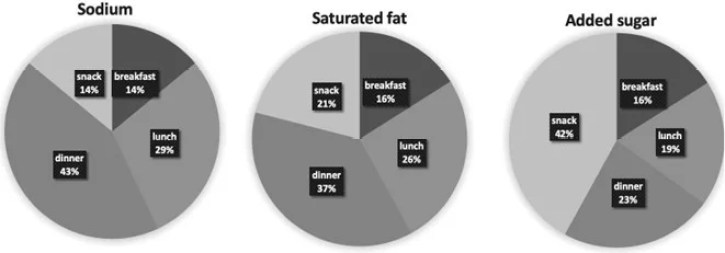
The charts below show the average percentages in typical meals of three types of nutrients, all of which may be unhealthy if eaten too much.
Summarise the information by selecting and reporting the main features, and make comparisons where relevant.
Average percentages of sodium, saturated fats and added sugars in typical meals consumed in the USA
Student answer (Band 5.5)
The given pie charts depict different percentages of sodium, saturated fats, and added sugars in typical meals consumed in America. As for sodium, breakfast and snacks both contain around 14 percent sodium, while lunch contributes around 29 percent and the largest share comes from dinner that is almost 43 percent.
Next comes the saturated fats, in which breakfast contains 16, snacks 21%, lunch 26%, and lastly dinner has the highest amount of saturated fat, around 37%. third chart shows added sugar which is same as saturated fats: breakfast is around 16%, lunch is 19%, and dinner is around 23%, while the highest amount comes from snacks, around 42%.
AI examiner evaluation
| Criterion | Band |
|---|---|
| Task Achievement / Task Response | 4.5 |
| Coherence and Cohesion | 6.0 |
| Lexical Resource | 5.5 |
| Grammatical Range and Accuracy | 5.5 |
| Overall | 5.5 |
Task Achievement / Task Response: Band 4.5
You identify the three nutrients and report several key figures accurately, including dinner as the largest source of sodium (43%) and saturated fat (37%), and snacks as the largest source of added sugar (42%). However, the response has no clear overall summary comparing the charts, and the added-sugar description incorrectly says it is “the same as saturated fats”: the leading meal differs, and the figures are not the same. The account is also very brief and leaves comparisons between meal types and nutrients underdeveloped. It contains 95 words, 55 below the required minimum; the 13 words copied from the prompt are not counted. Add a concise overview and develop the most important contrasts to address the task more fully.
Coherence and Cohesion: Band 6.0
The information is presented in a generally understandable order: sodium first, saturated fat second, and added sugar last. Phrases such as “Next comes” and “third chart shows” help signal this sequence, so the reader can follow the basic progression. However, the response is a single paragraph and reads mainly as a list of figures rather than a connected comparison. The transition “Next comes the saturated fats” is somewhat mechanical, and “the same as saturated fats” creates an unclear link because the added-sugar pattern is different. Use separate paragraphs for an overview and details, and connect the charts through explicit comparisons, such as contrasting dinner’s high sodium and fat shares with snacks’ high sugar share.
Lexical Resource: Band 5.5
You use relevant chart vocabulary, including “percentages,” “contributes,” “largest share,” and “highest amount,” which makes the data generally clear. There is some variation in how you describe proportions, but the range is limited and several expressions are imprecise or repetitive. For example, “the same as saturated fats” does not accurately describe the added-sugar pattern, while “comes from dinner” is less precise than a phrase describing dinner’s share. “Around” and “amount” recur, and “third chart” is a basic reference. Aim for more precise language for proportions and comparisons, such as “accounts for,” “represents,” and “by contrast,” while ensuring that the wording reflects the figures accurately.
Grammatical Range and Accuracy: Band 5.5
The response includes both straightforward statements and longer sentences joined with “while,” as in the opening description of sodium, so there is some variety in sentence structure. Most of the figures remain understandable despite some grammatical and punctuation problems. The sentence beginning “Next comes the saturated fats, in which…” has an awkward relative clause, and “breakfast contains 16, snacks 21%” omits the repeated verb, making the list less controlled. The lowercase start in “third chart shows” and the run-on presentation of several figures also weaken accuracy. Use complete parallel clauses—for example, “Breakfast accounts for 16%, while snacks make up 21%”—and check sentence boundaries and capitalization.
See this exact question answered at other band scores. The same prompt compared across bands.
Browse more IELTS Writing model answers or get your own writing scored by the same AI examiner.