Band 7.0 IELTS Writing Task 1 Model Answer
Overall Band Score: 7.0 · Cambridge IELTS 17 · 2026-11-25
IELTS Writing Task 1 question
The charts below show the average percentages in typical meals of three types of nutrients, all of which may be unhealthy if eaten too much.
Summarise the information by selecting and reporting the main features, and make comparisons where relevant.
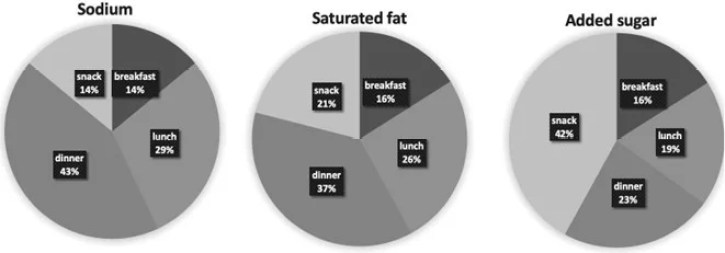
Average percentages of sodium, saturated fats and added sugars in typical meals consumed in the USA
Student answer (Band 7.0)
The three pie-charts give information about the average percetages of sodium, saturated fat, and added sugar in typical meals consumed by the Americans.
Overall, dinner had the highest amount of sodium and saturated fat, while the greatest quantity of added sugar was found in snacks. Breakfast had the least amount of all three nutrients.
43% of sodium taken by the Americans came from their dinner, and 14% from both snacks and breakfast. 29% of this nutrient was taken from their lunch. The highest portion of saturated fat was obtained from dinner as well, which accounted for 37% of this nutrient. 26% of this nutrient was taken from lunch and 21% from snack. Breakfast had the smallest amount of saturated fat, containing only 16% of it.
Snack had 42% of added sugar. This figure is followed by dinner, which consisted 23% of this nutrient. Lunch had 19% addded sugar, while the least amount was obtained in breakfast. Only 16% of added sugar was present in breakfast.
AI examiner evaluation
| Criterion | Band |
|---|---|
| Task Achievement / Task Response | 7.5 |
| Coherence and Cohesion | 7.0 |
| Lexical Resource | 6.5 |
| Grammatical Range and Accuracy | 6.5 |
| Overall | 7.0 |
Task Achievement / Task Response: Band 7.5
The response selects the main features accurately: dinner contributes the largest shares of sodium and saturated fat, while snacks account for the most added sugar, and breakfast is lowest for all three. The figures reported are consistent with the chart, including the 43% and 37% dinner shares and the 42% snack share. The overview is clear, and the body supports it with relevant comparisons across meals. This is a strong, well-focused summary. To make the account more fully developed, draw out a further comparison between the distributions—for example, sodium is more concentrated at dinner than saturated fat, whereas added sugar is notably concentrated in snacks. This would add analytical depth beyond listing the individual percentages.
Coherence and Cohesion: Band 7.0
The response is organised effectively into an introduction, a concise overview and two detail paragraphs. The progression from the overall pattern to sodium and saturated fat, then added sugar, is easy to follow. Linking expressions such as “Overall,” “as well,” and “while” help signal relationships, and the repeated references to each nutrient keep the comparisons clear. Cohesion is generally flexible, though some phrasing becomes repetitive, particularly the repeated “this nutrient” and “had” constructions. More varied referencing and sentence openings would make the flow smoother and less list-like. The paragraphing and logical sequence are already strong; the main opportunity is to make connections between the data more integrated.
Lexical Resource: Band 6.5
The vocabulary is adequate for describing the charts, with useful terms such as “accounted for,” “portion,” “greatest quantity,” and “obtained.” Meaning remains clear throughout. However, some choices are imprecise or unnatural for statistical reporting: “43% of sodium … came from their dinner” and “Snack had 42% of added sugar” would be more naturally expressed using “accounted for” or “contributed.” There are also spelling slips in “percetages” and “addded,” and “the Americans” is less natural than “Americans” in this context. These issues limit the precision and control of the vocabulary, despite a reasonable range. Aim for accurate collocations and proofread spelling carefully.
Grammatical Range and Accuracy: Band 6.5
The response uses a mix of simple and more developed sentence forms, including clauses with “while” and “which,” and most sentences communicate the intended comparisons clearly. Some grammatical control is evident in constructions such as “Breakfast had the least amount of all three nutrients.” However, there are errors in sentence patterns: “dinner, which consisted 23% of this nutrient” needs “consisted of” or, more naturally, “accounted for 23%.” The phrasing “43% of sodium taken by the Americans came from their dinner” is also awkwardly structured, and “from snack” lacks a natural article or plural form. These errors rarely obstruct meaning, but more consistent control of verb patterns and noun phrases is needed for greater accuracy.
See this exact question answered at other band scores. The same prompt compared across bands.
Browse more IELTS Writing model answers or get your own writing scored by the same AI examiner.