Band 5.0 IELTS Writing Task 1 Model Answer
Overall Band Score: 5.0 · Cambridge IELTS 17 · 2026-11-25
IELTS Writing Task 1 question
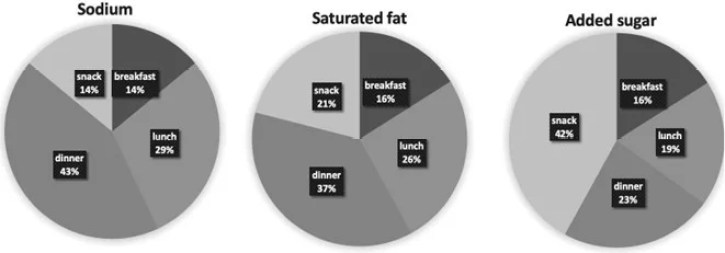
The charts below show the average percentages in typical meals of three types of nutrients, all of which may be unhealthy if eaten too much.
Summarise the information by selecting and reporting the main features, and make comparisons where relevant.
Average percentages of sodium, saturated fats and added sugars in typical meals consumed in the USA
Student answer (Band 5.0)
The charts below show average percentages of sodium , saturated fats and added sugars in typical meals consumed in the USA , and from that we can conclued
Sodium is more concentrated in dinner meals with 43% , then in lunch with 29 %, and then snack and breakfast with 14% of sodium.
Saturated fat is also concentrated more in dinner meals with 37% , lunch with 26 % , snack with 21% and breakfast with 16% of saturated fat .
For the added sugar, the first place goes for snack as the meal that containes 42% of it , second it comes dinner with 23% , third lunch with 19%, and finally breakfast with 16% of added sugar .
AI examiner evaluation
| Criterion | Band |
|---|---|
| Task Achievement / Task Response | 4.5 |
| Coherence and Cohesion | 5.0 |
| Lexical Resource | 5.0 |
| Grammatical Range and Accuracy | 5.0 |
| Overall | 5.0 |
Task Achievement / Task Response: Band 4.5
You report the main meal rankings accurately: dinner has the highest shares of sodium and saturated fat, while snacks lead for added sugar. The figures you give match the chart, including the equal 14% shares for sodium at breakfast and snacks. However, the response has no clear overview that draws these patterns together, and it mainly lists figures rather than selecting and comparing the most important features. It also contains only 103 words, below the required 150; 16 words copied from the task prompt were not counted. This leaves the summary underdeveloped and means the task is addressed only partially. Add a concise overview, develop comparisons across the three nutrients, and include enough relevant detail to meet the required length.
Coherence and Cohesion: Band 5.0
The information is presented in a sensible sequence, with one sentence each for sodium, saturated fat and added sugar. This makes the nutrient being discussed easy to identify, and ordering the meal shares from highest to lowest generally helps the reader follow the data. However, the response has no paragraphing or distinct overview, so it reads as a short list rather than a developed report. Linking is also repetitive: each sentence follows the same pattern of naming a nutrient and ranking meals. Use an introduction and overview, then group related comparisons—for example, dinner’s leading shares of sodium and saturated fat—into a body paragraph. This would create clearer progression and more varied cohesion.
Lexical Resource: Band 5.0
Your vocabulary is sufficient to identify the chart categories and report proportions, using terms such as “sodium,” “saturated fat,” “added sugar,” and “concentrated.” The repeated ranking language (“then,” “second,” “third,” and “finally”), however, makes the report sound formulaic, and some expressions are not natural for describing chart data. “The first place goes for snack” and “the meal that containes 42% of it” are awkward; “snacks account for the largest share” would be more precise. There are also spelling errors, including “conclued” and “containes.” Build a small range of accurate comparison phrases and check spelling so that your meaning is conveyed smoothly and without distracting errors.
Grammatical Range and Accuracy: Band 5.0
The response uses mostly simple sentence patterns, with some attempts to connect information through phrases such as “and then” and “For the added sugar.” The basic meaning is generally understandable, but the range is limited and several sentence constructions are faulty or incomplete. The opening sentence ends with “and from that we can conclued” without stating a conclusion, while “second it comes dinner” has an awkward word order. The repeated list-like structures also provide little evidence of control over more varied sentence forms. Practise complete overview sentences and comparison structures, such as “Dinner accounts for a larger share of sodium than lunch does.” Check word order, sentence boundaries and punctuation when revising.
See this exact question answered at other band scores. The same prompt compared across bands.
Browse more IELTS Writing model answers or get your own writing scored by the same AI examiner.