Band 6.0 IELTS Writing Task 1 Model Answer
Overall Band Score: 6.0 · Cambridge IELTS 17 · 2026-11-26
IELTS Writing Task 1 question
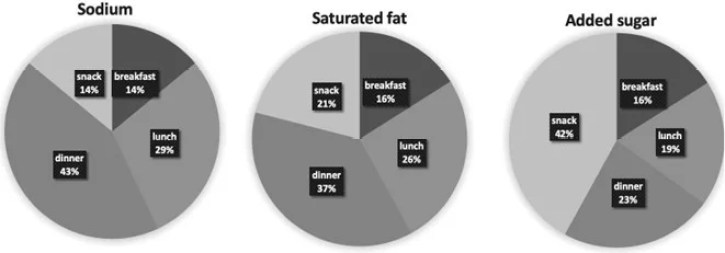
The charts below show the average percentages in typical meals of three types of nutrients, all of which may be unhealthy if eaten too much.
Summarise the information by selecting and reporting the main features, and make comparisons where relevant.
Average percentages of sodium, saturated fats and added sugars in typical meals consumed in the USA
Student answer (Band 6.0)
The pie charts compare the proportion in meal of three types of nutrients sodium, saturated fat and added sugar, all of which my be harmfull if consume too much.
Overall, dinner accounted the highest proportion of sodium and saturated fat. Snak and breakfast had the smallest shares of sodium and saturated fat. Snack had the highest and lowest amount of sugar.
Regarding sugar and saturated fat, dinner constituted the largest shares accounting 43% and 37%. Followed by lunch shared 29% and 26%. The amount of sodium in break fast and in snacks had the same proportion accounted 14%, respectively, meanwhile saturated fat in snacks and breakfast had 21% and 16%, respectively.
In terms of added sugar, snacks had the highest amound of sugar 42%, followed by dinner 23% which is approximately twice lower as compared to snacks. Lunch had 19% of the added sugar, although breakfast reoresented the smallest shares of added sugar, accounting 16%.
AI examiner evaluation
| Criterion | Band |
|---|---|
| Task Achievement / Task Response | 6.0 |
| Coherence and Cohesion | 6.0 |
| Lexical Resource | 6.0 |
| Grammatical Range and Accuracy | 5.5 |
| Overall | 6.0 |
Task Achievement / Task Response: Band 6.0
You identify the main pattern that dinner has the largest shares of sodium and saturated fat, and you correctly report several key figures, including 43% and 37% for dinner and 42% for snack-related added sugar. The response also compares meal categories rather than listing figures alone. However, the overview is unclear when it says “Snack had the highest and lowest amount of sugar”: snacks have the highest added sugar, while breakfast has the lowest. The sentence beginning “Regarding sugar and saturated fat” also labels 43% and 37% as sugar and saturated fat, although 43% is sodium. This misidentification weakens the accuracy of an otherwise relevant summary. Make the overview precise and ensure each figure is linked to the correct nutrient.
Coherence and Cohesion: Band 6.0
The response has a clear overall arrangement: an introduction, an overview, and paragraphs reporting the figures. This gives the reader a generally coherent route through the information. Some connections, however, are mechanical or unclear. “Regarding sugar and saturated fat” does not match the figures that follow, and “Followed by lunch shared 29% and 26%” is a fragment rather than a complete continuation. The overview’s claim about sugar also conflicts with the later, more accurate comparison. Grouping the sodium and saturated-fat figures together, then discussing added sugar, would make the progression easier to follow; use complete linking sentences and check that the overview agrees with the details.
Lexical Resource: Band 6.0
You use a suitable range of chart-reporting language, including “accounted,” “constituted,” “proportion,” and “respectively,” and the meaning is generally understandable. Some word choices and collocations are inaccurate or awkward, such as “proportion in meal,” “largest shares accounting,” and “approximately twice lower.” There are also spelling errors, including “harmfull,” “Snak,” “amound,” and “reoresented,” which reduce the accuracy of the vocabulary. Prefer precise, natural expressions such as “the proportion of each nutrient in meals,” “accounted for the largest share,” and “less than half as much.” Proofreading spelling and choosing standard collocations would make the report clearer and more controlled.
Grammatical Range and Accuracy: Band 5.5
You attempt both simple and more complex sentence forms, including a comparison introduced by “although” and clauses using “which.” The main information is usually recoverable, but some grammatical errors remain. For example, “dinner accounted the highest proportion” needs “accounted for,” while “all of which my be harmfull if consume too much” lacks a correct modal and passive construction. “Followed by lunch shared 29% and 26%” is not a complete sentence, and “break fast and in snacks had the same proportion accounted 14%” has an unclear structure. Build complete sentences around each comparison and check verb forms, articles, and prepositions. More consistently accurate complex sentences would strengthen the report.
See this exact question answered at other band scores. The same prompt compared across bands.
Browse more IELTS Writing model answers or get your own writing scored by the same AI examiner.