Band 6.0 IELTS Writing Task 1 Model Answer
Overall Band Score: 6.0 · Cambridge IELTS 17 · 2026-11-26
IELTS Writing Task 1 question
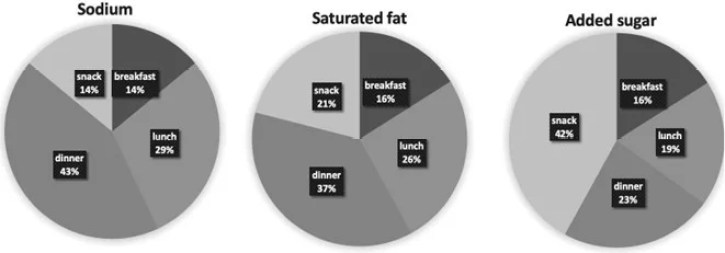
The charts below show the average percentages in typical meals of three types of nutrients, all of which may be unhealthy if eaten too much.
Summarise the information by selecting and reporting the main features, and make comparisons where relevant.
Average percentages of sodium, saturated fats and added sugars in typical meals consumed in the USA
Student answer (Band 6.0)
The pie charts represent the proportions of sodium, saturated fat and added sugar in four different meals consumed by the citizeins of the USA.
Overall, the proportion of sodium and saturated fat is significantly higher in dinner compared to the other meals. In contrast, the US population had a substantial amount of added sugar in their snacks. All the nutrients had their least proportion in the breakfast of the people.
The amount of sodium in dinner is in considerable amount as it accounts for 43% in the overall meal. The proportion of sodium in their lunch is nearly half as that in dinner as 29% of their lunch has sodium in it. It's proportion was equal in breakfast and snack as it contributes for 14% in both meals.
The proportion of saturated fat is significantly higher in dinner, while that of added sugar is comparitively higher in snacks. The proportion of saturated fat was half that of the proportion of added sugar in snacks. Meanwhile, both saturated fat and added sugar equally contributed in the breakfast of the population of the US as, they accounted for 16%. Additionally, saturated fat is higher in lunch compared to added sugar/
AI examiner evaluation
| Criterion | Band |
|---|---|
| Task Achievement / Task Response | 6.5 |
| Coherence and Cohesion | 6.0 |
| Lexical Resource | 6.0 |
| Grammatical Range and Accuracy | 6.0 |
| Overall | 6.0 |
Task Achievement / Task Response: Band 6.5
You identify the main pattern accurately: dinner has the highest shares of sodium and saturated fat, while snacks lead for added sugar. The overview also notes that breakfast is lowest for all three, which is supported by the figures, although breakfast and snacks tie for sodium. Several useful comparisons are included, such as sodium at 43% in dinner versus 29% at lunch, and the equal 16% breakfast shares for saturated fat and added sugar. This covers the task well, but some features are less fully reported: the saturated-fat figures for lunch and dinner and the added-sugar figures beyond the snack peak are not systematically compared. The claim that saturated fat in snacks is half the added sugar share is also imprecise: 21% is half of 42%, but the comparison would be clearer with the figures stated directly.
Coherence and Cohesion: Band 6.0
The response has a clear overall arrangement: an introduction, an overview, and paragraphs giving details. The progression from the broad patterns to specific meal figures is generally easy to follow, and linking expressions such as “Overall,” “In contrast,” and “Meanwhile” help signal relationships. However, the final paragraph combines saturated-fat and added-sugar comparisons without fully developing either set of figures, and it ends abruptly with a slash. Some connections are also repetitive, particularly the repeated use of “The proportion of…” and “Additionally.” Make the final paragraph more systematic—for example, compare all four meal shares for saturated fat, then summarise the contrasting added-sugar pattern—and use clear sentence endings and references.
Lexical Resource: Band 6.0
You use an adequate range of vocabulary for describing proportions, including “accounts for,” “contributes,” “significantly higher,” and “substantial amount.” These choices make the main comparisons understandable. However, some expressions are unnatural or imprecise for chart reporting: “in considerable amount” and “has sodium in it” could be expressed more directly as shares or proportions. “Proportion” is repeated frequently, and “citizeins” and “comparitively” contain spelling errors. The phrase “the proportion of sodium and saturated fat is” also treats two items as one, though this is primarily a grammatical issue. Aim for precise, natural collocations such as “accounted for 43% of sodium intake” and vary reporting verbs without using inflated wording.
Grammatical Range and Accuracy: Band 6.0
You use a mix of simple and complex forms, including contrast clauses (“while that of added sugar…”) and comparisons (“nearly half as that in dinner”). Most of the message remains understandable, but some grammatical patterns are inaccurate. For example, “nearly half as that in dinner” needs a complete comparison structure, such as “just over two-thirds of the dinner figure.” In “The proportion of sodium and saturated fat is,” the plural subject requires “are,” and “as, they accounted” has an unnecessary comma. The final sentence also lacks a full stop. Review comparison structures, subject–verb agreement, and punctuation, while keeping the useful variety of sentence forms already attempted.
See this exact question answered at other band scores. The same prompt compared across bands.
Browse more IELTS Writing model answers or get your own writing scored by the same AI examiner.