Band 6.5 IELTS Writing Task 1 Model Answer
Overall Band Score: 6.5 · Cambridge IELTS 17 · 2026-11-26
IELTS Writing Task 1 question
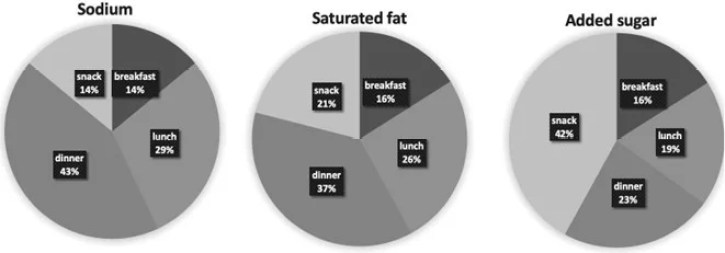
The charts below show the average percentages in typical meals of three types of nutrients, all of which may be unhealthy if eaten too much.
Summarise the information by selecting and reporting the main features, and make comparisons where relevant.
Average percentages of sodium, saturated fats and added sugars in typical meals consumed in the USA
Student answer (Band 6.5)
The provided pie charts illustrate the average proportion of three kinds of nutrients in the four basic meals of American citizens. Over consumption of these nutrients can turn out to be unhealty.
Overall, sodium is present in the largest quantity in breakfast; while, saturated fat constitutes a large portion of dinner. Snack contains a bigger chunk of added sugar.
The addition of sodium in meals is seemed to be a loop as it was started with breakfast making up 14% of the total nutrients in it and surged throughout lunch (29%) and dinner (43%); however, it came back to 14% with snack.
The percentage of saturated fat increased from breakfast to dinner but stayed at average in snack. Saturated fat was 16% in breakfast, 26% in lunch, 37% in dinner and 21% in snack. Added sugar formed most of the snack as it was in higest quantity, 42%. Other meals contained lesser amount of added sugar, with 16% in breakfast, 19% in lunch and 23% in dinner.
AI examiner evaluation
| Criterion | Band |
|---|---|
| Task Achievement / Task Response | 7.5 |
| Coherence and Cohesion | 7.0 |
| Lexical Resource | 6.0 |
| Grammatical Range and Accuracy | 6.0 |
| Overall | 6.5 |
Task Achievement / Task Response: Band 7.5
The response selects the main patterns and reports the figures accurately: sodium and saturated fat peak at dinner (43% and 37%), while added sugar is highest in snacks (42%). It also includes the relevant meal-by-meal comparisons, so the key information is clearly covered. However, the overview contains a significant reversal: it says sodium is largest at breakfast, although breakfast is tied with snacks for the lowest share at 14%. The phrase “saturated fat constitutes a large portion of dinner” is also less precise than identifying dinner as its peak. The detailed paragraphs otherwise support the overview well. Correcting that overview error and stating the contrasting peaks more directly would make the summary more consistently accurate and fully developed.
Coherence and Cohesion: Band 7.0
The response has a clear overall structure: an introduction, an overview, and separate discussion of the nutrient figures. The progression from sodium to saturated fat and then added sugar is easy to follow, and the percentages are generally placed where they support the relevant point. Some linking is less effective, however. “While;” is incorrectly punctuated, and “however” in the sodium paragraph creates a slightly awkward contrast when the figure simply returns to its starting level. The overview’s claim about sodium at breakfast also conflicts with the later, accurate account, weakening the flow between sections. Use more precise links such as “before returning to” and ensure the overview agrees with the details to make the progression smoother.
Lexical Resource: Band 6.0
There is adequate vocabulary to describe the charts, including “proportion,” “constitutes,” “increased,” and “formed most,” and the meaning is generally clear. The writer also attempts more expressive phrases such as “a bigger chunk” and “a loop,” but these are informal or imprecise for an academic report. “The addition of sodium” does not naturally describe a percentage share, while “stayed at average” is unclear. There are also spelling errors in “unhealty” and “higest.” Aim for precise chart language and consistent academic register, using terms such as “accounted for,” “share,” and “remained” rather than conversational imagery. This would improve accuracy and flexibility without requiring unnecessarily complex vocabulary.
Grammatical Range and Accuracy: Band 6.0
The response uses a mix of simple and complex forms, including a relative clause in “all of which may be unhealthy” and a contrastive clause in the sodium description. Most relationships between figures remain understandable, but some grammatical errors and awkward constructions persist. For example, “The addition of sodium in meals is seemed to be a loop” combines incompatible verb forms; “it was started with breakfast” is also an unnatural passive construction. In “Sodium is present …; while,” the punctuation before “while” is faulty, and “Saturated fat was 16% in breakfast” uses an incorrect preposition within the sentence pattern. Practise accurate clause construction and use straightforward forms such as “The sodium share starts at…” and “at breakfast.”
See this exact question answered at other band scores. The same prompt compared across bands.
Browse more IELTS Writing model answers or get your own writing scored by the same AI examiner.