Band 6.0 IELTS Writing Task 1 Model Answer
Overall Band Score: 6.0 · Cambridge IELTS 17 · 2026-11-26
IELTS Writing Task 1 question
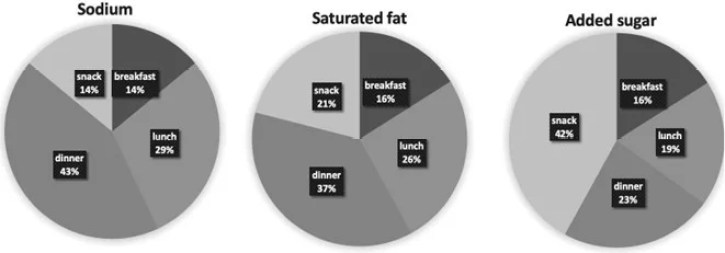
The charts below show the average percentages in typical meals of three types of nutrients, all of which may be unhealthy if eaten too much.
Summarise the information by selecting and reporting the main features, and make comparisons where relevant.
Average percentages of sodium, saturated fats and added sugars in typical meals consumed in the USA
Student answer (Band 6.0)
The pie charts illustrate the average proportions of three nutrients which can be unhealthy at higher concentration - sodium, saturated fats and added sugar - in everyday meals.
Overall, dinner meals hold the highest percentage of sodium and saturated fat while snacks have the largest portion of added sugar. Breakfast has the least proportion and lunch with moderate quantity of all three nutrients.
The level of sodium is higher in dinner with 43%, lunch with 23% being the second biggest sodium holder and snacks and breakfast each with 14%. In case of saturated fat, dinner holds 37% of its proportion, lunch at 26%, and breakfast have least fat with 16% and snacks with 21%, the second least meal with fats.
The added sugar is mostly found in snacks with 42% while dinner have 23% and lunch with 19%. The least portion of added sugar is found in breakfast with 16%.
AI examiner evaluation
| Criterion | Band |
|---|---|
| Task Achievement / Task Response | 6.0 |
| Coherence and Cohesion | 6.5 |
| Lexical Resource | 6.0 |
| Grammatical Range and Accuracy | 6.0 |
| Overall | 6.0 |
Task Achievement / Task Response: Band 6.0
You provide a clear overview of the main pattern: dinner has the highest shares of sodium and saturated fat, while snacks lead for added sugar. Most figures are reported accurately, including dinner’s 43% sodium and 37% saturated fat, and snacks’ 42% added sugar. However, lunch sodium is given as 23%, whereas the chart shows 29%, so one important comparison is inaccurate. The statement that breakfast has the least proportion is also too broad: it is tied with snacks for the lowest sodium share, but is not lowest for saturated fat. The response covers all three nutrients, though some comparisons and the overview are less precise than others. Check each figure and qualify generalisations by nutrient.
Coherence and Cohesion: Band 6.5
The response is arranged in a clear sequence, with an introduction, an overview, and separate paragraphs describing sodium and saturated fat, then added sugar. This makes the main information easy to locate, and linking phrases such as “Overall,” “In case of,” and “The least portion” help signal relationships. The organisation is coherent, but some connections are mechanical, and the saturated-fat discussion combines several comparisons in one long sentence. The overview also groups breakfast and lunch broadly without making the distinctions clear. To strengthen progression, organise the details consistently by meal or nutrient, and use concise comparison structures such as “Dinner exceeds lunch by…” while ensuring each reference clearly identifies the nutrient being discussed.
Lexical Resource: Band 6.0
You use an adequate range of task-related vocabulary, including “average proportions,” “highest percentage,” “largest portion,” and “least proportion.” These terms allow the reader to understand the comparisons, and the nutrient names are handled clearly. Some choices are imprecise or unnatural for describing chart data: “dinner meals hold” and “sodium holder” personify the meals, while “higher concentration” is less suitable than a phrase describing the share in meals. “Moderate quantity” is also vague when the chart provides percentages. Aim for precise, conventional reporting language and avoid repeating “portion” and “holds.” More accurate collocations would make the account sound more controlled without requiring unnecessarily complex vocabulary.
Grammatical Range and Accuracy: Band 6.0
You use a mix of simple statements and longer sentences, and the meaning is generally clear. The opening sentence uses dashes to add the nutrient list, while the overview and detail paragraphs attempt several comparisons. Some grammatical errors remain, particularly with subject–verb agreement and sentence construction: “breakfast have least fat” should be “breakfast has the least fat,” and “dinner have 23%” should be “dinner has 23%.” The phrase “lunch with 23% being the second biggest…” is also an awkwardly formed clause. Articles are sometimes missing, as in “has least proportion.” Review agreement, articles, and the structure of comparison clauses; these corrections would improve accuracy while preserving your range of sentence forms.
See this exact question answered at other band scores. The same prompt compared across bands.
Browse more IELTS Writing model answers or get your own writing scored by the same AI examiner.