Band 5.0 IELTS Writing Task 1 Model Answer
Overall Band Score: 5.0 · Cambridge IELTS 17 · 2026-11-28
IELTS Writing Task 1 question
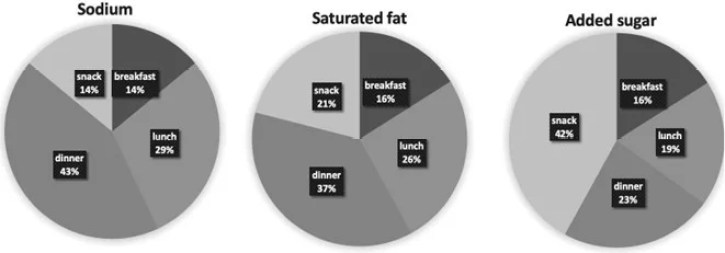
The charts below show the average percentages in typical meals of three types of nutrients, all of which may be unhealthy if eaten too much.
Summarise the information by selecting and reporting the main features, and make comparisons where relevant.
Average percentages of sodium, saturated fats and added sugars in typical meals consumed in the USA
Student answer (Band 5.0)
The pie charts illustrate the average percentages of sodium,satured fats and added sugars in typical meals ,which may be unhealthy if consumed too much in the USA.
Overall,we can clearly see that the sodium is the major nutrient which is consumed mostly on dinner and lunch. Added sugar is highly eaten on snacks and less on lunch , while satured fat is used on all the typical meals with approximate quantity.
Sodium is highly used on dinner around 43%
AI examiner evaluation
| Criterion | Band |
|---|---|
| Task Achievement / Task Response | 4.0 |
| Coherence and Cohesion | 5.0 |
| Lexical Resource | 5.5 |
| Grammatical Range and Accuracy | 5.5 |
| Overall | 5.0 |
Task Achievement / Task Response: Band 4.0
You identify the subject of the charts and give a relevant overall observation: sodium is highest at dinner, while added sugar is most prominent in snacks. The figure of 43% for dinner sodium is accurate. However, the response reports only one specific value and omits most key comparisons, including the meal breakdown for saturated fat and the other sodium and sugar figures. The statement that saturated fat is consumed in “approximate quantity” across meals is unclear and does not reflect the chart, where dinner is highest at 37% and breakfast lowest at 16%. The response is also substantially below the required 150 words, leaving the task only minimally addressed. Add a fuller overview and select several accurate comparisons across all three nutrients.
Coherence and Cohesion: Band 5.0
There is a basic structure: an introduction is followed by an overview and then a detail about sodium. The linking word “Overall” helps signal the summary, and the ideas remain related to the charts. However, the response ends after a single data point, so there is no clear progression through the three nutrients or meal categories. The overview combines several claims in one sentence, and the final sentence is isolated rather than part of a developed comparison. Organise the body into logical groups—for example, sodium and saturated fat together, then added sugar—and use clear comparisons to connect the figures. This would give the response a more complete and coherent progression.
Lexical Resource: Band 5.5
The response uses some relevant chart vocabulary, including “average percentages,” “typical meals,” “nutrient,” and “consumed,” so the topic is generally understandable. There is also an attempt to describe relative amounts with “major” and “less.” However, the range is limited and several choices are inaccurate or unnatural: “highly eaten” and “highly used” do not collocate naturally with nutrients, while “approximate quantity” is vague. “Satured” is misspelled twice, and “sodium” is better described as being present in meals rather than as a nutrient that is “used.” Use precise terms such as “accounted for,” “proportion,” and “highest share” to describe the chart data.
Grammatical Range and Accuracy: Band 5.5
You produce a few understandable sentence forms, including a relative clause in the introduction (“which may be unhealthy if consumed too much”) and a comparison in the overview. However, the range is narrow, with most information expressed through simple statements, and the final line is a sentence fragment: “Sodium is highly used on dinner around 43%” lacks a clear grammatical structure for presenting the figure. The opening also has awkward clause construction, and punctuation spacing is inconsistent, such as the spaces before commas and the missing space after “Overall,”. Practise complete sentences that compare two figures, for example, “Sodium accounted for 43% at dinner, compared with 29% at lunch.”
See this exact question answered at other band scores. The same prompt compared across bands.
Browse more IELTS Writing model answers or get your own writing scored by the same AI examiner.