Band 5.5 IELTS Writing Task 1 Model Answer
Overall Band Score: 5.5 · Cambridge IELTS 17 · 2026-11-28
IELTS Writing Task 1 question
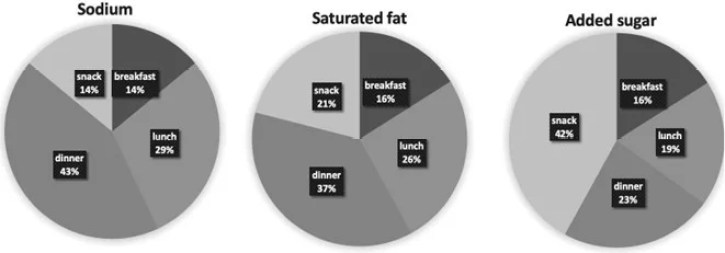
The charts below show the average percentages in typical meals of three types of nutrients, all of which may be unhealthy if eaten too much.
Summarise the information by selecting and reporting the main features, and make comparisons where relevant.
Average percentages of sodium, saturated fats and added sugars in typical meals consumed in the USA
Student answer (Band 5.5)
The three pie charts shows that the average portion of the three nutrients sodium,saturated fat and added sugar , in daily meals consuming in the USA.
Overall, Dinner were highly accounted in sodium and saturated fat while added sugar were highly accounted for snacks Hence the breakfast was leastly accounted for all three nutrients.
Dinner is the main source of sodium and saturated fat is 43% and 37% and lunch is accounted for 29% and 26%, snacks is accounted for 14% and 21% and breakfast is accounted for 14% and 16%. while, breakfast is the one which having low portion of sodium and satuared fat in first two pie charts.
In constrast, snacks were highly accounted for added sugar which was 42% and breakfast was 16% which was low in every chart, dinner was secound in added sugar which was like 23%. lunch was 19% . in The USA sodium and saturated fat were highly consumed than added sugar and sodium,saturated fat and added sugar was less added in breakfast.
AI examiner evaluation
| Criterion | Band |
|---|---|
| Task Achievement / Task Response | 6.5 |
| Coherence and Cohesion | 5.5 |
| Lexical Resource | 5.0 |
| Grammatical Range and Accuracy | 5.0 |
| Overall | 5.5 |
Task Achievement / Task Response: Band 6.5
You identify the main contrasts accurately: dinner has the largest shares of sodium and saturated fat, while snacks lead for added sugar. The figures you report for these meals and for breakfast and lunch are consistent with the chart, and your overview gives the reader a useful summary. This covers the task well, with some features more fully reported than others. However, the final claim that sodium and saturated fat were consumed more than added sugar is not supported by these percentages, which show meal shares rather than total consumption of one nutrient versus another. To strengthen the response further, keep comparisons tied closely to what the charts measure and make the overview’s comparison across all four meals more precise.
Coherence and Cohesion: Band 5.5
The response has a recognisable structure: an introduction, an overview, and separate discussion of the first two nutrients and added sugar. This helps the reader follow the broad comparison. However, progression within paragraphs is uneven, and several links are either repetitive or unclear. For example, “while” begins a new sentence after a full stop, and “In constrast” introduces a useful shift but the following details are presented in short, loosely connected statements. The final sentence also repeats earlier points rather than drawing them together clearly. Use a more consistent sequence—overview, sodium and saturated fat, then added sugar—and connect comparisons with precise references such as “by contrast” or “whereas.”
Lexical Resource: Band 5.0
You use relevant chart vocabulary, including “average portion,” “highly,” “low portion,” and “accounted for,” and the reader can generally understand the comparisons. However, the range is limited and several phrases are repeated, especially “accounted for,” which is not a natural way to describe percentages in meals. Some word choices and forms also make the meaning less precise, such as “daily meals consuming” and “leastly accounted.” Spelling errors such as “satuared,” “constrast,” and “secound” further reduce accuracy. Aim for concise, natural reporting language and vary it with terms such as “made up,” “represented,” and “the largest share.”
Grammatical Range and Accuracy: Band 5.0
You attempt both simple statements and longer comparisons, and the main message is usually understandable. However, control of sentence structure and agreement is inconsistent. The opening has a subject–verb error in “The three pie charts shows,” while “Dinner were highly accounted” also has incorrect agreement. The sentence beginning “Dinner is the main source…” joins several figures and clauses without a clear grammatical structure, making the relationships difficult to follow. Capitalisation and punctuation are also uneven, particularly around sentence openings and commas. Build comparisons in complete, controlled sentences—for example, state the dinner figures first, then contrast them with lunch, snacks, and breakfast—and check subject–verb agreement and sentence boundaries.
See this exact question answered at other band scores. The same prompt compared across bands.
Browse more IELTS Writing model answers or get your own writing scored by the same AI examiner.