Band 6.0 IELTS Writing Task 1 Model Answer
Overall Band Score: 6.0 · Cambridge IELTS 17 · 2026-11-28
IELTS Writing Task 1 question
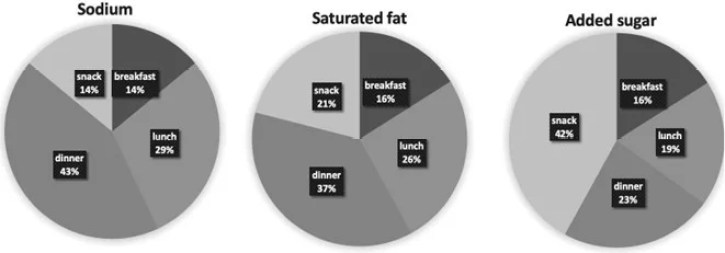
The charts below show the average percentages in typical meals of three types of nutrients, all of which may be unhealthy if eaten too much.
Summarise the information by selecting and reporting the main features, and make comparisons where relevant.
Average percentages of sodium, saturated fats and added sugars in typical meals consumed in the USA
Student answer (Band 6.0)
The charts illustrate the average percents of thee kinds of typical meals, all of them may be detrimental if taken too much.
Regarding the first nutrient, Sodium, accounts for a 14% in snacks as well as breakfast, whereas it shows a surge in dinner at a 43% and lunch, where it contributes to a 29%.
On the other hand, saturated fats contribute to a 21% in snacks, 16% in breakfast, 37% in dinner, and finally 26% in dinner. Whereas, added sugars come up with a percentage of 42% in snacks, 16% in breakfast, 19% in lunch, and a 23% in dinner.
Overall, snacks attain the highest position for contain the most contents of added sugars and breakfast as the least in this category. Whereas, dinner comprises of the most of saturated fats around 37%. In addition, dinner comes up with the meal, which contains the most of the sodium, peaking at a 43%.
AI examiner evaluation
| Criterion | Band |
|---|---|
| Task Achievement / Task Response | 6.0 |
| Coherence and Cohesion | 6.0 |
| Lexical Resource | 5.5 |
| Grammatical Range and Accuracy | 5.5 |
| Overall | 6.0 |
Task Achievement / Task Response: Band 6.0
You identify the main pattern that dinner accounts for the largest shares of sodium and saturated fat, while snacks lead for added sugar. Most figures are reported accurately, including the 14% sodium shares for breakfast and snacks and the 42% added-sugar share for snacks. However, the saturated-fat figures contain a key misreading: the final 26% is assigned to dinner, although it belongs to lunch; dinner is already correctly given as 37%. The overview also omits useful comparisons, such as breakfast being the lowest meal for sodium and saturated fat, and the contrast between dinner-led sodium and snack-led sugar. Covering these features more clearly and checking each figure against the chart would make the summary more complete and precise.
Coherence and Cohesion: Band 6.0
The response has a recognisable structure: it introduces the charts, reports figures, and ends with an overview. This gives the reader a coherent general route through the information. However, the overview comes after the detailed figures, and the body groups information in a way that makes comparisons harder to follow. The transition “On the other hand” does not clearly signal the move from sodium to saturated fat, while “Whereas” begins a fragment rather than a complete linked sentence. The repeated “Whereas” and “In addition” also make cohesion somewhat mechanical. Put the main overview immediately after the introduction, then organise the details by meal or nutrient and use clear, accurate links between complete sentences.
Lexical Resource: Band 5.5
You use some relevant chart vocabulary, including “contribute,” “percentage,” “peaking,” and “highest position,” and the reader can generally understand the comparisons. There are, however, noticeable problems with word choice and collocation. “Average percents of thee kinds of typical meals” misrepresents the chart, which shows nutrient shares across meals, and “highest position for contain the most contents” is unnatural and unclear. “Surge” suggests a change over time, whereas these charts compare proportions, and “come up with” is too informal for an academic report. Aim for precise, conventional expressions such as “accounts for,” “the largest proportion,” and “the share of added sugar.”
Grammatical Range and Accuracy: Band 5.5
You attempt both simple and more developed sentence forms, and several statements communicate the figures clearly. Some grammatical errors remain, particularly in sentence construction and clause linking. “Regarding the first nutrient, Sodium, accounts for…” lacks a clear grammatical subject; write, for example, “For sodium, dinner accounts for…”. “Whereas, added sugars come up…” is not a complete sentence in this position, and “breakfast as the least” needs a grammatical comparison such as “breakfast has the lowest share.” There are also article and preposition problems in phrases such as “a 14%” and “in dinner.” These errors rarely prevent understanding, but more consistently complete sentences and accurate comparison structures would improve control.
See this exact question answered at other band scores. The same prompt compared across bands.
Browse more IELTS Writing model answers or get your own writing scored by the same AI examiner.