Band 5.0 IELTS Writing Task 1 Model Answer
Overall Band Score: 5.0 · IELTS Academic Practice Accelerator · 2026-11-06
IELTS Writing Task 1 question
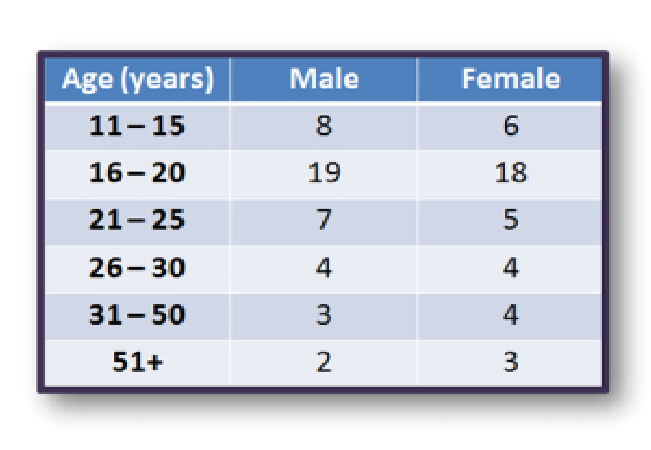
The table gives information about the average hours spent on the Internet by European people of different age groups.
Summarise the information by selecting and reporting the main features, and make comparisons where relevant.
Student answer (Band 5.0)
The table shows about the average hours spent on the internet by European people of different age groups, first in the table is the people that are 11-15 years old, male's is spending 8 hours and female's is spending 6 hours, there is a two-hour difference between them. The next on the table is people that are 16-20 years old, looking at the table we can see that male is spending much a lot of time in the internet which is shocking 19 hours, females lag behind by one hour, but overall, they also spend a lot of time on the internet. The next on the table is 21-25 years old people, the males is spending 7 hours and females is spending 5 hours, comparing with 16-20 year olds the result is much less, for males the hours decreased by 12 hours and for females is decreased by 13 hours. The next on the table is 26-30 years old people, comparing to the previous age groups their result is good, males spend 4 hour and females is spending 4 hours like the same with males. The next age category is 31-50 years old people, their female statistic is the same with earlier age group which is 4 hours. The following age group is 51+ years old people, their statistics is much less comparing to every age categories, the males spending 2 hours in the internet and females spend 3 hours. Overall, 51+ years old people is spending much less hours comparing to the others.
AI examiner evaluation
| Criterion | Band |
|---|---|
| Task Achievement / Task Response | 5.0 |
| Coherence and Cohesion | 5.0 |
| Lexical Resource | 5.0 |
| Grammatical Range and Accuracy | 5.0 |
| Overall | 5.0 |
Task Achievement / Task Response: Band 5.0
You report figures for all six age groups, and several are accurate, including the peak of 19 male hours and 18 female hours among 16–20-year-olds and the low of 2 and 3 hours among people aged 51+. However, the response mainly lists categories in sequence rather than selecting and summarising the key patterns. The final sentence identifies the lowest-use group, but there is no clear overview of the overall trend: usage peaks at 16–20 and then generally declines with age. Some comparisons are also incomplete; for example, the 31–50 group’s male figure of 3 hours is omitted. Focus on the main pattern and notable gender differences, rather than describing every row separately.
Coherence and Cohesion: Band 5.0
The response follows the table’s age-group order, so readers can generally locate the information being discussed. It also uses basic linking expressions such as “The next” and “Overall.” However, the repeated “The next on the table” structure makes the progression mechanical, and the response is presented as one long paragraph rather than being organised into an introduction, overview and detail paragraphs. Some connections are unclear, such as “comparing to the previous age groups their result is good,” which does not explain what is being compared or why it is good. Group related figures together and use comparisons to guide the reader through the main trends, rather than relying on repeated sequencing phrases.
Lexical Resource: Band 5.0
You use relevant topic vocabulary, including “age groups,” “hours,” “difference,” and “decreased,” and the reader can usually understand which figures you mean. However, the range is limited and several expressions are repetitive or imprecise. “Spend a lot of time” is repeated, while “their result is good” does not clearly describe a data pattern. Phrases such as “males is spending much a lot of time in the internet” also show weak collocation and word choice. Use precise language for reporting data, such as “recorded,” “stood at,” “was higher than,” and “declined,” and vary the terms used to describe the figures. This would make the comparisons clearer and more appropriate to an academic summary.
Grammatical Range and Accuracy: Band 5.0
You attempt to combine information using clauses and comparisons, for example, “comparing with 16–20 year olds the result is much less,” but sentence structures are often faulty, and errors occur frequently. Subject–verb agreement is inconsistent in “males is spending” and “people is spending”; verb forms are also awkward in “females is decreased.” Articles and sentence boundaries need attention, as the opening sentence runs through several ideas joined mainly by commas. The response relies heavily on simple repeated patterns, with limited accurate variety. Practise writing shorter, controlled sentences first, then combine them using accurate comparative clauses. Check agreement, tense and punctuation in each sentence before moving on.
See this exact question answered at other band scores. The same prompt compared across bands.
Browse more IELTS Writing model answers or get your own writing scored by the same AI examiner.