Band 5.5 IELTS Writing Task 1 Model Answer
Overall Band Score: 5.5 · IELTS Academic Practice Accelerator · 2026-11-08
IELTS Writing Task 1 question
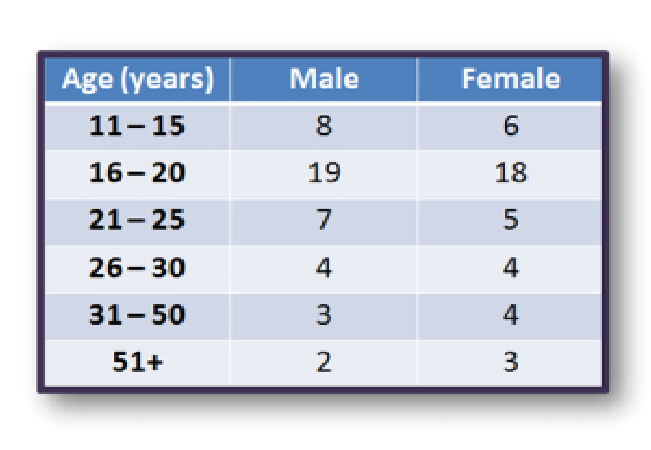
The table gives information about the average hours spent on the Internet by European people of different age groups.
Summarise the information by selecting and reporting the main features, and make comparisons where relevant.
Student answer (Band 5.5)
The table depicts the infromation about the average hours spent on the internet by europeon people of various age groups.
The most noticable feature is that people of 16-20 years of age use internet widely while, people of age 51 and above accounts for negligible proportion.
First and foremost, the 16-20 years of age people is in predominant category to spend hours on the internet accounts for both male and female, 19 and 18 hours respectively.On the other hand 11-15 years of people stand at the second dominant category fall to 8 and 6 proportion with male and female respectively while, the age group of 21-25 years trailed behind second dominant category with 7 male and 5 female.
Moreover, the people of age 26-30 years spend 4 hours each accounts for both male and female.If we talk about the 31-50 years of age they considerably spend less hours on the internet as 3 to 4 hours for both male and female.In contrast, the aged people was the least significant category.
AI examiner evaluation
| Criterion | Band |
|---|---|
| Task Achievement / Task Response | 6.0 |
| Coherence and Cohesion | 5.5 |
| Lexical Resource | 5.5 |
| Grammatical Range and Accuracy | 5.0 |
| Overall | 5.5 |
Task Achievement / Task Response: Band 6.0
You identify the main pattern accurately: the 16–20 group records the highest figures for both sexes, while the 51+ group is lowest. You also report several key comparisons correctly, including 19 versus 18 hours for ages 16–20 and equal figures of 4 for ages 26–30. This addresses the task, but some features are less fully reported or clearly expressed. In particular, the final group’s exact figures (2 hours for males and 3 for females) are omitted, and “negligible proportion” is not a precise description of hours. The overview would be stronger if it summarised the overall decline with age after the peak and noted that male figures are generally higher, with two exceptions.
Coherence and Cohesion: Band 5.5
The response has a recognisable structure: an introduction, an overview, and two paragraphs describing the age groups. This gives the reader a basic route through the information, and phrases such as “On the other hand” and “Moreover” attempt to connect comparisons. However, progression is not consistently clear because some linking expressions do not show the relationship accurately, and several sentences contain crowded or unclear information. For example, “fall to 8 and 6 proportion” makes the comparison difficult to follow, while “trailing behind second dominant category” is awkwardly connected to the preceding point. Use a clearer sequence, such as describing the peak, the middle groups, and then the lowest figures, with simpler links between them.
Lexical Resource: Band 5.5
You use some relevant vocabulary for describing data, including “predominant,” “trailing behind,” and “considerably,” and the reader can generally understand the comparisons. However, several choices are inaccurate or unnatural for this task: “use internet widely” does not clearly mean spending more hours, “negligible proportion” refers to a share rather than a number of hours, and “second dominant category” is an awkward description. There are also spelling errors in “infromation,” “europeon,” and “noticable.” Aim for precise, conventional language such as “recorded the highest average,” “the lowest figure,” and “declined to.” This would make the data description clearer and more natural.
Grammatical Range and Accuracy: Band 5.0
You attempt both simple and more complex sentences, including comparisons introduced by “while” and “whereas”-type contrasts, but control is uneven. Agreement errors appear in “the 16–20 years of age people is” and “the aged people was,” where plural subjects require plural verbs. Some sentence structures are incomplete or difficult to parse, particularly “the 16–20 years of age people … accounts for both male and female,” and punctuation is often missing after full stops or before new clauses. These errors sometimes make relationships between figures unclear. Build sentences around a clear subject and verb—for example, “Men aged 16–20 spent 19 hours online, compared with 18 hours for women”—and check agreement and sentence boundaries.
See this exact question answered at other band scores. The same prompt compared across bands.
Browse more IELTS Writing model answers or get your own writing scored by the same AI examiner.