Band 6.0 IELTS Writing Task 1 Model Answer
Overall Band Score: 6.0 · IELTS Academic Practice Accelerator · 2026-11-09
IELTS Writing Task 1 question
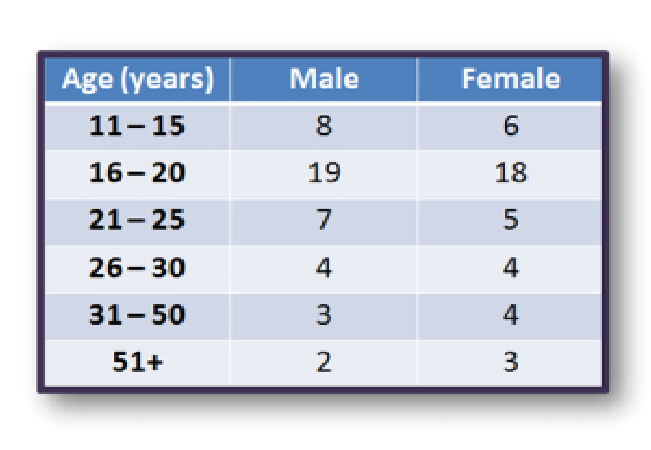
The table gives information about the average hours spent on the Internet by European people of different age groups.
Summarise the information by selecting and reporting the main features, and make comparisons where relevant.
Student answer (Band 6.0)
The given table illustrates and describes the information about the average hours spent by European people of different age groups on the Internet. There are total of 6 age groups starting from 11 and ending on 51 plus. There are two groups of people; One is male and the other one is female. It can be clearly seen that the young people and usually more kids and teenagers spent more time on the internet as compared to other age groups.
Specifically, for the age group of 11-15 years the men's spent 8 hours and the women's spent 6 hours on the internet. The people of age group 16-20 spent the highest average hours on the internet. The men's spent 19 hours on average and women's spent 18 on average. For the other four age groups from 21-51 years and beyond 51 years it is lower than the first two age groups and the lowest on the board was people of age over 51 who spent on average 2 to 3 hours on the internet.
AI examiner evaluation
| Criterion | Band |
|---|---|
| Task Achievement / Task Response | 6.5 |
| Coherence and Cohesion | 6.5 |
| Lexical Resource | 5.5 |
| Grammatical Range and Accuracy | 5.5 |
| Overall | 6.0 |
Task Achievement / Task Response: Band 6.5
You identify the main pattern accurately: the 16–20 group records the highest figures for both sexes, while the 51+ group has the lowest, and you report the values for the first two age groups correctly. This gives the response a clear, relevant overview. However, the comparison of the remaining groups is underdeveloped: the 21–25, 26–30 and 31–50 figures are not reported, and the statement that these groups are all lower than the first two misses useful distinctions, such as the equal male and female figure at 26–30 and the female figure exceeding the male figure at 31–50. To strengthen coverage, summarise these middle-age comparisons as well as the extremes.
Coherence and Cohesion: Band 6.5
The information follows a generally sensible order, moving from an introduction and broad pattern to specific age-group figures. Phrases such as “Specifically” help signal the shift to details, and the reader can follow the main comparisons. However, the response is presented as one continuous paragraph, so the overview and supporting details are not clearly separated. Some links are also imprecise: “For the other four age groups” groups several distinct results together, while “it is lower” has an unclear reference. Use a separate overview paragraph and organise the remaining figures into a clear comparison, with explicit references to the age groups and sexes.
Lexical Resource: Band 5.5
The vocabulary is sufficient to communicate the topic, with relevant terms such as “average hours,” “age group,” and “spent … on the internet.” However, the range is limited and some expressions are repetitive or unnatural, including “illustrates and describes the information” and “the lowest on the board.” The repeated use of “spent” also makes the account less precise. Choose concise, conventional language for describing tables and comparisons, and vary reporting verbs where appropriate. For example, “shows” is more direct than “illustrates and describes,” while “recorded the fewest hours” is clearer than “the lowest on the board.” These refinements would make the report more natural and precise.
Grammatical Range and Accuracy: Band 5.5
You use some longer sentence forms, including a sentence that contrasts the two sexes within an age group, and the main meaning is generally understandable. However, grammatical control is uneven, and several errors affect naturalness. Examples include “There are total of 6 age groups,” which needs an article, and “the young people and usually more kids and teenagers spent,” where the sentence structure and verb form are faulty. “The men's spent” and “the women's spent” also use an incorrect possessive construction; write “men spent” and “women spent.” There is some variety, but more accurate control of articles, agreement, and sentence construction is needed, alongside careful punctuation and capitalisation.
See this exact question answered at other band scores. The same prompt compared across bands.
Browse more IELTS Writing model answers or get your own writing scored by the same AI examiner.