Band 5.0 IELTS Writing Task 1 Model Answer
Overall Band Score: 5.0 · IELTS Academic Practice Accelerator · 2026-11-09
IELTS Writing Task 1 question
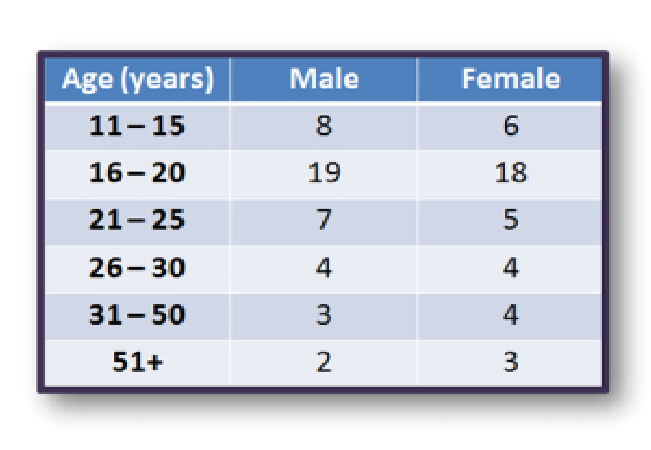
The table gives information about the average hours spent on the Internet by European people of different age groups.
Summarise the information by selecting and reporting the main features, and make comparisons where relevant.
Student answer (Band 5.0)
The table compare the average number of hours per week of euoprean people that divide into six differnet groups.
People with age from 11 to 15 spend total 14 hours on internet which include 8 hours of male and 6 hours of female. People with the age of 16 to 20 have spend most of the time on internet which is 37 hours per week and in the age of 51 plus it has the lowest time that people spend on internet which is total 5 hours.
The age from 21 to 25 years total time spend on internet is 12 hours which is 7 hours of male and 5 hours of female. Later in the age of 26 to 30 years these figure decreased into total 8 hours which is 4 hours of male and 4 hours of female and in the age of 31 to 50 total time spend on internet is 7 hours, 3 hours of male and 4 hours of female.
AI examiner evaluation
| Criterion | Band |
|---|---|
| Task Achievement / Task Response | 5.0 |
| Coherence and Cohesion | 5.5 |
| Lexical Resource | 5.0 |
| Grammatical Range and Accuracy | 5.0 |
| Overall | 5.0 |
Task Achievement / Task Response: Band 5.0
You identify several relevant features and report the figures accurately, including the peak for 16–20-year-olds (37 hours combined) and the low for people aged 51 and over (5 hours). You also give totals for the other age groups. However, the response is only partly developed: it has no clear overview of the overall pattern, such as the sharp rise to the 16–20 group followed by a general decline with age. The opening says the table divides people into six groups, but does not summarise what the data show. To strengthen the response, add a concise overview and make key comparisons between male and female usage, including that males record higher figures in the younger groups while females equal or exceed them in some older groups.
Coherence and Cohesion: Band 5.5
The information is arranged in a generally understandable order: the first paragraph introduces the table, and the following paragraphs report age groups and figures. Basic links such as “which” and “Later” help connect details. However, progression is limited because the response mainly lists groups rather than organising them around the main trends. The final paragraph moves through three age bands without explaining their relationship to the earlier figures, and “these figure” has an unclear reference. A separate overview paragraph and grouping the age bands by pattern—for example, the peak and subsequent decline—would make the organisation clearer. Use linking expressions selectively to show comparison and contrast rather than relying on a sequence of individual data points.
Lexical Resource: Band 5.0
The response uses enough basic vocabulary to communicate the topic, including “average number,” “spend,” “total,” and “lowest.” However, the range is limited and several choices or forms are inaccurate, such as “euoprean,” “differnet,” “these figure,” and “spend total 14 hours.” Repeated use of “age,” “hours,” and “spend” also makes the description sound repetitive. Aim for more precise data-reporting language, such as “recorded,” “accounted for,” “combined total,” and “declined.” Check spelling carefully and use natural collocations—for example, “people aged 11 to 15” rather than “people with age from 11 to 15.” These changes would improve clarity and make the vocabulary more appropriate to an academic summary.
Grammatical Range and Accuracy: Band 5.0
You communicate the main figures using simple sentences and some attempts at longer structures, but grammatical errors are frequent and sometimes make the relationships between ideas less clear. For example, “The table compare” has subject–verb disagreement, while “People with the age of 16 to 20 have spend” uses an incorrect verb form. Phrases such as “the age from 21 to 25 years total time spend” lack a clear grammatical structure, and articles and prepositions are often missing or misplaced. Sentence patterns are also repetitive, with many clauses joined through “which.” Practise accurate comparative sentences and vary structures, for example: “Males aged 16–20 spent 19 hours online, compared with 18 hours for females.” Check agreement, verb forms, and sentence boundaries when editing.
See this exact question answered at other band scores. The same prompt compared across bands.
Browse more IELTS Writing model answers or get your own writing scored by the same AI examiner.