Band 5.5 IELTS Writing Task 1 Model Answer
Overall Band Score: 5.5 · IELTS Academic Practice Accelerator · 2026-11-10
IELTS Writing Task 1 question
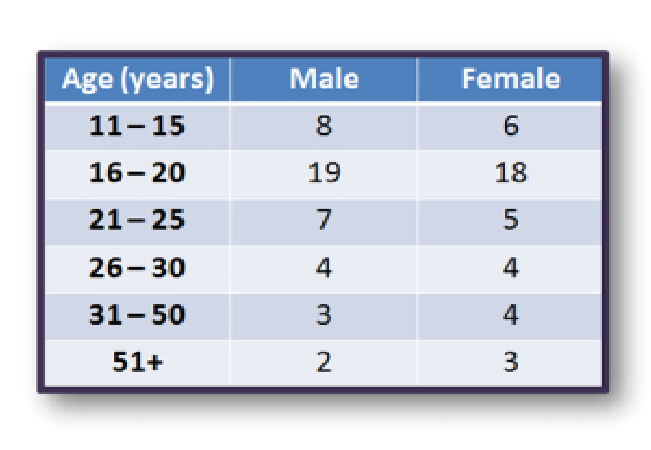
The table gives information about the average hours spent on the Internet by European people of different age groups.
Summarise the information by selecting and reporting the main features, and make comparisons where relevant.
Student answer (Band 5.5)
The table shows the average internet usage by Europen men and women of six age groups.
Overall, people aged 16 to 20 years spend the highest amount of time on internet while people over 51 years spend the least amount of time. Males use more internet than females.
People aging from 16 to 20 years spend total 37 hours on internet where males and females of this age group spend 19 hours and 18 hours respectively .People aged 11 to 15 spend the next largest amount of time (14 hours). People aged over 51 years spend only 5 hours on internet while females of this age group overtake males by 1 hour. Males of three age groups (11-15, 16-20, 21-25) spend 5 hours more on internet than females of these age groups while females of two age groups (31-50, 51+) use 2 hours more internet than males of same age groups. Both men and women aged 26 to 30 spend 4 hours on internet.
AI examiner evaluation
| Criterion | Band |
|---|---|
| Task Achievement / Task Response | 6.0 |
| Coherence and Cohesion | 5.5 |
| Lexical Resource | 5.5 |
| Grammatical Range and Accuracy | 5.5 |
| Overall | 5.5 |
Task Achievement / Task Response: Band 6.0
You identify the main pattern accurately: the 16–20 group has the highest figures, and people aged 51+ have the lowest. You also report several relevant comparisons, including the 37-hour combined total for ages 16–20 and the equal four-hour figures for ages 26–30. However, the overview says males use more internet than females, which is too broad: females record higher figures in the 31–50 and 51+ groups, and the sexes are equal at 26–30. The claim that males in three groups spend five hours more is also inaccurate; the differences are two, one and two hours. A more precise overview and checking each comparison against the table would make the key features clearer and more fully developed.
Coherence and Cohesion: Band 5.5
The response has a recognisable structure, moving from an introduction and overview to supporting details, and the information is generally grouped by age. This gives the reader a basic route through the data. However, the final paragraph becomes a long sequence of figures and comparisons, so the progression is not always easy to follow. The sentence beginning “Males of three age groups” combines several comparisons and is difficult to process, while “People aged 11 to 15 spend the next largest amount” would be clearer if linked explicitly to the combined male and female total. Use shorter sentences and organise the details into clearer groups, such as the younger age bands and the older groups. This would improve cohesion and reduce the list-like effect.
Lexical Resource: Band 5.5
You use relevant vocabulary for describing a table, including “average internet usage,” “highest amount of time,” and “overtake,” and the meaning is generally clear. However, some wording is repetitive or imprecise: “spend … on internet” and “use more internet” recur, and “people aging from” is not a natural way to describe an age group. There is also a spelling error in “Europen.” The phrase “males … spend 5 hours more” is not only inaccurate as a comparison but uses a broad expression where “higher by” would be more precise. Build a small range of accurate reporting phrases, such as “record,” “account for,” and “the figure for,” and check spelling and collocations before finishing.
Grammatical Range and Accuracy: Band 5.5
You attempt both simple and more complex sentence forms, including the contrast in “while females of this age group overtake males by 1 hour.” Most of the data remains understandable, but some grammatical errors and punctuation problems reduce accuracy. For example, “People aging from 16 to 20 years spend total 37 hours” needs a more natural structure, such as “People aged 16 to 20 spend a total of 37 hours.” In “where males and females … spend,” the clause connection is awkward, and there is a missing space after the full stop before “People aged 11 to 15.” Articles and prepositions are also inconsistent in phrases such as “on internet.” Practise accurate age-group constructions and divide long comparisons into complete, well-punctuated sentences.
See this exact question answered at other band scores. The same prompt compared across bands.
Browse more IELTS Writing model answers or get your own writing scored by the same AI examiner.