Band 6.0 IELTS Writing Task 1 Model Answer
Overall Band Score: 6.0 · IELTS Academic Practice Accelerator · 2026-11-10
IELTS Writing Task 1 question
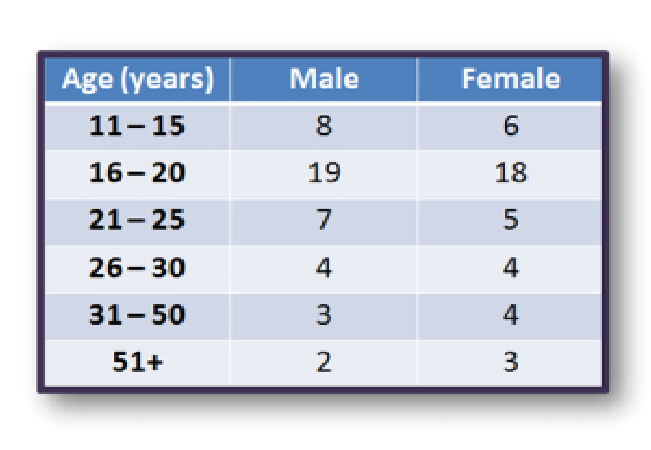
The table gives information about the average hours spent on the Internet by European people of different age groups.
Summarise the information by selecting and reporting the main features, and make comparisons where relevant.
Student answer (Band 6.0)
The chart gives us the information about the average time spent by European people of various ages on the internet on a daily basis.
Overall, the chart shows data about people from 11 years old to 51 and more years old. Moreover, the data suggests that the people from the age group of 16 to 20 are spending more time compared to the other age groups.
Regarding the data, in the age group of 11 to 15, males are spending 8 hours and females are giving 6 hours on average. Then the age group of 16 to 20 is spending more hours then other which are 19 for males and 18 for females. The numbers again drop in the age group of 21 to 25 with only 7 and 5 hours spent by males and females, respectively
People who are 26 to 30 are those in which both male and female are spending the same number of hours, which is 4. Furthermore, those from 31 to 50 are with 3 in male and 4 in female on average, and 51 plus are 2 hours in male and 3 in female
AI examiner evaluation
| Criterion | Band |
|---|---|
| Task Achievement / Task Response | 6.0 |
| Coherence and Cohesion | 6.0 |
| Lexical Resource | 5.5 |
| Grammatical Range and Accuracy | 5.5 |
| Overall | 6.0 |
Task Achievement / Task Response: Band 6.0
You identify the main pattern accurately: the 16–20 group records the highest figures, and the values generally fall among older groups. The figures you report for each age and sex match the table, including the equal value of 4 for ages 26–30 and the female advantage in the two oldest groups. This covers the key data, but the overview is somewhat limited: it does not clearly summarise the overall male–female pattern, such as males being higher in the younger groups while females are higher from 31 onwards. Some details are also presented as a list rather than compared or synthesised. A more complete overview and clearer comparisons would make the main features more fully developed.
Coherence and Cohesion: Band 6.0
The response has a recognisable structure, moving from an introduction and overview to details about the age groups. Sequencing is generally logical, and linking expressions such as “Overall,” “Regarding the data,” and “Furthermore” help guide the reader. However, the body is largely one long paragraph, so the information would be easier to follow if divided into two groups, for example younger and older ages. Some connections are mechanical or unclear: “Then the age group of 16 to 20 is spending more hours then other” does not smoothly connect the comparison to the figures, and the final sentence compresses two age groups together. Use clearer comparison links and paragraphing to strengthen progression.
Lexical Resource: Band 5.5
You use enough topic vocabulary to communicate the data, including “average time,” “age group,” “numbers drop,” and “respectively.” The meaning is generally clear, but several phrases are repetitive or imprecise, particularly repeated uses of “spending” and “hours.” Some collocations are unnatural, such as “females are giving 6 hours” and “those from 31 to 50 are with 3 in male.” “The chart gives us the information” is also less suitable for a formal report than a direct description of what the table presents. Aim for more precise reporting verbs and natural expressions for figures and comparisons; this would improve flexibility and accuracy without changing the factual content.
Grammatical Range and Accuracy: Band 5.5
You attempt a mixture of simple and more developed sentences, including the overview beginning “Moreover” and the comparison introduced by “Furthermore.” Most of the intended meaning remains understandable, but some grammatical errors recur. For example, “the age group of 16 to 20 is spending” treats a group as people, while “which are 19 for males and 18 for females” has an unclear reference. The final sentence, “those from 31 to 50 are with 3 in male,” is also structurally incomplete. There are errors in comparative construction and punctuation, including the missing full stop after “respectively.” Build clearer subject–verb patterns and check that pronouns refer unambiguously to the figures or people being described.
See this exact question answered at other band scores. The same prompt compared across bands.
Browse more IELTS Writing model answers or get your own writing scored by the same AI examiner.