Band 6.0 IELTS Writing Task 1 Model Answer
Overall Band Score: 6.0 · IELTS Academic Practice Accelerator · 2026-11-10
IELTS Writing Task 1 question
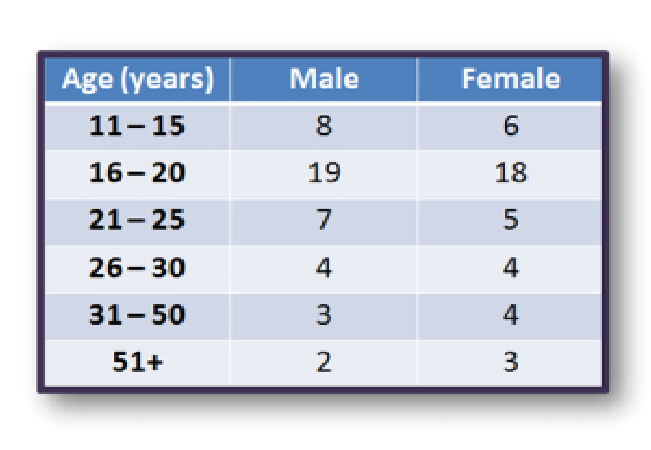
The table gives information about the average hours spent on the Internet by European people of different age groups.
Summarise the information by selecting and reporting the main features, and make comparisons where relevant.
Student answer (Band 6.0)
The table shows the data about the average hours spent on the internet by different age categories of male and female in Europe.
Overall, the age groups are divided into six categories, ranging from 11-51+ years. The most time spent on the internet is from the age 16-20 in both male and female. While the age group over 51 years has the least number of hours spent online.
The male and female of age group between 11-15 spent 8 and 6 hours on internet. The category 16-20 years of age is the most frequent internet user, on average male spends 19 hours while females spend 18 hours on internet. From age 21-25 the time spent online start decreasing and reduced to 7 hours for males and 5 hours for females.
Meanwhile, 26-30 years age group male and female spend equal time on internet thats accounted for 4 hours. From age 31-50 years the the females starts spending more time online reported for 4 hours a day while males accounted for 3 hours a day. At last, the 51+ years people spend the least time online and that is accounted for 2 hours for males and 3 hours for females.
AI examiner evaluation
| Criterion | Band |
|---|---|
| Task Achievement / Task Response | 6.5 |
| Coherence and Cohesion | 6.5 |
| Lexical Resource | 6.0 |
| Grammatical Range and Accuracy | 5.5 |
| Overall | 6.0 |
Task Achievement / Task Response: Band 6.5
The response covers the table’s main features and gives an overview: internet use peaks among 16–20-year-olds for both sexes and is lowest among people aged 51+. The reported figures are accurate, and you also identify the equal values for ages 26–30 and the female advantage in the two oldest groups. This provides a relevant account of the data. However, the overview could compare the broader pattern more clearly—for example, that use generally falls after the 16–20 peak, while the male figure is higher in the younger groups. Some details are less fully developed: the opening claim that the age groups range “from 11-51+ years” is imprecise, and “most frequent internet user” does not clearly describe average hours. A sharper summary of the main comparisons would strengthen the response.
Coherence and Cohesion: Band 6.5
The information is arranged in a coherent sequence: an introduction and overview are followed by figures for the younger groups and then the older groups. This makes the table’s progression easy to follow, and linking expressions such as “Overall,” “Meanwhile,” and “At last” help signal movement between points. The organisation is effective, though cohesion is not always smooth or precise. For instance, “From age 21-25 the time spent online start decreasing and reduced” combines two descriptions of the same change, while “At last” is an awkward transition for the final age category. Repeated sentence openings with “The age group” and “From age” also make the account somewhat mechanical. More varied comparisons and clearer links between the overview and supporting details would improve progression.
Lexical Resource: Band 6.0
You use an adequate range of vocabulary to describe the table, including “average,” “categories,” “decreasing,” and “equal time.” The meaning is generally clear, and you make some effort to describe patterns rather than simply list every figure. However, several choices are imprecise or unnatural for data reporting. “Most frequent internet user” suggests frequency of use rather than hours spent, and “accounted for 4 hours” is not a natural collocation for reporting a value. “The least number of hours spent online” is also wordy. There is repetition of “spend/spent” and “on the internet,” limiting flexibility. Aim for concise, accurate phrases such as “recorded,” “averaged,” and “declined,” while checking collocations and word forms.
Grammatical Range and Accuracy: Band 5.5
The response includes both simple sentences and attempts at more complex structures, such as the contrast beginning “While the age group over 51 years…” and the time sequence “From age 21-25…”. Most relationships between the figures remain understandable. Some grammatical errors persist, however. The overview’s “While” clause is a fragment, and “the time spent online start decreasing and reduced” has incorrect verb forms and agreement. Other examples include “male spends” where a plural subject is intended, “the females starts,” and the repeated “the the.” Articles and sentence boundaries also need attention, as in “on internet” and the comma splice in “Meanwhile, 26-30 years age group male and female spend equal time on internet thats accounted for 4 hours.” More accurate clause construction and consistent subject–verb agreement would improve control.
See this exact question answered at other band scores. The same prompt compared across bands.
Browse more IELTS Writing model answers or get your own writing scored by the same AI examiner.