Band 7.0 IELTS Writing Task 1 Model Answer
Overall Band Score: 7.0 · IELTS Academic Practice Accelerator · 2026-11-11
IELTS Writing Task 1 question
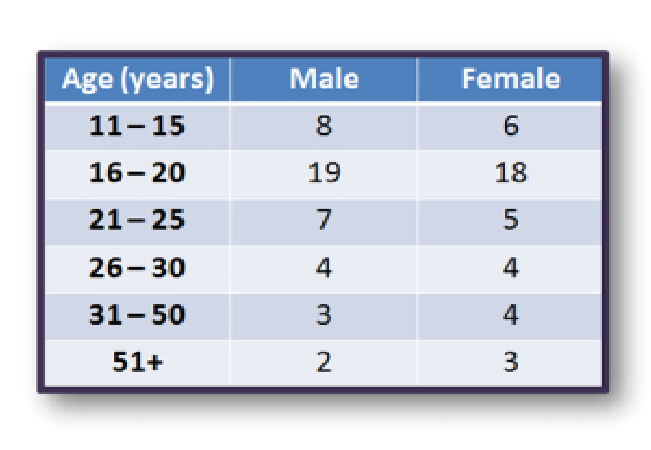
The table gives information about the average hours spent on the Internet by European people of different age groups.
Summarise the information by selecting and reporting the main features, and make comparisons where relevant.
Student answer (Band 7.0)
The given table illustrates the data on the average time spent by different age groups of netizens in Europe. Overall, people aged 16-20 spent the most, whereas people aged 51+ spent the least time using the internet.
In the young age group of 11-15 years, the average time spent by males and females is 8 and 6 hours, respectively. The hours increased significantly to 19 hours for males and 18 hours for females in the 16-20 age group.
The number of hours decreases in the older age groups; both males and females in the 26-30 age group spend an equal average time on the internet of 4 hours. By the 31 to 50 age group, males decrease to 3, by contrast the females remain constant at 4 hours. People aged 51 years tend to spend the lowest average time on the internet, 2 hours for males and 3 hours for females.
AI examiner evaluation
| Criterion | Band |
|---|---|
| Task Achievement / Task Response | 6.5 |
| Coherence and Cohesion | 7.0 |
| Lexical Resource | 6.5 |
| Grammatical Range and Accuracy | 7.0 |
| Overall | 7.0 |
Task Achievement / Task Response: Band 6.5
The response identifies the main pattern accurately: the 16–20 group records the highest figures for both sexes, while the 51+ group records the lowest. It also reports most of the key values correctly and compares males and females in several age bands. This gives the reader a clear account of the table’s central features. However, coverage is not fully balanced: the 21–25 figures (7 hours for males and 5 for females) are omitted, and the overview could better summarise the general decline after the peak and the small differences between sexes. Also, “people aged 51 years” is less precise than the table’s “51+” category. Including the omitted group and a more complete overview would strengthen the report.
Coherence and Cohesion: Band 7.0
The information is organised in a clear sequence, moving from an overview to younger groups and then to older groups. Paragraphing helps distinguish the main summary from the supporting details, and linking expressions such as “Overall,” “whereas,” and “By contrast” make relationships between figures easy to follow. The progression is generally logical, although the account jumps from the 16–20 group directly to 26–30, leaving the 21–25 category unreported and creating a small gap in the sequence. The final paragraph also combines several age groups in one block. A more systematic progression through every age band, with a concise overview of the overall pattern, would make the organisation feel more complete and cohesive.
Lexical Resource: Band 6.5
The vocabulary is adequate for describing the table, and terms such as “average time,” “age group,” “increased significantly,” and “decreases” communicate the main comparisons. There is some variation in how the data is described, rather than relying entirely on repeated basic wording. A few choices are less natural or precise: “netizens” is unnecessarily informal for this report, “the data on” is vague, and “the females remain constant” does not clearly describe the figure of four hours. “People aged 51 years” also changes the meaning of the table’s open-ended 51+ category. More precise reporting language and natural collocations would improve flexibility and accuracy while preserving the clear meaning.
Grammatical Range and Accuracy: Band 7.0
The response uses a useful mix of simple and more complex structures, including the contrast in “Overall, people aged 16–20 spent the most, whereas…” and the clause beginning “By the 31 to 50 age group.” Most sentences are easy to understand, and punctuation is generally controlled. Some grammatical choices are less accurate or consistent. For example, the report shifts from past tense (“spent”) to present tense (“is,” “spend,” and “decreases”) without a clear reason; maintaining one tense would improve control. In “males decrease to 3,” the subject is people rather than the number of hours, so the sentence structure is awkward. The final sentence also needs the category expressed as “people aged 51 and over.” These are limited issues, but refining them would make the writing more consistently accurate.
See this exact question answered at other band scores. The same prompt compared across bands.
Browse more IELTS Writing model answers or get your own writing scored by the same AI examiner.