Band 5.5 IELTS Writing Task 1 Model Answer
Overall Band Score: 5.5 · IELTS Academic Practice Accelerator · 2026-11-11
IELTS Writing Task 1 question
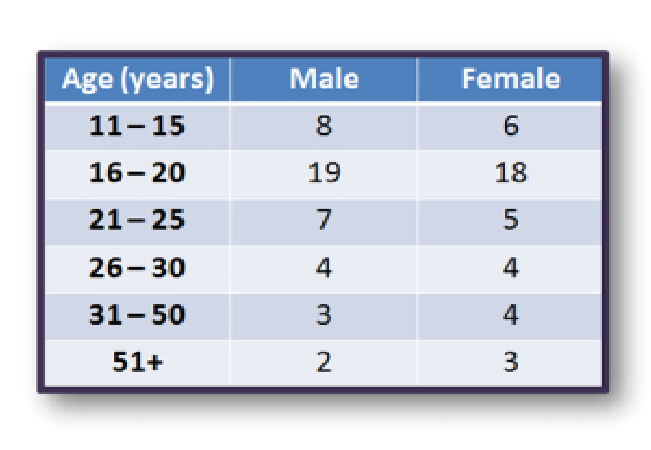
The table gives information about the average hours spent on the Internet by European people of different age groups.
Summarise the information by selecting and reporting the main features, and make comparisons where relevant.
Student answer (Band 5.5)
The table gives displays information about the average time spent on internet by people of europe of different ages.
It has been mainly been divided in between male and female and different age groups,starting from 11-15 and going all the way to 51+.
the first row gives us the average hours information of male and female aged 11-15, from the table we can see that average screentime of a male is 8 hours and the average hours spent by a female is 6 hours, 2 hours less than the males. Similarly the males of the age group of 16-20 spends around 19 hours whereas the females spends 18 hours, this age group spends the most average hours over all the other age groups.
The age group 21-25 males spends 7 hours and the females spend 5 hours. The males and Females of age group 26-30 have the same average hours spent which is quite interesting. the age group 31-50 males spends around 3 hours on the internet which is 1 hour lesser than the women of the same age group.the least average hours spent on internet is by the 51+ age group, the men spent around 2 hours whereas the women spent 3 hours.
AI examiner evaluation
| Criterion | Band |
|---|---|
| Task Achievement / Task Response | 5.0 |
| Coherence and Cohesion | 5.5 |
| Lexical Resource | 6.0 |
| Grammatical Range and Accuracy | 5.5 |
| Overall | 5.5 |
Task Achievement / Task Response: Band 5.0
You report the figures accurately, including the peak for 16–20-year-olds (19 hours for males and 18 for females), the equal values for ages 26–30, and the lowest figures for the 51+ group. You also make relevant comparisons between sexes. However, the response mainly lists age groups one by one and does not provide a clear, separate overview of the main patterns. For example, it does not summarise that internet use peaks at ages 16–20 and then generally declines with age, or that males record higher figures in most groups while females are higher in the two oldest groups. A concise overview and more emphasis on these broad features would make the summary more complete and developed.
Coherence and Cohesion: Band 5.5
The information follows a generally understandable order, moving through the age groups, and linking expressions such as “Similarly” and “whereas” help show comparisons. The response is also divided into paragraphs, although the opening paragraphs are very short and the main body reads largely as a sequence of separate data points. Some links are repetitive, particularly the repeated use of “the age group,” and the progression would be clearer if the figures were grouped by broader patterns—for example, the peak and subsequent decline, followed by comparisons between males and females. More consistent punctuation and clearer paragraphing would also help the reader follow the summary without effort.
Lexical Resource: Band 6.0
You use a suitable range of task-related vocabulary, including “average hours,” “age group,” “spent,” and “least,” and terms such as “screentime” show an attempt to vary your wording. The meaning is generally clear, but some choices are awkward or imprecise: “gives displays information” is redundant, “people of europe” is not a natural description, and “average screentime” is less appropriate than a neutral reference to hours spent online. Capitalisation is inconsistent, as in “Females,” and “internet” is not consistently presented as a proper name. Aim for accurate, natural collocations and use a small set of precise terms consistently rather than switching between “time,” “hours,” and “screentime.”
Grammatical Range and Accuracy: Band 5.5
You attempt both simple statements and longer comparative sentences, and the figures remain understandable. However, there are some recurring errors in sentence structure and agreement. For example, “It has been mainly been divided” repeats the auxiliary, while “the males … spends” and “the females spends” use a singular verb with plural subjects. The opening sentence also has an awkward construction, and several sentences run together without appropriate capitalisation or punctuation, such as the transition from “quite interesting” to “the age group 31–50.” Use a wider range of accurately controlled sentence patterns, check subject–verb agreement, and separate complete sentences with full stops.
See this exact question answered at other band scores. The same prompt compared across bands.
Browse more IELTS Writing model answers or get your own writing scored by the same AI examiner.