Band 6.0 IELTS Writing Task 1 Model Answer
Overall Band Score: 6.0 · IELTS Academic Practice Accelerator · 2026-11-12
IELTS Writing Task 1 question
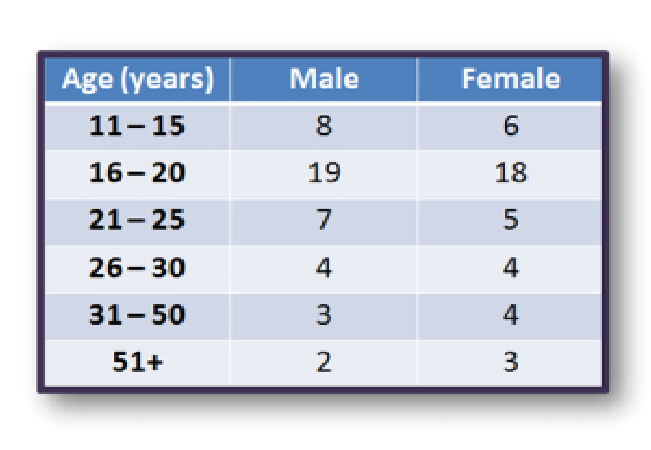
The table gives information about the average hours spent on the Internet by European people of different age groups.
Summarise the information by selecting and reporting the main features, and make comparisons where relevant.
Student answer (Band 6.0)
The table compares the data about the mean time spent on using the internet by different age group of male and females in Europe in hours unit.
Overall, while mostly young men tends to use a bit more time on internet than young women, elderly men uses slightly less time than older women. Although, at a certain age the numbers of hours spent for both the genders remain same, the hours tend to reduce with the increasing age.
Around the age of 11-15, male tends to use internet for 8 hours, the figure for females is less at 6 hours. Additionally, in case of men age ranging from 16-20 years and 21-25 years spends 19 hours and 7 hours respectively. Females tend to spend 18 hours and 5 hours for the corresponding age. On the other hand, the value tends to remain same for the age of 26-30 years at 4 hours.
For the age group of 31-50 years, while old women tends to spend slightly more time on internet which is 4 hours, men spends only 3 hours. For the elderly one's of aging 51+ years, men spends 2 hours and women spends 3 hours respectively.
AI examiner evaluation
| Criterion | Band |
|---|---|
| Task Achievement / Task Response | 6.0 |
| Coherence and Cohesion | 6.0 |
| Lexical Resource | 6.0 |
| Grammatical Range and Accuracy | 5.5 |
| Overall | 6.0 |
Task Achievement / Task Response: Band 6.0
You report the figures accurately and cover all six age groups, including the peak for 16–20-year-olds and the equal male and female figures for ages 26–30. Your overview also identifies the broad decline with age and the shift from higher male figures among younger groups to slightly higher female figures in the older groups. This gives the reader a clear summary of the main patterns. However, the overview’s phrase “at a certain age” is vague, and the claim that men use “a bit more time” is not true of every younger group: it is accurate for the first three groups, but the difference is not consistent across all ages. Make the overview more precise by naming the peak and the age groups where the gender figures are equal or reverse.
Coherence and Cohesion: Band 6.0
The response is arranged in a clear sequence: an introduction, an overview, and then details moving through the age groups. This makes the data easy to follow, and phrases such as “Additionally” and “On the other hand” help signal relationships between points. Some linking is mechanical or not quite suited to the relationship being expressed; for example, “Although” begins a sentence without a contrasting clause, while “On the other hand” introduces the equal figures for ages 26–30 rather than a clear contrast. The final two paragraphs also repeat the age-by-age pattern without grouping the main comparisons. Use transitions more selectively and organise details into meaningful groups, such as the peak and subsequent decline, then the older groups.
Lexical Resource: Band 6.0
You use an adequate range of vocabulary for describing the table, including “mean time,” “figure,” “corresponding age,” and “reduce.” These choices generally communicate the comparisons, and the reader can understand the reported data. Some word choices and collocations are inaccurate or repetitive, however. “The data about the mean time” is less natural than “average time spent,” and “use internet for 8 hours” would be clearer as “spend 8 hours on the internet.” The repeated use of “tends to” also makes the description less direct, while “elderly one's” is an unsuitable form in this context. Aim for precise, natural collocations and vary reporting verbs, for example “records,” “spends,” and “falls.”
Grammatical Range and Accuracy: Band 5.5
You attempt both simple and more complex sentence forms, including a contrast in “while old women tends to spend slightly more time…” and a comparison using “the figure for females.” The main information remains understandable, but some errors in agreement, sentence construction, and punctuation reduce accuracy. For example, “young men tends” should be “young men tend,” and “men spends” should be “men spend.” The sentence beginning “Although, at a certain age…” is not correctly formed because “although” introduces a dependent clause without a complete contrasting main clause. There are also inconsistent singular and plural forms in “different age group” and “both the genders.” Check subject–verb agreement and make sure each complex sentence has a complete, logically connected structure.
See this exact question answered at other band scores. The same prompt compared across bands.
Browse more IELTS Writing model answers or get your own writing scored by the same AI examiner.