Band 6.5 IELTS Writing Task 1 Model Answer
Overall Band Score: 6.5 · IELTS Academic Practice Accelerator · 2026-11-17
IELTS Writing Task 1 question
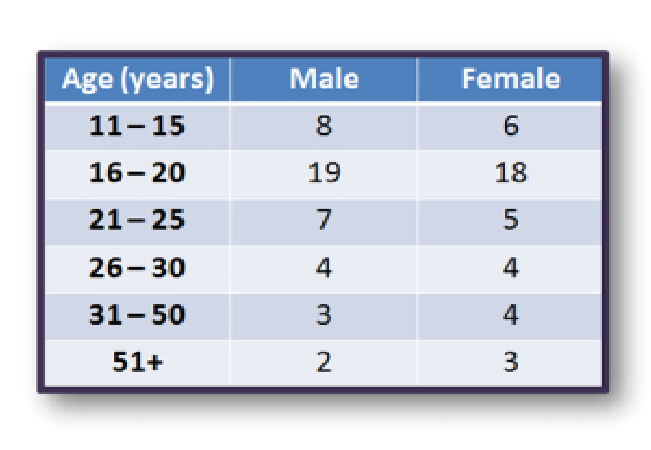
The table gives information about the average hours spent on the Internet by European people of different age groups.
Summarise the information by selecting and reporting the main features, and make comparisons where relevant.
Student answer (Band 6.5)
The table compares the number of hours Europeans of different age groups and gender spend on the internet.
Overall, age 16-20 collectively spend more hours on the internet, while age 51+ spend the least. In terms of gender age 26-30 spend a similar number of hours on the internet. Men spend more hours on the internet apart from age 31-50 and 51+.
Looking at age, the highest number of hours spent is by those aged between 16-20, 19 males and 18 females. In contrast, age 51+ are spend the least time, 2 males and 3 females.
Turning to gender, men were spending more hours than women on the internet. Those aged between 11-15 stayed for 8 hours compared to 6 hours for women. Similarly, those aged 21-25 recorded 7 hours compared to their counterparts whose was 5 hours. Conversely, females aged 31-50 stayed for longer at 4 hours compared to 3 by men. 51+ followed a the trend as women was 3, while the men was 2. Finally, age 26-30 spent an equal number of hours, 4.
AI examiner evaluation
| Criterion | Band |
|---|---|
| Task Achievement / Task Response | 7.0 |
| Coherence and Cohesion | 6.5 |
| Lexical Resource | 6.0 |
| Grammatical Range and Accuracy | 5.5 |
| Overall | 6.5 |
Task Achievement / Task Response: Band 7.0
You identify the main pattern accurately: the 16–20 group has the highest figures for both sexes, the 51+ group the lowest, and men record higher values in most age bands. You also support these points with relevant figures, including 19 and 18 hours for ages 16–20 and the equal value of 4 for ages 26–30. The overview is clear, and the response covers both age and gender comparisons. To make the summary more fully developed, state the overall downward pattern after the 16–20 peak more explicitly and avoid the broad claim that men spend more without immediately qualifying it; women are higher in both older groups. The main features are covered, though some comparisons could be synthesised more precisely.
Coherence and Cohesion: Band 6.5
The response has a clear overall arrangement: an introduction, an overview, and separate paragraphs focusing first on age and then on gender. This gives the reader a logical route through the information, and transitions such as “In contrast,” “Similarly,” and “Conversely” help signal comparisons. The organisation is coherent, but cohesion is not always smooth. The overview’s sentence beginning “In terms of gender age 26-30” is awkwardly connected, and the final paragraph lists age groups one by one rather than grouping the comparisons into a more fluent pattern. Some references, such as “their counterparts,” are also less precise than naming women directly. More natural linking and clearer grouping would strengthen progression.
Lexical Resource: Band 6.0
You use an adequate range of task-related vocabulary, including “compares,” “highest,” “in contrast,” “recorded,” and “equal number,” so the data remains understandable. There are also attempts to vary expressions for time spent, such as “spend,” “stayed,” and “recorded.” However, some choices are imprecise or unnatural for a formal data summary: “collectively spend more hours” suggests a combined total, while “stayed for” is not an appropriate collocation for internet use. “Age” is also repeatedly used where “people aged” or “the age group” would be more natural. Aim for precise, consistent terms such as “hours spent online,” “recorded,” and “the oldest age group”; this would improve accuracy and reduce repetition.
Grammatical Range and Accuracy: Band 5.5
You attempt a mix of simple and more complex sentences, including contrast clauses with “while” and “compared to,” and most meanings can be followed. However, errors in verb forms, agreement, and sentence construction remain noticeable. For example, “age 51+ are spend” combines incompatible verb forms, while “women was 3” and “the men was 2” have subject–verb agreement errors. The overview phrase “In terms of gender age 26-30 spend” also lacks clear sentence structure and punctuation. Tense shifts between “spend,” “were spending,” and “recorded” make the account less consistent. Use a consistent present tense for table data and check agreement and clause boundaries; more accurate control of these patterns would improve the response.
See this exact question answered at other band scores. The same prompt compared across bands.
Browse more IELTS Writing model answers or get your own writing scored by the same AI examiner.