Band 6.0 IELTS Writing Task 1 Model Answer
Overall Band Score: 6.0 · IELTS Academic Practice Accelerator · 2026-11-18
IELTS Writing Task 1 question
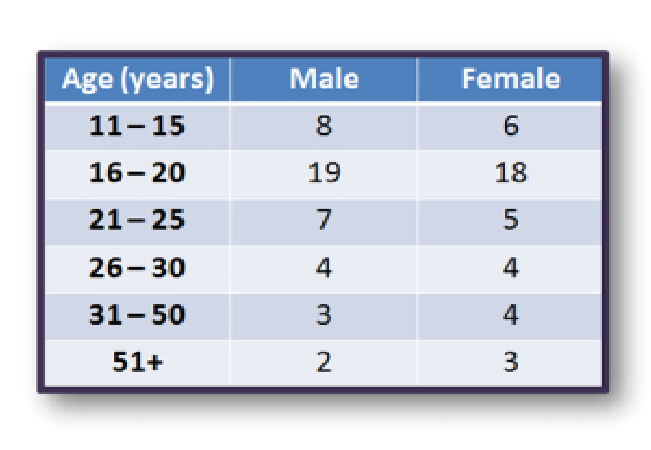
The table gives information about the average hours spent on the Internet by European people of different age groups.
Summarise the information by selecting and reporting the main features, and make comparisons where relevant.
Student answer (Band 6.0)
The information about the time spent on the internet by European people of different age groups is depicted in this table. It compares the data of both male and female in hours.
Overall, both the male and female of age group 16-20, spent the highest time on the internet, while people older than 50, spent the lowest time on the internet. It is noticeable that, people whose age ranging from 26 to 30 spent the same amount of time regardless of gender.
To begin with, boys of 11-15 age used internet for 8 hours on average and girls for 6 hours. The highest figure observed in the people of 16-20 years, where boys using internet for 19 hours and girls for 18 hours. For age group of 21-25, the number dropped to 7 hours for boys and 5 hours for girls. Both gender of age 26-30, waste only 4 hours of the day on the internet . With increase in age, the time spent on internet by boys fell to 3 hours, while in case of girls in remained the same. And for people over fifty, the time reduced by 1 hour for both genders.
AI examiner evaluation
| Criterion | Band |
|---|---|
| Task Achievement / Task Response | 6.5 |
| Coherence and Cohesion | 6.5 |
| Lexical Resource | 6.0 |
| Grammatical Range and Accuracy | 5.5 |
| Overall | 6.0 |
Task Achievement / Task Response: Band 6.5
You cover the main pattern accurately: both sexes reach their highest Internet use at ages 16–20, and the figures are lowest among people aged 51 and over. You also report the key values for each age group, including the equal four-hour figures for ages 26–30. This gives the response a clear overview and relevant comparisons. However, some details are less fully expressed: “with increase in age” does not clearly identify the 31–50 group, and “the time reduced by 1 hour for both genders” would be clearer if you stated the final figures of two hours for males and three for females. Avoid describing four hours as “only” without a clear basis for that judgement.
Coherence and Cohesion: Band 6.5
The response has a coherent overall arrangement: an introduction is followed by an overview and then a chronological account of the age groups. Phrases such as “To begin with” and “For age group of 21–25” help signal progression, and the reader can follow the comparisons. The progression is not always fully smooth, however. The final sentences move from ages 26–30 to 31–50 and then over 50 without explicitly naming the 31–50 figures, so the reference in “the time spent” is less clear than it could be. Some linking is also mechanical. Improve this by grouping the figures into a clear sequence and using precise references to each age band.
Lexical Resource: Band 6.0
You use an adequate range of task-related vocabulary, including “depicted,” “compares,” “highest figure,” “dropped,” and “reduced,” which helps describe the data without relying only on “hours.” Some choices are imprecise or unnatural for a neutral report. “Waste only 4 hours” suggests disapproval rather than describing a statistic, while “the number dropped” is less precise than referring to Internet use or average hours. There is also repetition of “spent time on the internet.” Aim for more consistent, formal collocations such as “spent an average of” and “Internet use fell.” These refinements would make the description more precise and natural.
Grammatical Range and Accuracy: Band 5.5
You attempt both simple and more complex sentence forms, including the contrast in “while in case of girls…” and the overview sentence beginning “Overall.” Meaning is generally clear, but some grammatical errors remain. For example, “both the male and female … spent” has awkward number agreement, and “people whose age ranging” is missing a verb form. In “girls in remained the same,” the pronoun is incorrect, while commas interrupt phrases in “It is noticeable that, people…” and “people older than 50, spent…”. Work on complete relative clauses (“whose ages ranged”), consistent subject–verb agreement, and punctuation that does not separate a subject from its verb. These corrections would improve control while retaining your sentence variety.
See this exact question answered at other band scores. The same prompt compared across bands.
Browse more IELTS Writing model answers or get your own writing scored by the same AI examiner.