Band 5.5 IELTS Writing Task 1 Model Answer
Overall Band Score: 5.5 · IELTS Academic Practice Accelerator · 2026-11-19
IELTS Writing Task 1 question
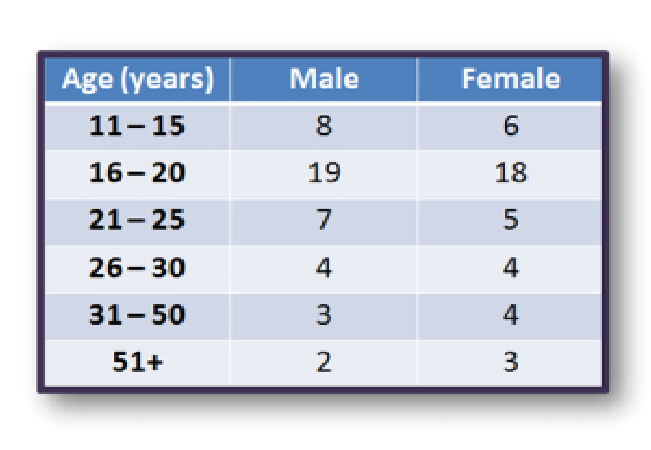
The table gives information about the average hours spent on the Internet by European people of different age groups.
Summarise the information by selecting and reporting the main features, and make comparisons where relevant.
Student answer (Band 5.5)
The Table illustrates the the average time spend on internet by the European people based on their gender and different age groups .
The Table show that between the age of 11 to 15, a average male spend around 8 hours and female spends ariund 6 hours of his or her entire day on internet.
But this numbers grows rapidly from 8 hours to 19 hours in male and from 6 hours to 18 hours in the age group between 16 years to 20 years. however everything seems to be normal from the age group of 21 onwards. The average hour keeps on declining from there on in both the male and female. The average time drops from 19 hours to just 7 hours in male and from 18 hours to only 5 hours in female between the ae group of 21 to 25.
this numbers is seen to declining gradually and reaching just 2 hours in male and 3 hours in female by the age group of 51 years and above
AI examiner evaluation
| Criterion | Band |
|---|---|
| Task Achievement / Task Response | 6.0 |
| Coherence and Cohesion | 5.5 |
| Lexical Resource | 5.5 |
| Grammatical Range and Accuracy | 5.0 |
| Overall | 5.5 |
Task Achievement / Task Response: Band 6.0
You identify the main pattern accurately: internet use peaks among 16–20-year-olds (19 hours for males and 18 for females) and then declines with age, reaching 2 and 3 hours respectively in the oldest group. You also include several relevant comparisons, such as the 11–15 figures and the sharp fall for ages 21–25. However, some features are less fully reported: the equal figures for ages 26–30 and the female increase from 3 to 4 hours between the final two age categories are omitted. The overview is also implied rather than clearly stated as a concise summary of the overall pattern. A more complete overview and coverage of these smaller contrasts would make the response more fully developed.
Coherence and Cohesion: Band 5.5
The response follows a broadly understandable sequence, moving from the youngest group to the peak and then describing the decline among older people. Linking expressions such as “But,” “however,” and “from there on” help show the intended progression. However, the information is presented in one continuous block rather than clearly organised into an introduction, overview, and detail paragraphs. Some links are awkward or unclear, particularly “however everything seems to be normal,” which does not specify the comparison being made. Repetition of “average” and “age group” also makes the progression feel less controlled. Separate paragraphs and more precise transitions between the peak, subsequent decline, and gender comparisons would improve cohesion.
Lexical Resource: Band 5.5
You use relevant vocabulary for describing the table, including “declining,” “rapidly,” “drops,” and “reaching,” and the reader can generally understand the comparisons. However, the range is somewhat repetitive, especially in repeated references to “average,” “hours,” and “age group.” Several word choices or collocations are inaccurate or informal for an academic report: “time spend on internet,” “his or her entire day,” and “everything seems to be normal” do not express the data precisely. Spelling slips such as “ariund” and “ae” also reduce accuracy. Aim for concise, conventional reporting language, for example “hours spent online” and “the figure then declined,” and check spelling carefully.
Grammatical Range and Accuracy: Band 5.0
You attempt both simple and more complex sentence forms, including a sentence describing the rise from the youngest to the next age group and another tracing the decline. However, grammatical control is inconsistent. Examples include “The Table show,” where the subject and verb do not agree, and “a average male spend,” which has article and verb-form errors. “This numbers grows” and “this numbers is seen to declining” also show problems with agreement and verb construction. Articles, plurals, and sentence punctuation are not consistently controlled, and the opening contains duplicated words and spacing. These errors sometimes make the reader pause, although the main comparisons remain understandable. Practise accurate sentence patterns for describing figures, especially past-tense or present-tense consistency and subject–verb agreement.
See this exact question answered at other band scores. The same prompt compared across bands.
Browse more IELTS Writing model answers or get your own writing scored by the same AI examiner.