Band 6.0 IELTS Writing Task 1 Model Answer
Overall Band Score: 6.0 · IELTS Academic Practice Accelerator · 2026-11-20
IELTS Writing Task 1 question
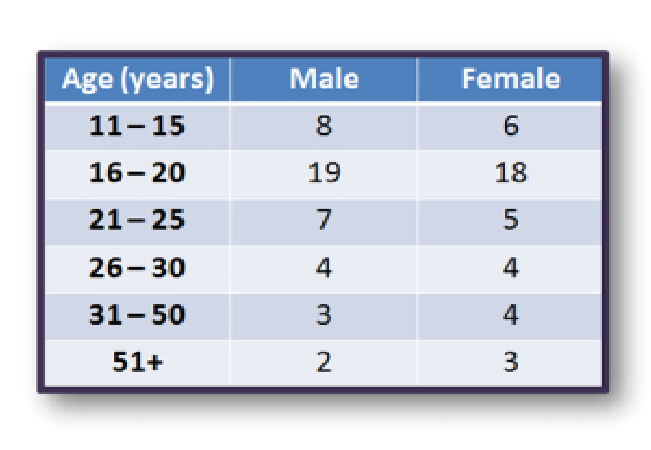
The table gives information about the average hours spent on the Internet by European people of different age groups.
Summarise the information by selecting and reporting the main features, and make comparisons where relevant.
Student answer (Band 6.0)
The table presents data about the average hours spent on the internet by European people of different age groups.
Overall, the males and females of the age group 16-20 spent most hours on the internet. In contrast, population who is 51+ years uses the least. The number of male users in almost all age groups are comparatively more than female users.
It can be seen that, teenagers and early 20's kids uses maximum time on internet which results in 19 hours in Male and 18 hours in female compared to rest. It is followed by the kids of age group 11-15 which is almost half in comparison to previous one that is 8 hours in Male and 6 hours in Female. Additionally, the age group 21-25 represents a slight drop in the internet users which 7 hours in Male and 5 hours in female. Mostly, in all the above cases male uses more time on internet as compared to female.
The data shows that, both male and females of age group 25-30 and 31-50 uses almost same time on internet which is 3-4 hours everyday. The lowest amount of time spent by males and females is from the age group 51+ , they spent 2 hours and 3 hours respectively. Females of age group 31 to 51+ uses relatively more time on internet than males.
AI examiner evaluation
| Criterion | Band |
|---|---|
| Task Achievement / Task Response | 6.0 |
| Coherence and Cohesion | 6.0 |
| Lexical Resource | 5.5 |
| Grammatical Range and Accuracy | 5.5 |
| Overall | 6.0 |
Task Achievement / Task Response: Band 6.0
You identify the main pattern accurately: the 16–20 group records the highest figures for both sexes, while people aged 51+ record the lowest. You also report several relevant values and compare male and female use across age groups. However, the overview claim that males spend more time in “almost all” groups is not quite accurate: females are higher in both 31–50 and 51+, and the sexes are equal at 26–30. The description of the older groups is also less precise, since 26–30 is reported as 4 hours for both sexes, whereas 31–50 is 3 for males and 4 for females. A clearer overview and more exact comparisons would make the key features more fully developed.
Coherence and Cohesion: Band 6.0
The response has a clear overall structure, with an introduction, an overview, and two paragraphs describing the figures. The progression from the highest-use groups to the older groups is generally easy to follow, and phrases such as “In contrast” and “Additionally” help signal relationships. Some linking is mechanical or repetitive, however: “It can be seen,” “The data shows,” and repeated references to “the age group” do not always create smooth connections. The final comparison about females aged 31 to 51+ is useful, but it would be clearer if the two age bands were distinguished explicitly. More precise referencing and less formulaic transitions would strengthen the flow.
Lexical Resource: Band 5.5
You use enough topic vocabulary to communicate the main comparisons, including “average hours,” “slight drop,” and “lowest amount of time.” However, several choices are imprecise or unnatural for an academic data report. “Teenagers and early 20’s kids” is informal and does not accurately describe all the age bands, while “internet users” suggests numbers of people rather than hours spent online. Phrases such as “uses maximum time” and “spent most hours” also sound awkward. There is some repetition of “age group,” “hours,” and “internet.” Aim for concise, formal expressions that describe the measured quantity directly, such as “recorded the highest average usage” or “time spent online.”
Grammatical Range and Accuracy: Band 5.5
You attempt a mix of simple and more complex sentences, and the overall meaning remains clear. Some grammatical errors recur, particularly with subject–verb agreement and sentence construction. For example, “The number of male users … are” should use a singular verb, and “both male and females … uses” has agreement and number problems. In “which 7 hours in Male and 5 hours in female,” the clause is incomplete; a verb such as “was” is needed. There are also inconsistent articles and plural forms, as in “population who is 51+ years uses.” These errors do not generally prevent understanding, but checking agreement and ensuring each comparison has a complete clause would improve accuracy.
See this exact question answered at other band scores. The same prompt compared across bands.
Browse more IELTS Writing model answers or get your own writing scored by the same AI examiner.