Band 6.5 IELTS Writing Task 1 Model Answer
Overall Band Score: 6.5 · IELTS Academic Practice Accelerator · 2026-11-20
IELTS Writing Task 1 question
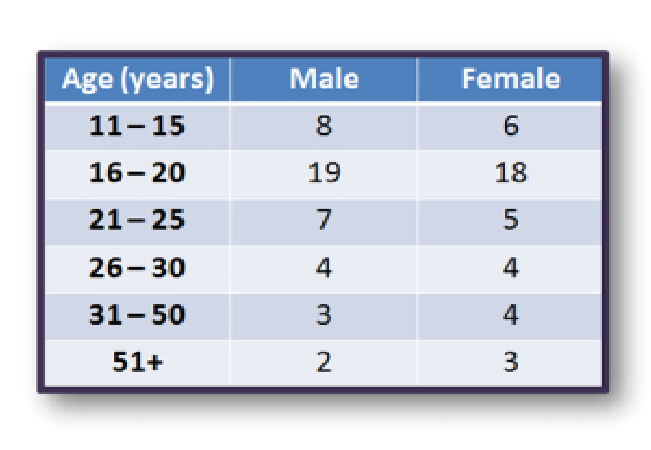
The table gives information about the average hours spent on the Internet by European people of different age groups.
Summarise the information by selecting and reporting the main features, and make comparisons where relevant.
Student answer (Band 6.5)
The table demonstrates the average time in hours spent by the European people belonging to different age groups on the internet.
Overall, most of the time is spent by the people from age group 16-20 years which clearly dominates other categories. Similarly, the least time is spent by the people that are above 50 years of age. Equal time on internet is spent by males and females in the age category 26-30 years.
Males from age group 11-15 years spend about 8 hours on average and females from the same category spend 6 hours. Similarly, in the age group 16-20 years, 19 hours and 18 hours are spent on the internet by males and females respectively. In category 21-25 years, the average internet consumption drops to 7 hours for males ans 5 hours for females.
In section 26-30 years both genders spend 4 hours on internet which further reduces to 3 hours in males in age category 31-50 years, however in females it remain the same in this category. After reaching the age of 51+ years internet consumption is reduced to 2 hours in males and 3 hours in females.
AI examiner evaluation
| Criterion | Band |
|---|---|
| Task Achievement / Task Response | 7.0 |
| Coherence and Cohesion | 7.0 |
| Lexical Resource | 6.0 |
| Grammatical Range and Accuracy | 6.5 |
| Overall | 6.5 |
Task Achievement / Task Response: Band 7.0
The response selects the main features and reports the figures accurately: the 16–20 group has the highest usage for both sexes, the 51+ group the lowest, and the 26–30 figures are equal. It also covers all six age bands and makes relevant male–female comparisons. The overview is clear, although it could be more informative by noting the broad pattern of a peak at 16–20 followed by a decline across the older groups, while acknowledging the small exception in the female figures at 31–50. The statement that usage “further reduces” after 26–30 is slightly over-generalised because female usage rises from 3 to 4 hours at 31–50. More synthesis of the overall pattern, rather than mainly listing values, would strengthen the report.
Coherence and Cohesion: Band 7.0
The information is organised in a clear sequence: an introduction and overview are followed by two paragraphs detailing the age groups. This makes the comparisons easy to follow, and linking expressions such as “Similarly,” “In category,” and “After reaching” help signal progression. The age-band grouping is sensible, and the response maintains a consistent focus on the table. Some transitions are a little mechanical, however, and the final paragraph combines several changes in one long sentence. More varied, precise links between the age groups and clearer separation of the male and female trends would make the progression smoother. Overall, the organisation is logical and the reader can readily locate the relevant comparisons.
Lexical Resource: Band 6.0
The vocabulary is adequate for describing the table, with useful terms such as “average,” “category,” “dominates,” and “consumption.” The writer also varies some phrasing rather than repeating “hours” in every sentence. However, several expressions are awkward or imprecise: “time on internet,” “internet consumption is reduced,” and “people belonging to different age groups” are less natural in this context. “Dominates” is also somewhat overstated for a numerical comparison. There is a spelling error in “ans,” and repeated use of “spend” and “category” limits flexibility. More accurate collocations for reporting usage and describing changes would improve precision and naturalness.
Grammatical Range and Accuracy: Band 6.5
The response uses a mix of simple and more complex structures, including relative clauses and contrast: “which clearly dominates other categories” and “..., however in females...”. Most sentences communicate the data clearly, and the paragraphing supports readability. Some grammatical errors remain, including the agreement error “it remain the same,” where the singular subject requires “remains,” and the punctuation around “..., however...” needs correction or a conjunction. The opening phrase “the European people belonging to different age groups” is also an awkwardly constructed noun phrase. To move beyond this level, aim for more consistently accurate complex sentences and check subject–verb agreement and punctuation when joining contrasting clauses.
See this exact question answered at other band scores. The same prompt compared across bands.
Browse more IELTS Writing model answers or get your own writing scored by the same AI examiner.