Band 5.5 IELTS Writing Task 1 Model Answer
Overall Band Score: 5.5 · IELTS Academic Practice Accelerator · 2026-11-23
IELTS Writing Task 1 question
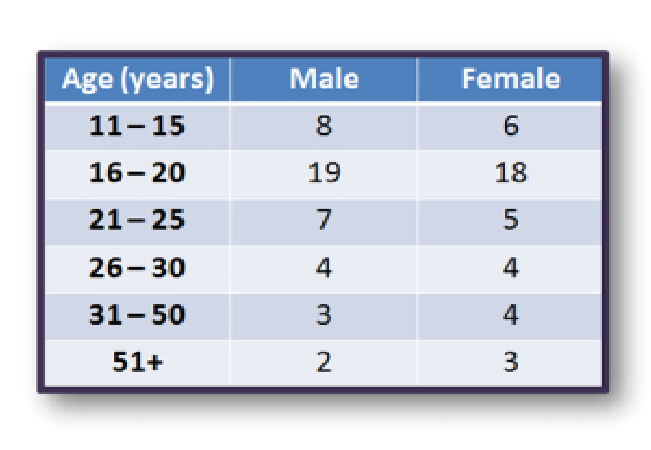
The table gives information about the average hours spent on the Internet by European people of different age groups.
Summarise the information by selecting and reporting the main features, and make comparisons where relevant.
Student answer (Band 5.5)
The table illustrates the age of males and females with average hours spent on the internet by European People of different age groups.
Overall, age group 16-20 which includes male and female spent most of the time on internet while age 51+ spent least time on internet and the remaining age groups are in between these age groups. Male, from every age group spent most of the time on internet rather than the females.
By considering 16-20 age group male spent most of their time on internet which is around 19 hours and females spent 18 hours. The age group from (26-30) there is a constant number of hours in males and females which is approximately 4 hours.
It could be seen that increasing age of european peoples results in decrease of usage hours on the internet and therefore at age 51+ male spent approximately around 2 hours while females around 3 hours. The moderate number of males and females spent most of the time in a age group (11-15).
In conlusion, table is showing that increasing age of european peoples results in decrease of number of average hours in male and females.
AI examiner evaluation
| Criterion | Band |
|---|---|
| Task Achievement / Task Response | 5.5 |
| Coherence and Cohesion | 5.5 |
| Lexical Resource | 5.5 |
| Grammatical Range and Accuracy | 5.5 |
| Overall | 5.5 |
Task Achievement / Task Response: Band 5.5
You identify the main peak and low point accurately: the 16–20 group records the highest figures (19 hours for males and 18 for females), while the 51+ group has the lowest (2 and 3). You also include the equal four-hour figures for ages 26–30. However, the overview is not fully accurate: males do not spend more time in every age group, since females are higher in the 31–50 and 51+ groups, and the figures are equal at 26–30. The claim that usage decreases as age increases is also too broad because hours rise sharply from ages 11–15 to 16–20. Covering these contrasts more precisely and reporting the 21–25 figures would make the summary more complete.
Coherence and Cohesion: Band 5.5
The response has a recognisable structure, with an overview followed by paragraphs describing selected age groups and a concluding statement. This gives the reader some organisation, and phrases such as “Overall” and “It could be seen” signal transitions. However, progression is limited because the conclusion repeats the overview rather than adding a useful comparison, and the data are presented selectively without a clear sequence across all age groups. Some linking is awkward or repetitive, particularly the repeated claim that increasing age reduces internet use. Organise the details in a consistent order, such as moving from the youngest to oldest groups, and use comparisons to connect the figures rather than relying on repeated summary statements.
Lexical Resource: Band 5.5
You use relevant vocabulary for describing the table, including “average hours,” “age group,” “spent,” and “decrease,” so the topic remains understandable. However, the range is limited and several phrases are repeated, especially “spent most of the time on internet” and “age group.” Some word choices and collocations are unnatural, such as “constant number of hours” for equal figures and “moderate number” for an intermediate value. There are also spelling and form errors, including “conlusion” and inconsistent capitalisation in “European People.” Aim for more precise reporting language and vary expressions for comparisons, while checking spelling and natural combinations of words.
Grammatical Range and Accuracy: Band 5.5
The response attempts both simple and more extended sentences, and the main figures can generally be understood. However, sentence structures are often awkward or incomplete, and errors recur in agreement, articles, and sentence construction. For example, “age group 16-20 which includes male and female spent” does not form a clear grammatical clause, while “Male, from every age group spent” has an unnecessary comma and an unclear subject. Articles are also missing in phrases such as “on internet” and “in a age group.” Work on forming complete clauses, matching subjects and verbs, and using articles consistently. More accurate control of these basic patterns would make the comparisons easier to follow.
See this exact question answered at other band scores. The same prompt compared across bands.
Browse more IELTS Writing model answers or get your own writing scored by the same AI examiner.