Band 6.0 IELTS Writing Task 1 Model Answer
Overall Band Score: 6.0 · IELTS Academic Practice Accelerator · 2026-11-24
IELTS Writing Task 1 question
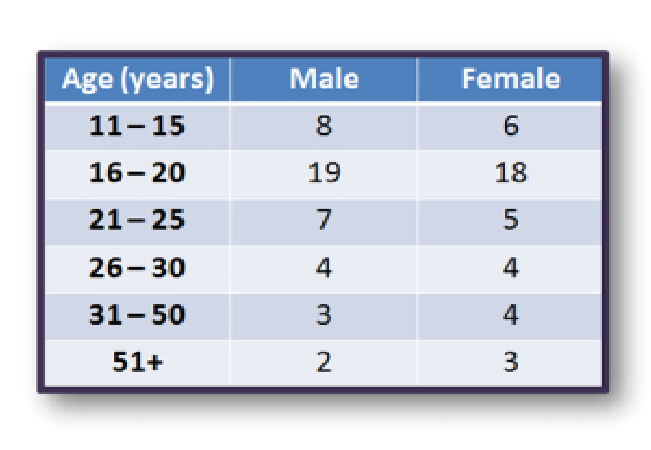
The table gives information about the average hours spent on the Internet by European people of different age groups.
Summarise the information by selecting and reporting the main features, and make comparisons where relevant.
Student answer (Band 6.0)
The table tabulates information about the average hours spent on the Internet by European people of different age groups.
Overall, the age group of 16-20 years old were the population who spent the longest on the Internet for both genders, while male and female aged 51 and beyond spent the shortest.
For male, the age group who spent most on the internet were people ages 16 to 20 with 19 hours, meanwhile 51 years old and above only spent 2 hours. The age bracket of 11 to 15 spent half compared to the highest number, with 8 hours, followed by young adults ages 21 to 25 accounted for 7 hours. The age with the least hours od spending were people aged 26-30 and 31-50 with 4 hours and 4 hours, respectively.
However for female, people ages 16 to 20 were also the highest population who spents their time most on the internet with 18 hours, followed by people ages 11 to 15 with 6. People ages 21 and above spent the lowest hours with 5 hours and less. This table states that age difference is paramount in terms of generation in this modernized world, particularly on theusag internet.
AI examiner evaluation
| Criterion | Band |
|---|---|
| Task Achievement / Task Response | 6.0 |
| Coherence and Cohesion | 6.0 |
| Lexical Resource | 5.5 |
| Grammatical Range and Accuracy | 5.5 |
| Overall | 6.0 |
Task Achievement / Task Response: Band 6.0
You identify the main pattern accurately: the 16–20 group records the highest figures for both sexes, while the 51+ group has the lowest male figure. Most reported values are correct, including 19 and 18 hours for 16–20-year-old males and females. However, the overview says both genders aged 51+ spent the least, although females aged 51+ recorded 3 hours and females aged 26–30 recorded 4; this is still the female minimum, but the comparison could be stated more precisely. The claim that females aged 21 and above spent “the lowest hours” is unclear and overlooks the separate figures for ages 26–30, 31–50 and 51+. The final comment about age and the modern world is not supported by the table. A more complete overview and clearer reporting of the female figures would strengthen the response.
Coherence and Cohesion: Band 6.0
The response has a clear overall structure: an introduction, an overview, and separate paragraphs for male and female data. This makes the main comparisons easy to locate, and transitions such as “Overall” and “However” help signal the organisation. Some links are mechanical or do not express the relationship accurately; for example, “meanwhile” joins the male peak and minimum, while “followed by” is used for figures that are not consistently ranked. The female paragraph also groups all ages from 21 onward together, making the information less precise and harder to follow. The final sentence shifts from describing the table to a broad comment, weakening the progression. Grouping the age bands consistently and using clearer comparison links would improve cohesion.
Lexical Resource: Band 5.5
You use a reasonable range of task-related vocabulary, including “tabulates,” “age group,” “age bracket,” and “spent.” These choices generally make the subject clear, and the response varies its wording rather than repeating one expression throughout. However, several collocations and word forms are unnatural or inaccurate, such as “highest population” for the group with the greatest number of hours and “the least hours od spending.” “Spents” is also an incorrect form, and “on theusag internet” contains a spelling or typing problem that makes the ending difficult to understand. The phrase “modernized world” is vague and not useful for describing the data. More precise terms such as “recorded,” “figure,” and “hours of Internet use” would make the report more natural and exact.
Grammatical Range and Accuracy: Band 5.5
You attempt a mix of simple and more complex sentences, including clauses introduced by “while” and “with,” and the main meaning is usually understandable. Some grammatical errors remain. In the overview, “the age group … were the population” has a subject–verb agreement problem and an awkward noun structure; “the age group … was” would be more accurate. “For male” and “for female” need plural or article forms, while “people ages 16 to 20” uses an incorrect grammatical pattern. The sentence beginning “The age with the least hours…” is also structurally awkward, and the final sentence has a malformed phrase after “particularly.” These errors do not generally prevent understanding, but more consistent agreement, articles, and sentence construction would improve accuracy.
See this exact question answered at other band scores. The same prompt compared across bands.
Browse more IELTS Writing model answers or get your own writing scored by the same AI examiner.