Band 5.5 IELTS Writing Task 1 Model Answer
Overall Band Score: 5.5 · IELTS Academic Practice Accelerator · 2026-11-05
IELTS Writing Task 1 question
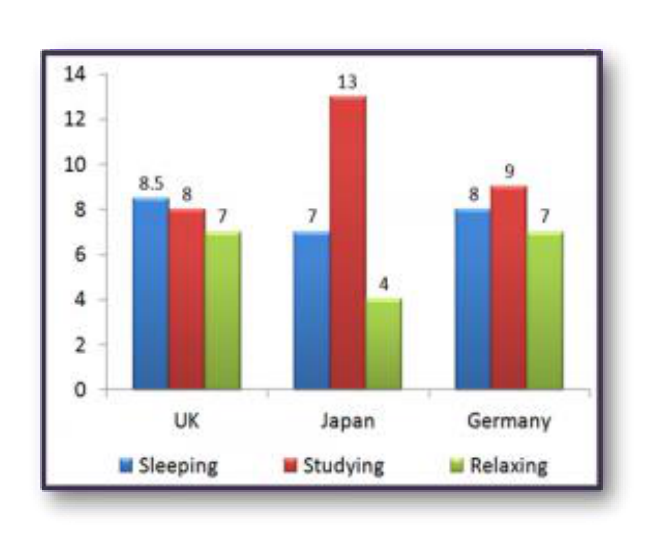
The bar chart shows the typical weekday for students in three different countries.
Summarise the information by selecting and reporting the main features, and make comparisons where relevant.
Student answer (Band 5.5)
The bar chart illustrates different activites of pupils during the weekend in different countries.
Overall,Japan has the highest studying hours around among all.Whereas, germany is at the second place and uk stands at last.However,Uk
is at top in sleeping hours and Japan is third in ranking.Relaxing hours remain eqviulent in both the uk and germany while japan has the least number of hours to relax.
The most busy weekday for learners of japan with maximum number of thirteen hours of concentrating on studies puts germany and uk far behind with a total spending of just nine and eight hours.Moreover,students of both the countries spend ample amount of time in their sleep having eight to nine hours of sleep.Whereas,Japan lacks this aspect along with the relaxing time a graduate have during his off-days.Time spent in relaxing remains constant among both the Germany and UK maintaining to get average of seven hours to relax which is not the case in japan due to only four hours left for relaxing after a tight schedule.
AI examiner evaluation
| Criterion | Band |
|---|---|
| Task Achievement / Task Response | 6.0 |
| Coherence and Cohesion | 5.0 |
| Lexical Resource | 5.5 |
| Grammatical Range and Accuracy | 5.0 |
| Overall | 5.5 |
Task Achievement / Task Response: Band 6.0
You identify the main comparisons: Japan records the most study time (13 hours) and the least relaxing time (4), while the UK and Germany both spend 7 hours relaxing. You also give an overview of the relative study levels, which helps address the task. However, the opening calls these weekend activities, although the chart is about a typical weekday, and the claim that the UK is at the top for sleeping is inaccurate: its 8.5 hours is only slightly above Germany’s 8 and Japan’s 7. Some comparisons are also unclear or imprecise, such as “Japan is third in ranking.” To strengthen the response, report the figures consistently and describe the key contrasts without adding unsupported interpretations about busy schedules or off-days.
Coherence and Cohesion: Band 5.0
The response has an identifiable overview followed by a paragraph with supporting comparisons, so the reader can recognise a basic structure. However, progression within the paragraphs is uneven: the overview moves quickly between studying, sleeping and relaxing, and the second paragraph shifts from study hours to sleep and then to relaxation without a clear organising pattern. Linking words such as “Whereas,” “However,” and “Moreover” are sometimes used awkwardly or repeatedly, and “Whereas” begins a fragment rather than a complete contrast. Improve cohesion by grouping the three activities systematically—for example, compare study hours first, then sleep and relaxation—and use clear sentence links rather than relying on repeated contrast markers.
Lexical Resource: Band 5.5
You attempt a range of vocabulary, including “illustrates,” “maximum,” “ample,” and “maintaining,” and the main topic remains understandable. However, several choices are inaccurate or unnatural for describing chart data: “activites” is misspelled, “eqviulent” is not the intended word, and “concentrating on studies” and “ample amount of time in their sleep” are awkward collocations. Expressions such as “Japan lacks this aspect” and “a tight schedule” add interpretation rather than neutrally reporting the figures. Aim for precise, conventional language such as “spend,” “record,” “hours,” and “the highest/lowest figure.” This would make the comparisons clearer and reduce the effect of spelling and word-choice errors.
Grammatical Range and Accuracy: Band 5.0
You attempt both simple and more complex sentences, including contrasts introduced by “while” and “whereas,” but control is inconsistent. Some sentence boundaries and punctuation are faulty: “Overall,Japan…” lacks a space, and “Whereas, germany is at the second place…” is not a complete sentence. There are also errors in agreement and sentence construction, as in “the relaxing time a graduate have,” while “Japan has the highest studying hours around among all” is difficult to parse. Capitalisation of country names is inconsistent. Practise writing complete sentences with a clear subject and verb, and check agreement, articles and punctuation. More accurate control of these patterns would make your comparisons easier to follow.
See this exact question answered at other band scores. The same prompt compared across bands.
Browse more IELTS Writing model answers or get your own writing scored by the same AI examiner.