Band 5.0 IELTS Writing Task 1 Model Answer
Overall Band Score: 5.0 · IELTS Academic Practice Accelerator · 2026-11-06
IELTS Writing Task 1 question
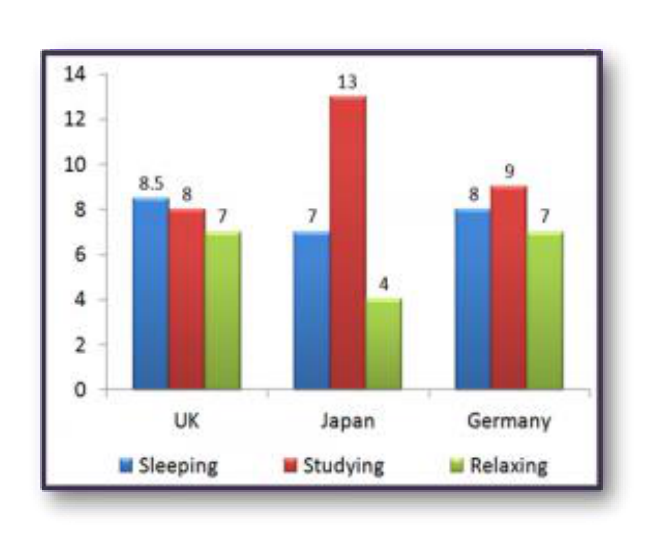
The bar chart shows the typical weekday for students in three different countries.
Summarise the information by selecting and reporting the main features, and make comparisons where relevant.
Student answer (Band 5.0)
The given bar chart depicts how many hours were spent by students for sleeping, studying and relaxing in UK, Japan and Germany.
overall, it can be clearly seen that students spent maximum hours for studying, whereas the opposite was true for relaxation.
Looking at the charts in the more detail, 8.5 hours were spent in UK for sleeping, whereas, 7 hours were spent in Japan for sleeping. The students spent 8 and 9 hours for sleeping in UK and Germany respectively. In UK 7 hours for relaxing Even through it declined to 4 hours were spent for relaxing. other side, the Japan spent 13 hours in studying and the UK spent 8 hours in studying. whereas, the students spent 7 hours in relaxing and the opposite side the students spent 4 hours in relaxing.
Quite the opposite the students spent similar in Japan and Germany for studying and relaxing which was recorded for 7 and 7 hours.
AI examiner evaluation
| Criterion | Band |
|---|---|
| Task Achievement / Task Response | 5.0 |
| Coherence and Cohesion | 4.5 |
| Lexical Resource | 5.5 |
| Grammatical Range and Accuracy | 5.0 |
| Overall | 5.0 |
Task Achievement / Task Response: Band 5.0
You identify the chart’s three activities and countries, and your overview correctly notes that studying takes the most time overall. However, the report only partially selects and compares the main features, and several figures are inaccurate or assigned to the wrong country. For example, Germany’s sleeping figure is 8 hours, not 9, and the sentence saying students spent 8 and 9 hours sleeping in the UK and Germany is therefore incorrect. You also say relaxation was the lowest overall, but do not clearly compare this with sleeping across all countries. The details are difficult to follow, and the final comparison of Japan and Germany is unclear. Organise the report around accurate key comparisons and give a clear overview of the main patterns.
Coherence and Cohesion: Band 4.5
There is an attempt at a basic structure, with an introduction, an overview and detail paragraphs. However, the progression between ideas is not clear, and the body repeatedly shifts between countries and activities. For instance, the sentence beginning “In UK 7 hours for relaxing” moves abruptly to Japan’s relaxation figure, while “other side” then introduces studying. Several linking expressions, including “whereas,” “Even through” and “Quite the opposite,” are used inaccurately or do not show the intended relationship. The final sentence is also hard to interpret because it combines studying and relaxing without clearly stating which figures belong to which country. Group the information consistently and use simpler, more precise links between comparisons.
Lexical Resource: Band 5.5
Your vocabulary is sufficient to identify the chart’s subject and activities, using terms such as “depicts,” “studying,” “sleeping” and “relaxing.” You also attempt comparison language, including “maximum” and “opposite.” However, several choices are unnatural or imprecise, such as “spent maximum hours for studying,” “spent similar,” and “the opposite side.” Repetition of “spent” and “hours” also limits flexibility. These choices sometimes make the comparisons less clear, even though the general topic remains understandable. Aim for accurate collocations commonly used to describe charts, such as “spend the most time studying,” “recorded” or “stood at” for figures, and “by contrast” when comparing countries or activities.
Grammatical Range and Accuracy: Band 5.0
You attempt both simple statements and longer sentences with contrast clauses, but the range is limited and the longer constructions are often faulty. Examples include “In UK 7 hours for relaxing,” which is not a complete sentence, and “Even through it declined to 4 hours were spent for relaxing,” where the clause structure is unclear. There are also recurring problems with articles and sentence boundaries, as in “in the more detail,” “in UK,” and the run-on sequence beginning “other side, the Japan.” Capitalisation and punctuation are inconsistent, including the lowercase “overall” after the opening sentence. Use complete subject–verb sentences, check articles and prepositions, and separate each comparison with appropriate punctuation.
See this exact question answered at other band scores. The same prompt compared across bands.
Browse more IELTS Writing model answers or get your own writing scored by the same AI examiner.