Band 5.5 IELTS Writing Task 1 Model Answer
Overall Band Score: 5.5 · IELTS Academic Practice Accelerator · 2026-11-06
IELTS Writing Task 1 question
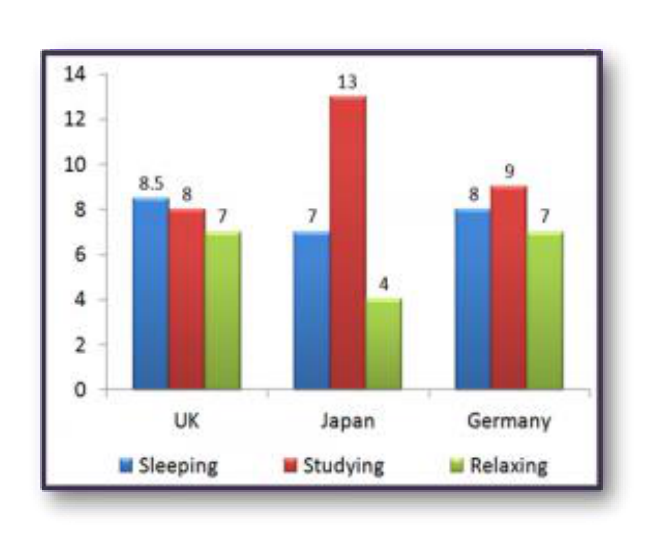
The bar chart shows the typical weekday for students in three different countries.
Summarise the information by selecting and reporting the main features, and make comparisons where relevant.
Student answer (Band 5.5)
The bar chart illustrates the portions of three activites ( sleeping, studying, and relaxing) measured in hour, in students from 3 contries ( UK, Japan, and Germany) during the weekday.
Overall, the Japanies students study more hour than the UK and Germany students, while the UK students sleep more than the Jaban and germany students. Moreover, Germany students study more then UK students.
In details, Japanies students spend most of thier time for studying, wich is around 13 hour per day comparing UK and Germany students that they spend 8 and 9 hour respectivly, the relaxing time in Japanies students very short around 4 hour per day comparing with Germany and UK students witch equaled around 7 hour per day.
However, Sleeping time in all students very close, Japanies students sleep around 7 houres per day, while Germany and UK students sleep 8 and 8.5 hour per day respectively.
AI examiner evaluation
| Criterion | Band |
|---|---|
| Task Achievement / Task Response | 6.0 |
| Coherence and Cohesion | 6.0 |
| Lexical Resource | 5.0 |
| Grammatical Range and Accuracy | 5.0 |
| Overall | 5.5 |
Task Achievement / Task Response: Band 6.0
You identify the chart’s main comparisons accurately: Japanese students study the most (13 hours), while UK students sleep the most (8.5 hours), and the figures for relaxing are lower in Japan than in the other two countries. The overview also notes that German students study more than UK students. However, some details are less fully developed: the response does not clearly compare all three countries across each activity, and the opening description calls the figures “portions” rather than hours. The response is also one word below the required minimum of 150 words. Add a little more precise comparison—for example, that Germany’s 9 study hours are one hour above the UK figure—to complete the summary more fully.
Coherence and Cohesion: Band 6.0
The response has a clear overall arrangement: an introduction, an overview, and two paragraphs covering study/relaxation and sleep. This makes the main information easy to locate, and linking expressions such as “Overall,” “Moreover,” and “However” help signal the direction of the discussion. Some connections are less smooth, though. The long sentence beginning “Japanies students spend most…” combines study and relaxation comparisons without a clear break, while “In details” does not introduce the paragraph naturally. The overview also repeats information that is then given again in the detail paragraphs. Use clearer sentence boundaries and organise each paragraph around a distinct comparison to make progression more consistent.
Lexical Resource: Band 5.0
You use relevant vocabulary for describing the chart, including “illustrates,” “comparing,” “respectively,” and “per day,” so the reader can understand the intended comparisons. However, the range and control are limited by repeated basic wording and noticeable spelling and word-choice errors, including “activites,” “contries,” “Japanies,” “thier,” and “houres.” Some collocations are also unnatural: students do not “spend most of their time for studying,” and “portions” is not an appropriate description of values measured in hours. These errors do not prevent the main message from being understood, but they reduce precision. Practise accurate country adjectives and natural phrases such as “spend time studying” and “the number of hours spent.”
Grammatical Range and Accuracy: Band 5.0
You attempt both simple and more complex sentence forms, including comparisons with “while” and “comparing,” and the overall meaning is generally recoverable. However, some sentence structures are incomplete or awkward. For example, “the relaxing time in Japanies students very short” is missing a verb, and “Sleeping time in all students very close” also needs a verb such as “is.” There are recurring problems with articles, plurals, and agreement in phrases such as “measured in hour” and “students study more hour.” The long sentence beginning “Japanies students spend…” would also benefit from being divided into two sentences. Check that each clause has a complete verb and that nouns agree in number.
See this exact question answered at other band scores. The same prompt compared across bands.
Browse more IELTS Writing model answers or get your own writing scored by the same AI examiner.