Band 6.0 IELTS Writing Task 1 Model Answer
Overall Band Score: 6.0 · IELTS Academic Practice Accelerator · 2026-11-08
IELTS Writing Task 1 question
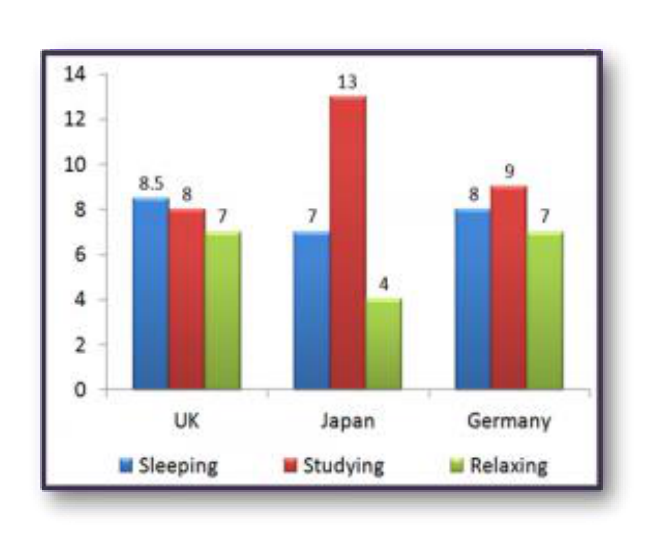
The bar chart shows the typical weekday for students in three different countries.
Summarise the information by selecting and reporting the main features, and make comparisons where relevant.
Student answer (Band 6.0)
The bar graph show how students spend their weekday in three different countries i.e. UK, Japan and Germany. It is obvious that the students in Japan spend most of their weekday in studying as compared to UK and Germany. where the studying ration among the students are almost same, with a slight increase in Germany. The sleeping quantity is nearly same in all the three countries, although UK is a bit higher than the rest of them. Japan is lower than the remaining two countries in relaxation, where students exercise relaxation in weekday with a value of 4 only. The relaxation value for UK and Germany is same, which is 7.
Overall, in weekday, the people who study are higher in Japan with a value of 13, while the value for UK is 8 and Germany is 9. Sleeping ratio among them is same, it is 8.5 for UK, 7 for Japan and 8 for Germany. Moreover, students who go for relaxation in UK and Germany are same while it is lower for Japan with a value of 4.
AI examiner evaluation
| Criterion | Band |
|---|---|
| Task Achievement / Task Response | 6.0 |
| Coherence and Cohesion | 6.0 |
| Lexical Resource | 5.5 |
| Grammatical Range and Accuracy | 5.5 |
| Overall | 6.0 |
Task Achievement / Task Response: Band 6.0
You identify the main comparisons accurately: Japan has the highest study figure (13) and lowest relaxation figure (4), while relaxation is equal in the UK and Germany (7 each). You also report the sleeping values correctly. This gives the response a relevant overview and covers all three activities. However, the overview is repeated in the second paragraph rather than using that space to develop the most important contrasts. The statement that studying in the UK and Germany is “almost same” could be made more precise by explicitly comparing 8 with 9. Also, “students exercise relaxation” does not clearly describe the chart’s measure. A sharper overview of the contrasting Japanese pattern and the broadly similar UK/German figures would make the key features clearer and more fully developed.
Coherence and Cohesion: Band 6.0
The response is arranged in two paragraphs and follows a generally understandable sequence, moving from broad comparisons to figures for each activity. Linking expressions such as “although” and “Moreover” help connect some points. However, the second paragraph largely repeats information already given in the first, so progression is limited. The opening paragraph also contains a sentence fragment after “Germany.”, and the relationship between the opening overview and the later summary is not always clear. Organise the report into a concise overview followed by a paragraph grouping the detailed comparisons, and use references such as “these figures” only when their meaning is unmistakable. This would make the cohesion less repetitive and more controlled.
Lexical Resource: Band 5.5
You use relevant topic vocabulary, including “studying,” “sleeping,” “relaxation,” “value,” and “higher,” so the chart’s subject remains clear. There are also attempts to vary expression, such as “a bit higher” and “lower than the remaining two.” However, several choices are imprecise or unnatural for describing chart data: “studying ration,” “sleeping quantity,” and “students exercise relaxation” do not express the intended measures naturally. “People who study are higher” also confuses the number of people with the number of hours. Use precise terms such as “time spent studying,” “hours of sleep,” and “relaxation time.” More accurate collocations would improve clarity and give the vocabulary greater flexibility.
Grammatical Range and Accuracy: Band 5.5
You attempt both simple and more complex sentence forms, for example, the comparison beginning “although UK is a bit higher” and the clause “where students exercise relaxation.” Most of the intended comparisons can still be understood. Some grammatical errors remain, however: “The bar graph show” needs subject–verb agreement, “the studying ration … are” has an agreement problem, and “where the studying…” begins with an inappropriate sentence break after “Germany.” The repeated pattern “it is…” also limits structural variety. Check singular and plural agreement, sentence boundaries, and article use, and practise combining comparisons into accurate complex sentences. These corrections would make the report more consistently controlled without sacrificing the range you are attempting.
See this exact question answered at other band scores. The same prompt compared across bands.
Browse more IELTS Writing model answers or get your own writing scored by the same AI examiner.