Band 6.5 IELTS Writing Task 1 Model Answer
Overall Band Score: 6.5 · IELTS Academic Practice Accelerator · 2026-11-08
IELTS Writing Task 1 question
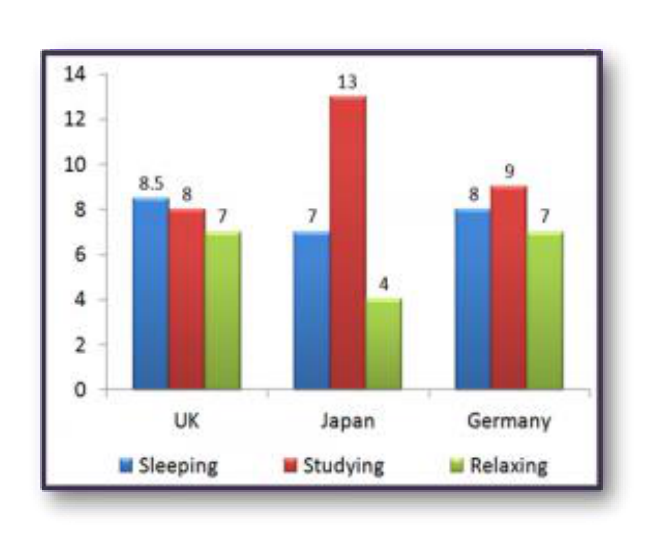
The bar chart shows the typical weekday for students in three different countries.
Summarise the information by selecting and reporting the main features, and make comparisons where relevant.
Student answer (Band 6.5)
The bar chart illustrates how students in three different country, namely UK, Japan and Germany, spend their typical weekdays on sleeping, relaxing and studying.
Overall, the most striking aspects in the figure is that Japanese students spend their most time studying, while student in the UK spend their most time sleeping. Relaxing takes the least time in Japan.
In details, students in the UK spend 8.5 hours sleeping, which is the highest figure among the three countries.They also spend 8 hours studying and 7 hours relaxing.
Moreover, Japanese student spend 13 hours studying, which is significantly higher then the figures for UK and Germany. However, they spend only 7 hours sleeping and 4 hours relaxing, the lowest figures in these catergories. In Germany, students spend 9 hours studying, 8 hours sleeping and 7 hours relaxing. These figures are relatively balanced compared with the other two countries. Also Germany shows similar figures for sleeping and relaxing.
AI examiner evaluation
| Criterion | Band |
|---|---|
| Task Achievement / Task Response | 7.0 |
| Coherence and Cohesion | 6.5 |
| Lexical Resource | 6.0 |
| Grammatical Range and Accuracy | 6.0 |
| Overall | 6.5 |
Task Achievement / Task Response: Band 7.0
The response identifies the chart’s main comparisons accurately: Japan has the highest study figure (13 hours) and the lowest relaxation figure (4), while UK students sleep the most (8.5 hours). It also reports the remaining figures correctly and gives a clear overview, including the relatively balanced German pattern. This addresses the task well and supports the key points with relevant data. To make the account more fully developed, compare the countries more consistently across each activity—for example, explicitly note that Germany studies for 9 hours, between Japan and the UK, and that UK and Germany both relax for 7 hours. The overview’s claim about UK students’ most time is clear, but could specify that sleeping is their largest activity.
Coherence and Cohesion: Band 6.5
The response has a clear overall arrangement: an introduction, an overview, and country-focused detail paragraphs. The progression from the general pattern to specific figures is easy to follow, and linking expressions such as “Overall,” “Moreover,” and “However” help signal relationships. This coherent structure is a strength. Some cohesion is less controlled, however: “In details” is an awkward transition, and the country-by-country organisation leads to repeated references to the same comparisons rather than grouping all countries under each activity. There is also a missing space after “countries.” in the UK paragraph, which interrupts presentation slightly. For a more flexible progression, organise the details around sleeping, studying, and relaxing, using concise comparisons within each.
Lexical Resource: Band 6.0
Vocabulary is adequate for describing the chart, with useful terms such as “illustrates,” “spend,” “highest figure,” “significantly higher,” and “relatively balanced.” These choices communicate the data clearly, though the range is somewhat repetitive and some expressions are inaccurate or imprecise. “In details” is not the natural phrase here, and “the most striking aspects” is less well formed than “the most striking feature.” There are also spelling errors in “catergories” and a word-choice error in “higher then.” Aim for more precise chart language, such as “record,” “account for,” or “by comparison,” while checking spelling and collocations carefully. This would add flexibility without making the description unnecessarily elaborate.
Grammatical Range and Accuracy: Band 6.0
The response uses a mix of simple and more complex forms, including relative clauses (“which is the highest figure”) and contrast clauses beginning with “while” and “However.” Most sentences remain understandable, and the figures are generally presented in clear sentence patterns. Some grammatical errors persist: “three different country” needs a plural noun, “the most striking aspects … is” has a subject–verb agreement problem, and “student in the UK” and “Japanese student” need plural forms. The sentence “Relaxing takes the least time in Japan” is grammatically sound, but the overview would benefit from more consistently controlled sentence structures. Review agreement, articles, and plural marking, then proofread punctuation and spacing to improve accuracy.
See this exact question answered at other band scores. The same prompt compared across bands.
Browse more IELTS Writing model answers or get your own writing scored by the same AI examiner.