Band 6.5 IELTS Writing Task 1 Model Answer
Overall Band Score: 6.5 · IELTS Academic Practice Accelerator · 2026-11-09
IELTS Writing Task 1 question
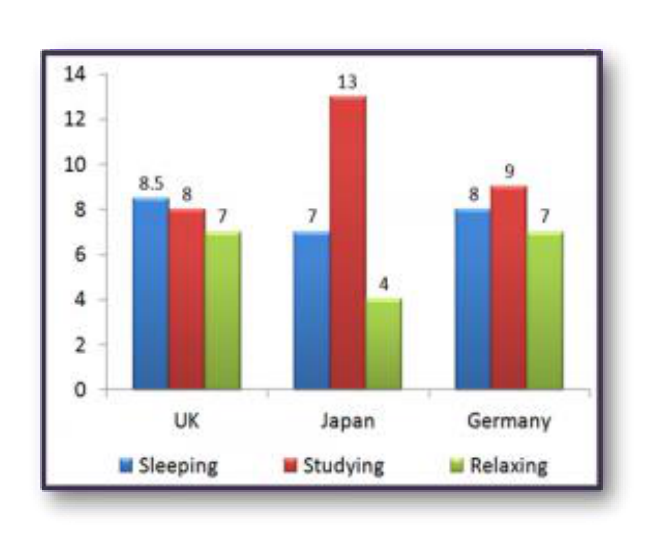
The bar chart shows the typical weekday for students in three different countries.
Summarise the information by selecting and reporting the main features, and make comparisons where relevant.
Student answer (Band 6.5)
The bar chart depicts the number of hours of sleeping, studying and relaxing for the typical weekday of students from the UK, Japan and Germany.
Overall, the studying period of Japan is the maximum one, and the other two countries hours are divided without much difference. The relaxing period of Japan is the shortest in comparison with the other two countries.
The number of hours UK students spend on sleeping is the highest one among sleeping, studying and relaxing which are respectively 8.5, 8 and 7. The relaxing time of Germany and the UK students is the same. German students' study time is higher than sleeping and relaxing, which is 9 hours. Their sleeping and relaxing hours are respectively 8 hours and 7 hours.
Japan has the longest study hours and the shortest relaxing hours in comparison with the other two countries. The students of Japan study for 13 hours. Their relaxing time is 9 hours less compare to study. They sleep for 7 hours and relax for 4 hours.
AI examiner evaluation
| Criterion | Band |
|---|---|
| Task Achievement / Task Response | 7.0 |
| Coherence and Cohesion | 6.0 |
| Lexical Resource | 6.0 |
| Grammatical Range and Accuracy | 6.0 |
| Overall | 6.5 |
Task Achievement / Task Response: Band 7.0
The response selects the main comparisons accurately: Japan has the highest study figure at 13 hours and the lowest relaxation figure at 4, while UK and German relaxation are both 7 hours. It also reports the sleeping and studying figures for each country, so the key categories are covered. The overview identifies the standout Japanese pattern, although “the other two countries hours are divided without much difference” is vague and does not clearly summarise the UK–Germany comparison. There is also a factual inconsistency: Japan’s relaxation time is described as “9 hours less” than study, whereas the chart shows a difference of 9 hours, and the earlier statement that it is 4 hours is correct. A more precise overview and consistent reporting would strengthen an otherwise relevant summary.
Coherence and Cohesion: Band 6.0
The response has a clear overall structure: an introduction, an overview, and separate paragraphs describing the UK/Germany and Japan. This makes the information easy to follow, and the country-by-country organisation is appropriate. However, some connections between ideas are mechanical or unclear. For example, “which are respectively 8.5, 8 and 7” requires the reader to infer that the figures refer to sleeping, studying and relaxing, while “the other two countries hours” is not a clear reference. The final paragraph also repeats the point that Japan has the longest study and shortest relaxation times, already stated in the overview. Use clearer referencing and linking, and reserve the overview for the main patterns so the body paragraphs can add detail without repetition.
Lexical Resource: Band 6.0
The vocabulary is adequate for describing the chart, with relevant terms such as “depicts,” “respectively,” “highest,” and “shortest.” The writer also uses several ways to describe time, including “spend,” “study time” and “relaxing time.” However, some word choices and collocations are awkward or imprecise, such as “the maximum one,” “the other two countries hours,” and “the longest study hours.” “The relaxing period … is the shortest in comparison” is also less natural than a direct comparison of the figures. These choices do not prevent understanding, but they limit precision and fluency. Aim for standard chart language such as “the highest figure,” “hours spent studying,” and “compared with,” and avoid repeating “period” and “time” where a more concise phrase is available.
Grammatical Range and Accuracy: Band 6.0
There is a mix of simple sentences and some more developed structures, including “German students’ study time is higher than sleeping and relaxing” and the relative clause in “which are respectively 8.5, 8 and 7.” Most meanings remain understandable, but some grammatical errors and awkward constructions persist. For example, “the other two countries hours” needs a possessive form, and “the relaxing period of Japan” would be clearer with a possessive construction such as “Japanese students’ relaxation time.” In “Their relaxing time is 9 hours less compare to study,” the comparison structure and verb form are faulty; the chart difference should be expressed as “nine hours less than their study time.” Vary sentence patterns while checking possessives, comparison structures and the links between clauses.
See this exact question answered at other band scores. The same prompt compared across bands.
Browse more IELTS Writing model answers or get your own writing scored by the same AI examiner.