Band 6.5 IELTS Writing Task 1 Model Answer
Overall Band Score: 6.5 · IELTS Academic Practice Accelerator · 2026-11-09
IELTS Writing Task 1 question
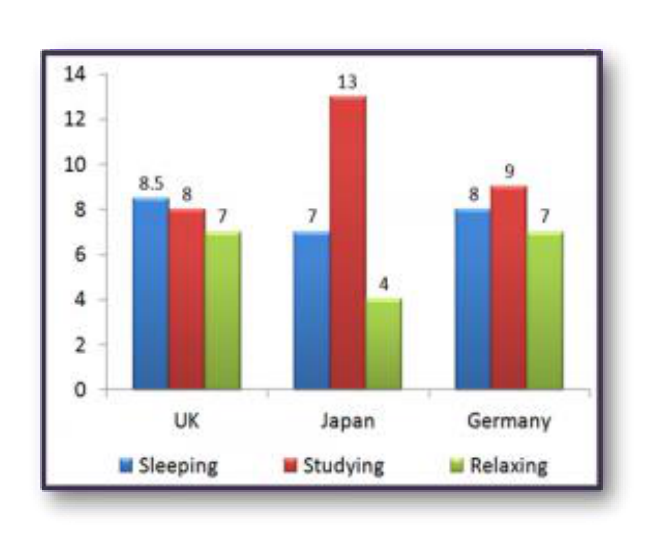
The bar chart shows the typical weekday for students in three different countries.
Summarise the information by selecting and reporting the main features, and make comparisons where relevant.
Student answer (Band 6.5)
The bar chart illustrastes the usual weekday schedule for students in UK, Japan and Germany.
Overall, majority of the students spend their time studying in all countries but Japanese have the highest number in this category. Conversely, the least days are spent relaxing in all three countries and sleeping remains close to each other across all countries.
Japan has 13 scheduled days dedicated to studying which is far more than others. Also Japanese students spend only 4 days relaxing compared to 7 days of relaxing in Germany and UK. Germans spend 9 days studying which is followd by 8 days of studying in UK, however both of them have equall number of relaxing days.
Third category is sleeping and the students in UK spend 8.5 days in this category. Germany follows UK with 8 days dedicated to this and Japanese spend 7 days sleeping which is the least among all.
AI examiner evaluation
| Criterion | Band |
|---|---|
| Task Achievement / Task Response | 7.5 |
| Coherence and Cohesion | 7.0 |
| Lexical Resource | 6.0 |
| Grammatical Range and Accuracy | 6.0 |
| Overall | 6.5 |
Task Achievement / Task Response: Band 7.5
The response identifies the main patterns and supports them with relevant figures: Japan has the highest study figure (13), while its relaxation figure (4) is lower than the UK and Germany (both 7). It also accurately compares sleeping time across the three countries. The overview captures the broad contrasts, although “the least days are spent relaxing in all three countries” is not quite accurate: relaxing is the lowest category in Japan, but in the UK and Germany it is below studying yet not below sleeping. The chart reports hours, not days, so describing the figures as “days” misrepresents the units. To strengthen the report, state the unit correctly and make the overview more precise while retaining the useful comparisons already included.
Coherence and Cohesion: Band 7.0
The information is arranged clearly: an introduction is followed by an overview, then comparisons of studying and relaxing, and finally sleeping. This gives the reader a logical progression through the categories, and linking phrases such as “Conversely,” “Also,” and “however” help connect points. The organisation is effective, though some transitions feel formulaic, particularly “Third category is sleeping,” and the second body paragraph combines two categories without a particularly smooth transition. Use clearer topic sentences and vary the way comparisons are linked. Also ensure that references such as “this category” have an unmistakable antecedent; the overall structure is clear, but cohesion could be more flexible and polished.
Lexical Resource: Band 6.0
The response uses an adequate range of task-related vocabulary, including “dedicated to,” “compared to,” “category,” and “follows,” so the comparisons are generally understandable. However, some choices are inaccurate or unnatural: “scheduled days” and “days” mislabel the chart’s hours, while “the least days are spent relaxing” is an awkward way to describe the smallest amount of time. There are also spelling errors in “illustrastes,” “followd,” and “equall,” and “number” is not the most suitable noun for these time figures. Aim for precise chart language and check spelling carefully. More natural alternatives such as “hours spent studying” and “the lowest figure” would improve clarity and control.
Grammatical Range and Accuracy: Band 6.0
There is a mix of simple and more complex sentence forms, including the contrast in “Germans spend 9 days studying …, however both of them have…” and the relative clause “which is the least among all.” Most sentences communicate the intended comparisons, but some grammatical errors remain. For example, “Overall, majority of the students” needs an article, and “Japanese have the highest number” has an unclear plural reference and noun construction. “Germany follows UK” also omits articles before the country names, while “which is followd by” has an incorrect verb form. Work on articles, agreement, and accurate clause construction, and punctuate contrastive clauses more carefully. These corrections would make the varied sentence patterns more consistently controlled.
See this exact question answered at other band scores. The same prompt compared across bands.
Browse more IELTS Writing model answers or get your own writing scored by the same AI examiner.