Band 4.5 IELTS Writing Task 1 Model Answer
Overall Band Score: 4.5 · IELTS Academic Practice Accelerator · 2026-11-10
IELTS Writing Task 1 question
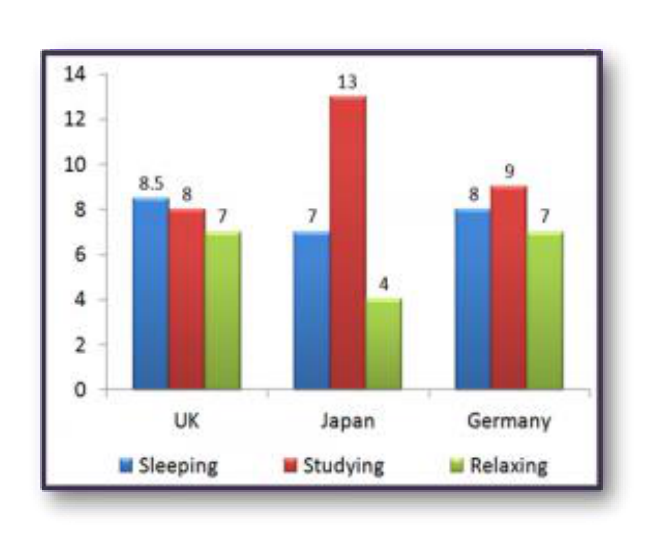
The bar chart shows the typical weekday for students in three different countries.
Summarise the information by selecting and reporting the main features, and make comparisons where relevant.
Student answer (Band 4.5)
Overall:
The bar chart shows the pypical weekday for students in three different countries.In UK spend 8.5 hours sleeping, and japan spend 13 hours studying, and Germany spend 9 hours relaxing.
Firest we explain UK students a larg time spend 8.5 hours sleepin and spend 8 hours studying and spend 7 hours relaxing.
Next we see a Japan students spend 13 hours studying and spend 7 hours sleeping and they spend 4 hours relaxing in weekday.
The Germany students spend 9 hours studying and these spend 8 hours sleeping and thes e spend 7 hours relaxing.
AI examiner evaluation
| Criterion | Band |
|---|---|
| Task Achievement / Task Response | 4.0 |
| Coherence and Cohesion | 5.0 |
| Lexical Resource | 4.5 |
| Grammatical Range and Accuracy | 4.5 |
| Overall | 4.5 |
Task Achievement / Task Response: Band 4.0
You identify the chart’s three activities and report most figures accurately: for example, Japan’s 13 hours of studying and 4 hours of relaxing, and the UK’s 8.5 hours of sleeping. However, the overview contains a major factual error: Germany’s 9 hours are for studying, not relaxing. The response mainly lists figures country by country and does not clearly summarise the key overall patterns, such as studying being highest in Japan and relaxing being lowest there. The response is also substantially below the required 150 words, which leaves the comparisons and overview underdeveloped. To improve, give a concise, accurate overview first, then compare the countries using the most important figures.
Coherence and Cohesion: Band 5.0
The response has a basic sequence: an opening statement is followed by separate comments on the UK, Japan and Germany. The transitions “First” and “Next” help signal this order, so the reader can generally follow the country-by-country presentation. However, there is little overall progression beyond repeating the same pattern of listing each country’s hours, and the final sentence does not add a concluding comparison. The opening is labelled “Overall” but does not function as a reliable overview because it misidentifies Germany’s 9-hour activity. Develop a clearer structure by presenting the main trends first and grouping comparisons by activity where useful. Use linking phrases to show contrasts, rather than relying mainly on “and” and repeated country openings.
Lexical Resource: Band 4.5
Vocabulary is basic and repetitive, with the same verbs and activity words used throughout: “spend,” “hours,” “sleeping,” “studying” and “relaxing.” This is enough to communicate the chart’s general subject and several figures, but the limited range makes the report sound like a list rather than a summary. There are also noticeable spelling errors, including “pypical,” “Firest,” “sleepin” and “thes,” which reduce accuracy and polish. Some phrasing is not natural for describing chart data, such as “a larg time spend 8.5 hours sleepin.” Build a small set of accurate reporting expressions, such as “spent,” “accounted for” and “the highest figure,” and check spelling carefully before submitting.
Grammatical Range and Accuracy: Band 4.5
The response relies almost entirely on short, simple clauses, often joined with “and,” so it shows very limited structural variety. Frequent errors affect sentence formation and grammatical relationships. For example, “In UK spend 8.5 hours sleeping” lacks a clear subject and uses an incomplete article pattern; “Japan spend 13 hours studying” has subject–verb disagreement; and “these spend” does not form a correct subject and verb. The sentence about the UK also strings several clauses together without clear punctuation. Despite these problems, the reader can usually identify the intended figures and activities. Practise complete subject–verb sentences, correct agreement and articles, and use a few controlled comparison structures, such as “Japanese students spent more time studying than students in the UK.”
See this exact question answered at other band scores. The same prompt compared across bands.
Browse more IELTS Writing model answers or get your own writing scored by the same AI examiner.