Band 4.5 IELTS Writing Task 1 Model Answer
Overall Band Score: 4.5 · IELTS Academic Practice Accelerator · 2026-11-10
IELTS Writing Task 1 question
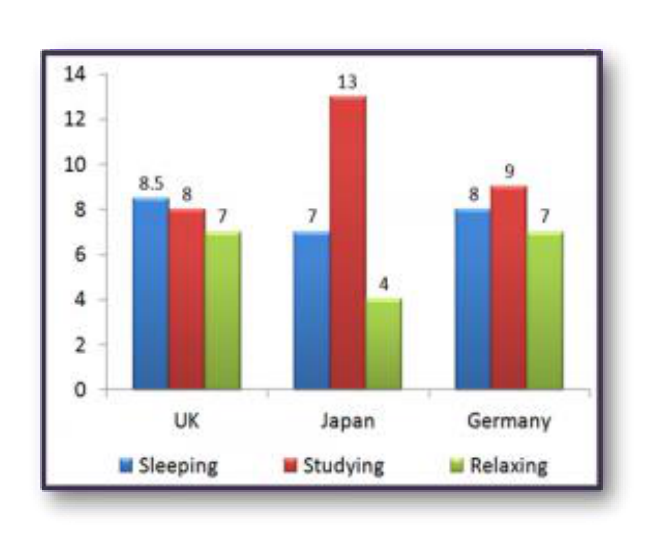
The bar chart shows the typical weekday for students in three different countries.
Summarise the information by selecting and reporting the main features, and make comparisons where relevant.
Student answer (Band 4.5)
The bar is showing how the number of typical weekday for students from three different activites in three various countires .
Overall , it can seen that there were two downward trands whereas another there was no upward trands but typical weekday for students only relaxing is unchanged over the years.
According to the chart the sleeping started of 8.5 compared , 8 for studying started in the UK as for, there was slight decreaed of 7 however in germany gradually increase 8 unti the end such as, the number for studying increased rapidly in japan 13.
AI examiner evaluation
| Criterion | Band |
|---|---|
| Task Achievement / Task Response | 3.5 |
| Coherence and Cohesion | 4.5 |
| Lexical Resource | 5.0 |
| Grammatical Range and Accuracy | 4.5 |
| Overall | 4.5 |
Task Achievement / Task Response: Band 3.5
You identify the chart’s three activities and make an attempt at an overview, but the response only partially reports the main features. The overview says there are “two downward trends” and that relaxing is “unchanged over the years,” although the chart compares countries, not changes over time; relaxing is 7 hours in the UK and Germany but 4 in Japan. Some figures are included, such as UK sleeping at 8.5 hours and studying at 8, but the account is incomplete and the comparisons are difficult to follow. Several key values are omitted, including Japan’s 7 hours of sleep and Germany’s 9 hours of study. The response is also 53 words below the required minimum. To improve, give a clear overview of the country differences and report the main figures accurately.
Coherence and Cohesion: Band 4.5
There is a basic attempt to organise the response: an opening, an overview beginning “Overall,” and a detail paragraph beginning “According to the chart.” This gives the reader some sense of structure. However, the progression is weak because the overview describes trends over time, while the chart compares three countries, and the final paragraph moves between activities and countries without a clear sequence. Linking phrases such as “as for” and “such as” do not clearly show how the figures relate, and the long final sentence combines several comparisons in a confusing way. Organise the details by activity or country, and use short, clear comparisons so each sentence develops one point.
Lexical Resource: Band 5.0
You use some task-related vocabulary, including “chart,” “sleeping,” “studying,” “relaxing,” and “increased,” so the reader can recognise the general subject. However, the range is limited and several word-choice, spelling, and collocation problems make the report difficult to understand. For example, “the number of typical weekday” does not express hours spent on activities, while “two downward trands” and “slight decreaed” are inaccurate forms. “Three various countires” is also an awkward and misspelled phrase. Aim for precise chart language such as “hours spent,” “was higher than,” and “remained the same,” and check spelling and word forms before submitting.
Grammatical Range and Accuracy: Band 4.5
The response attempts a few longer structures, including “Overall, it can seen that…” and a sentence beginning “According to the chart,” but control is limited and errors often obscure the intended comparisons. Examples include the missing auxiliary in “it can seen,” the incomplete construction “the sleeping started of 8.5 compared,” and the unclear sequence “there was slight decreaed of 7 however in germany gradually increase 8.” Sentence boundaries and punctuation are also unreliable, particularly in the final sentence, which joins several ideas without clear grammatical links. Practise accurate simple comparison sentences first, then combine them using clauses such as “while” or “whereas.” Check verb forms, articles, and sentence punctuation.
See this exact question answered at other band scores. The same prompt compared across bands.
Browse more IELTS Writing model answers or get your own writing scored by the same AI examiner.