Band 5.0 IELTS Writing Task 1 Model Answer
Overall Band Score: 5.0 · IELTS Academic Practice Accelerator · 2026-11-11
IELTS Writing Task 1 question
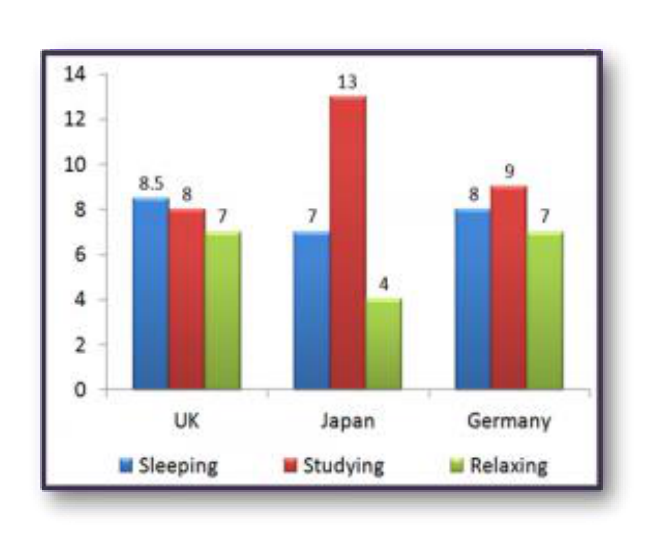
The bar chart shows the typical weekday for students in three different countries.
Summarise the information by selecting and reporting the main features, and make comparisons where relevant.
Student answer (Band 5.0)
The given bar chart illustrates the difficult weekdays for students in the the different countries and thier numbers in three differenmt activities.
Firstly, In the uk country and in germony the number of difficult week days and sleeping numbers was 8 to 8.5. On the other hand the number of sleeeping in japan was seven.Moreover in the weekdays the number of studying of uk and germony was maximum equal and the number was 8to 9.On the other hand in the japan the number was thirteen.
Secondly, In the weekdays the number of relaxing inthe uk and germany the number was same that was7 to7. while in the japan the number of relaxing was very low that was four.
In the over all in the japan country the number of studying was very high than in the other activities was very low. in the three digfferent countries.
AI examiner evaluation
| Criterion | Band |
|---|---|
| Task Achievement / Task Response | 5.0 |
| Coherence and Cohesion | 6.0 |
| Lexical Resource | 4.5 |
| Grammatical Range and Accuracy | 5.0 |
| Overall | 5.0 |
Task Achievement / Task Response: Band 5.0
You identify the three activities and make relevant comparisons, including Japan’s high study figure (13 hours) and lower relaxation figure (4), as well as the matching relaxation figures for the UK and Germany (7 each). However, the response does not give a clear, accurate overall summary of the main pattern across all countries, and some comparisons are unclear: “the number of studying of uk and germony was maximum equal” does not accurately describe the figures, which are 8 and 9. The opening also mischaracterises the chart as showing “difficult weekdays.” The response is under the required 150 words, which limits how fully you report the key features. Add a concise overview and state the main comparisons precisely.
Coherence and Cohesion: Band 6.0
The response has a basic overall arrangement: it introduces the chart, discusses sleeping and studying, then covers relaxing and ends with a general statement. Linking expressions such as “On the other hand,” “Moreover,” and “Secondly” help signal movement between points. However, the progression is sometimes mechanical, and the repeated phrasing “the number of” makes relationships harder to follow. The final overview is not clearly separated from the preceding details, while phrases such as “in the over all” do not establish a precise summary. Organise the body by country or activity, use clearer references to the figures, and reserve the final paragraph for a direct overview of the main contrasts.
Lexical Resource: Band 4.5
You use a small set of relevant terms, including “sleeping,” “studying,” and “relaxing,” so the reader can generally identify the chart categories. However, vocabulary is limited and repetitive, especially the repeated use of “number” and “the number of.” Several word choices are inaccurate or unnatural: “difficult weekdays” does not describe the chart, and “maximum equal” is not an appropriate way to compare the UK and Germany. Spelling errors such as “thier,” “differenmt,” “germony,” and “sleeeping” also reduce clarity. Build a more precise range for describing data, using terms such as “hours spent,” “highest,” “lowest,” and “similar,” and check spelling before submitting.
Grammatical Range and Accuracy: Band 5.0
You attempt both simple statements and longer comparisons, and the reader can usually understand the intended meaning. However, the range of sentence structures is limited, and longer sentences are often difficult to control. For example, “the number of relaxing inthe uk and germany the number was same” lacks a clear grammatical structure, while “the number of studying of uk and germony was maximum equal” has an unclear comparison. Articles, capitalization, spacing, and punctuation are also inconsistent, as in “in the japan” and “8to 9.” Practise forming complete comparison sentences with a clear subject and verb, such as “Students in the UK and Germany spent seven hours relaxing.”
See this exact question answered at other band scores. The same prompt compared across bands.
Browse more IELTS Writing model answers or get your own writing scored by the same AI examiner.