Band 5.5 IELTS Writing Task 1 Model Answer
Overall Band Score: 5.5 · IELTS Academic Practice Accelerator · 2026-11-11
IELTS Writing Task 1 question
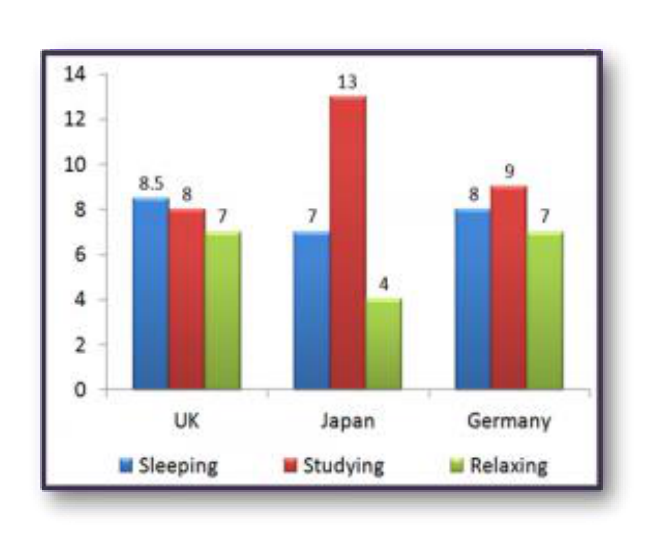
The bar chart shows the typical weekday for students in three different countries.
Summarise the information by selecting and reporting the main features, and make comparisons where relevant.
Student answer (Band 5.5)
The bar chart display the weekdays for pupils in three different countries.
Overall, sleeping, studying and relaxing are divided in a weekdays. UK and Germany patterns are similar to each other. While, Japan has high peak in studying.
The sleepling patterns of UK and Germany are between 8 to 9. on the the other side Japan is less than 8. Japanese students are more focus on studies, we are seeing high peak in study as well. While other two countries are remains the same.
Relaxing is also important, as we can see United kingdom's sleeping are 7 hours and then we see a huge reduction in Japan relaxing sechdule. Germany relaxing hours are same as UK. Japanese students are more focus on studies and take less rest then others. while we can not see much difference between in other countries in study, rest time and sleeping hours.
AI examiner evaluation
| Criterion | Band |
|---|---|
| Task Achievement / Task Response | 5.5 |
| Coherence and Cohesion | 5.5 |
| Lexical Resource | 5.0 |
| Grammatical Range and Accuracy | 5.0 |
| Overall | 5.5 |
Task Achievement / Task Response: Band 5.5
You identify the main contrast: the UK and Germany have broadly similar patterns, while Japanese students spend much more time studying and less time relaxing. The figures you mention are generally consistent with the chart, including sleeping at around 8–9 hours in the UK and Germany and 7 in Japan. However, the overview is vague, and some comparisons are unclear: “other two countries are remains the same” does not specify which activity or figures. The chart’s key values could be reported more precisely, especially studying (8, 13 and 9 hours) and relaxing (7, 4 and 7). The response also falls three words short of the required minimum. Develop the overview and support it with clear, accurate comparisons across all three activities.
Coherence and Cohesion: Band 5.5
The response has an identifiable structure, with an opening, an overview and paragraphs discussing sleeping, studying and relaxing. This gives the reader a basic route through the information. However, progression within paragraphs is uneven, and several linking expressions are awkward or repetitive, including “While” at the start of sentences and “on the the other side.” Some references are difficult to follow: “other two countries are remains the same” does not clearly identify the comparison, and the final sentence combines several activities without a clear sequence. Organise the details by activity or by country, then use precise links such as “By contrast” and “Similarly” to show how each figure relates to the others.
Lexical Resource: Band 5.0
You use relevant vocabulary for the topic, including “sleeping,” “studying,” “relaxing,” “patterns” and “reduction,” so the main subject is usually understandable. However, the range is limited and several word choices or collocations are inaccurate, such as “high peak in studying,” “more focus on studies,” and “relaxing sechdule.” There are also spelling errors, including “sleepling,” which reduce the accuracy of the description. Aim for natural chart language and vary how you describe amounts and comparisons. For example, use “spend more time studying” rather than “high peak in studying,” and “relaxation time” rather than “relaxing schedule.” Proofreading would help remove spelling slips.
Grammatical Range and Accuracy: Band 5.0
You attempt both simple statements and longer sentences, and the basic meaning can usually be understood. However, the range is limited, and attempts to join ideas often contain errors. Examples include “The bar chart display,” “UK and Germany patterns are similar,” and “other two countries are remains the same,” where verb forms, articles or agreement are not controlled. Sentence boundaries and punctuation are also inconsistent, as in “between 8 to 9. on the the other side.” These problems sometimes make comparisons harder to interpret. Practise accurate simple sentence patterns first, then combine them with controlled contrast clauses: for example, “The UK and Germany show similar patterns, whereas Japan records the highest study figure.”
See this exact question answered at other band scores. The same prompt compared across bands.
Browse more IELTS Writing model answers or get your own writing scored by the same AI examiner.