Band 5.0 IELTS Writing Task 1 Model Answer
Overall Band Score: 5.0 · IELTS Academic Practice Accelerator · 2026-11-11
IELTS Writing Task 1 question
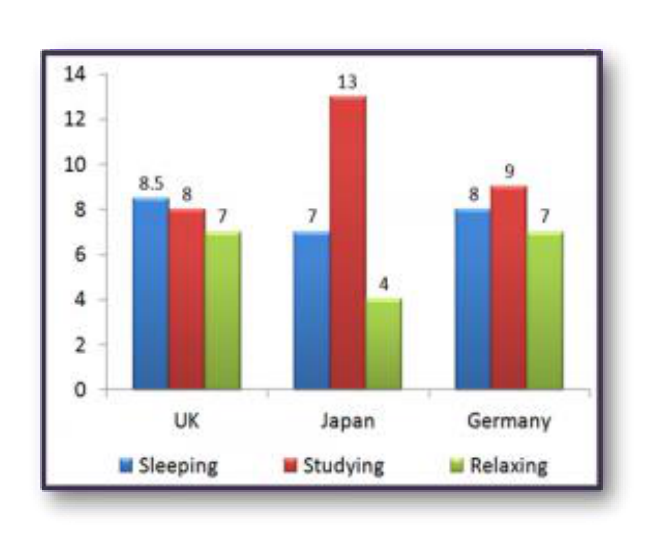
The bar chart shows the typical weekday for students in three different countries.
Summarise the information by selecting and reporting the main features, and make comparisons where relevant.
Student answer (Band 5.0)
This bar chart indicate the weekday of students espacially in Uk, Japan and Germany.
In Uk most of the student spending their weekdays by sleeping which is 8.5% and 8 % students doing their studies and 7% of students prefer relaxing on their weekdays.
In Japan, the chart is very from UK , mostly students in Japan choose student on their weekdays which is around 13% that is the highest percent of students amoung these three countries.7% of them just want to sleep and the 4% students choose relaxing over studing and sleeping which is the lowest persent among all three countries.
In Germany, the most number of students just studying on their weekends that is around 9% and 8% of students choose rest by sleeping and 7% of students just want to overcome their stressand they prefer relaxing on weekdays.
This is the report of students on weekdays in UK, Japan and Germany.
AI examiner evaluation
| Criterion | Band |
|---|---|
| Task Achievement / Task Response | 4.5 |
| Coherence and Cohesion | 5.5 |
| Lexical Resource | 5.0 |
| Grammatical Range and Accuracy | 5.0 |
| Overall | 5.0 |
Task Achievement / Task Response: Band 4.5
You report figures for all three countries and identify some relevant comparisons, including Japan’s 13 hours of studying as the highest figure and its 4 hours of relaxing as the lowest. However, the response only partially fulfils the task because it lacks a clear overview of the main pattern across the chart. The opening merely introduces the topic, while the closing repeats the country names rather than summarising the key features. There are also important inaccuracies: the chart shows activities in hours, not percentages, and the UK’s highest figure is sleeping at 8.5 hours, not a clear overall pattern for students. Focus on the main contrasts and describe the units accurately; avoid unsupported claims about what students “prefer” or why they relax.
Coherence and Cohesion: Band 5.5
The response has a basic, easy-to-follow structure: it introduces the chart, gives one paragraph each for the UK, Japan and Germany, and ends with a brief conclusion. Country-based sequencing helps readers locate the information. However, progression is limited because the report lists each country separately without drawing the main comparisons together, and the final sentence simply repeats the introduction. Linking is also sometimes awkward or unclear, as in “the chart is very from UK” and the long Japan sentence that runs figures and comparisons together. Use clearer comparison links such as “whereas” and “by contrast,” and make the overview a distinct summary of the chart’s main patterns.
Lexical Resource: Band 5.0
You use enough basic vocabulary to communicate the activities and countries, including “sleeping,” “studying” and “relaxing.” There are also attempts to vary expression, such as “the highest” and “the lowest.” However, the range is limited and several word choices or collocations are inaccurate, which sometimes makes the meaning difficult to follow. For example, “choose student” does not express studying, and “overcome their stress” adds an interpretation not shown by the chart. Spelling errors such as “espacially,” “amoung” and “persent” are noticeable. Use precise chart language, especially “hours,” “spend,” and “record,” and check spelling and common collocations before submitting.
Grammatical Range and Accuracy: Band 5.0
The response mainly uses simple sentence patterns, with a few attempts to join ideas using “which” and “and.” These attempts are not consistently controlled. For example, “This bar chart indicate” has subject–verb disagreement, while “most of the student spending” is missing an appropriate verb form and plural marking. The sentence beginning “In Japan” contains several clauses joined without clear punctuation, making the relationships between ideas hard to follow. Articles and sentence boundaries are also inconsistent. Practise accurate present-simple descriptions, such as “The chart shows” and “Most students spend,” then build longer comparisons with one clear clause structure at a time. These recurring errors limit clarity despite the reader being able to identify many intended figures.
See this exact question answered at other band scores. The same prompt compared across bands.
Browse more IELTS Writing model answers or get your own writing scored by the same AI examiner.