Band 6.0 IELTS Writing Task 1 Model Answer
Overall Band Score: 6.0 · IELTS Academic Practice Accelerator · 2026-11-13
IELTS Writing Task 1 question
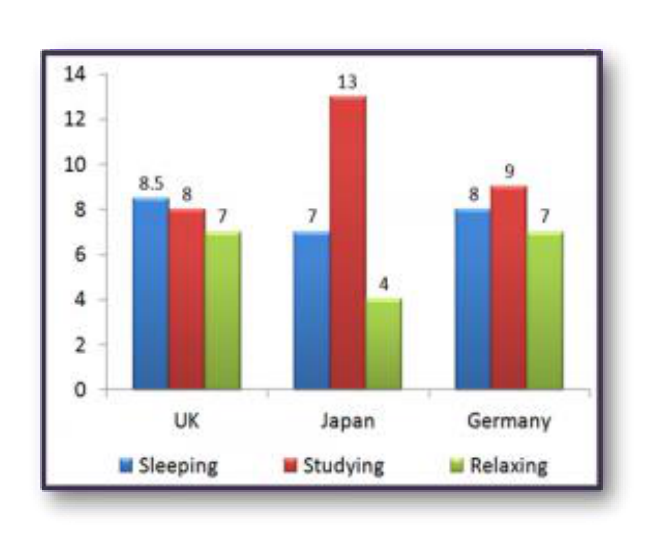
The bar chart shows the typical weekday for students in three different countries.
Summarise the information by selecting and reporting the main features, and make comparisons where relevant.
Student answer (Band 6.0)
The bar chart compares the typical weekday activity such as sleeping, studying and relaxing of students in UK, Japan and Germany.
Overall, it can be observed from the study that students in Japanese, study the most and relax the least. However, the chart shows that sudent in the UK and Germany sleeps the most with their respective values at 8.5 and 8 while their counterpart in Japan is 7. It's evident in this study that Japanese students sleep less than others.
Studying, is the highest activity that the Japanese students engage in, followed by Germany and closely by UK. Japanesse student gapped other students in other countries as there value peaked at 14, while UK is slightly behind Germany at 8 and 9 respectively.
Additionally, UK and German students relax more than the Japanesse student. As seen, the japanesse appeared to rest the least as their value is 4 while the UK and Germany stabled at 7 each.
AI examiner evaluation
| Criterion | Band |
|---|---|
| Task Achievement / Task Response | 7.0 |
| Coherence and Cohesion | 6.5 |
| Lexical Resource | 5.5 |
| Grammatical Range and Accuracy | 5.5 |
| Overall | 6.0 |
Task Achievement / Task Response: Band 7.0
You identify the main contrasts accurately: Japanese students spend the most time studying and the least relaxing, while UK and German students relax for seven hours each. The overview also notes that Japanese students sleep less than the others, and the country comparisons are generally supported with figures. However, one important figure is misreported: Japanese study time is 13 hours, not 14. The phrase “followed by Germany and closely by UK” also reverses the order, since Germany is at 9 hours and the UK at 8. Sleeping is covered in the overview but not developed in the detail paragraphs. Overall, the key features are addressed and supported, though these inaccuracies and uneven coverage limit precision.
Coherence and Cohesion: Band 6.5
The response has a clear overall shape: an introduction, an overview, and two paragraphs comparing study and relaxation. Ideas generally progress from the broad pattern to specific country figures, and linking expressions such as “Overall,” “However,” and “Additionally” help guide the reader. This provides a coherent arrangement. Some connections are less smooth, however: “Studying, is the highest activity…” begins a new point awkwardly, and the comparison of Germany and the UK is difficult to follow because the order is reversed in the sentence. The overview also repeats the point that Japanese students sleep less. To strengthen cohesion, group each activity’s figures in a consistent order and use clearer references when comparing countries.
Lexical Resource: Band 5.5
You use relevant task vocabulary, including “typical weekday activity,” “relax,” “values,” and “peaked,” so the chart’s subject is clear. There is some attempt to vary expression, but several word choices and collocations are inaccurate or unnatural, such as “students in Japanese,” “gapped other students,” and “stabled at 7.” Spelling errors in “sudent,” “Japanesse,” and “there” also reduce accuracy and polish. These issues do not prevent the reader from understanding the main comparisons, but they make the language less precise and sometimes require interpretation. Aim for standard forms such as “Japanese students,” “were ahead of,” and “stood at,” and check spelling carefully.
Grammatical Range and Accuracy: Band 5.5
The response includes both simple statements and some more developed structures, for example “while their counterpart in Japan is 7” and “As seen, the japanesse appeared to rest the least as their value is 4.” However, grammatical control is inconsistent. There are agreement and sentence-structure problems in “students in Japanese, study the most” and “students in the UK and Germany sleeps the most”; the latter subject requires a plural verb. The comma after “Studying” is also misplaced, and “their respective values at 8.5 and 8” lacks a complete verb phrase. These errors sometimes make relationships between ideas less clear. Practise accurate subject–verb agreement and complete comparison clauses, while retaining the range of sentence forms you attempt.
See this exact question answered at other band scores. The same prompt compared across bands.
Browse more IELTS Writing model answers or get your own writing scored by the same AI examiner.