Band 6.0 IELTS Writing Task 1 Model Answer
Overall Band Score: 6.0 · IELTS Academic Practice Accelerator · 2026-11-13
IELTS Writing Task 1 question
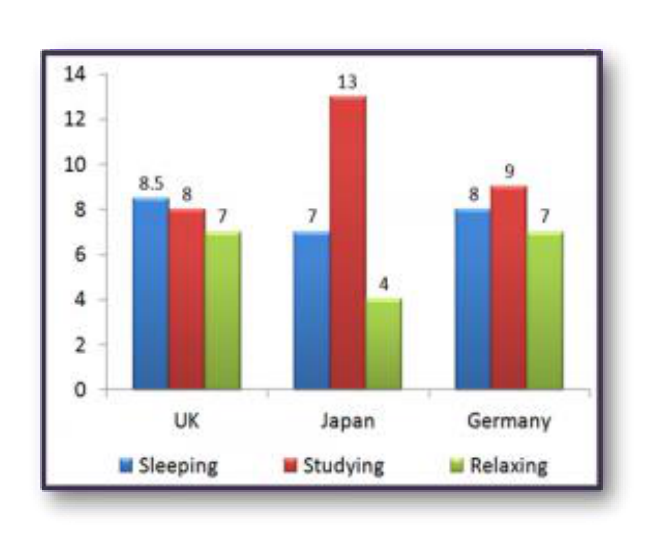
The bar chart shows the typical weekday for students in three different countries.
Summarise the information by selecting and reporting the main features, and make comparisons where relevant.
Student answer (Band 6.0)
The bar chart illustrates the weekday of British, German, and Japanese students. Overall, it is apparent that studying time of Japan and Germany students higher while sleeping time was higher among the British students. However, relaxing time of students in these three countries lower than other activities.
To begin with, sleeping time of UK students slightly higher than other countries students 8.5 hours, the German students sleep for 8 hours and Japanese students sleeping time lesser than other students. In addition, the study time of Japanese students significantly higher than other students which is 13 hours, while German students study for 9 hours in a day. The British students study only for 8 hours per day.
On the other side, comforting time of Japanese students is only 4 hours in a day which is considerably lesser than German and British students. Similarly, British and German students relaxing for 7 hours in a single day.
AI examiner evaluation
| Criterion | Band |
|---|---|
| Task Achievement / Task Response | 7.0 |
| Coherence and Cohesion | 6.5 |
| Lexical Resource | 5.5 |
| Grammatical Range and Accuracy | 5.5 |
| Overall | 6.0 |
Task Achievement / Task Response: Band 7.0
You cover the three activities and all three countries, and the figures you report are accurate: for example, UK students sleep for 8.5 hours, Japanese students study for 13 hours, and Japanese students relax for 4 hours. The overview identifies Japan and Germany as spending more time studying and UK students as sleeping the most, giving the reader a clear summary of key patterns. However, the overview’s claim that relaxing is lower than the other activities is too broad: it is true for Japan, but in the UK and Germany relaxing is close to sleeping and only slightly below studying. Make this comparison more precise, and state explicitly that Japanese students have the longest study day while spending the least time relaxing.
Coherence and Cohesion: Band 6.5
The response has a clear overall structure: an introduction and overview are followed by paragraphs comparing sleeping and studying, then relaxing. Sequencing phrases such as “To begin with,” “In addition,” and “On the other side” help signal movement between points, and the comparisons are generally easy to follow. This is a coherent arrangement, but some linking is mechanical, and the final paragraph’s “Similarly” does not clearly explain the relationship between the Japanese figure and the UK/German figures. The overview also combines several comparisons in a way that could be more logically precise. Use fewer formulaic transitions and connect each comparison directly—for example, contrast Japan’s four hours of relaxation with the seven hours recorded in both the UK and Germany.
Lexical Resource: Band 5.5
You use enough topic vocabulary to communicate the main information, including “illustrates,” “significantly higher,” and “considerably lesser.” However, several word choices and collocations are inaccurate or awkward, which limits precision. “Comforting time” does not mean time spent relaxing, and “weekday of … students” is not a natural way to describe the chart. Phrases such as “sleeping time lesser” and “relaxing time … lower” also show difficulty selecting the correct forms and combinations. Aim for consistent, natural expressions such as “hours spent sleeping,” “study time,” and “time spent relaxing.” This will make the comparisons clearer and help you express the data without relying on awkward or imprecise wording.
Grammatical Range and Accuracy: Band 5.5
You attempt both simple and more complex sentence forms, including a contrast with “while” and a relative clause in “which is 13 hours.” The overall meaning remains understandable, but errors in sentence structure and verb forms recur. For example, “studying time of Japan and Germany students higher” is missing a verb and has an unclear possessive construction; “sleeping time was higher among the British students” shifts tense, while “British and German students relaxing for 7 hours” lacks a finite verb. Articles and comparisons are also inconsistently formed, as in “slightly higher than other countries students.” Practise complete clauses with a consistent present tense: “Japanese students spend 13 hours studying, compared with nine hours in Germany.”
See this exact question answered at other band scores. The same prompt compared across bands.
Browse more IELTS Writing model answers or get your own writing scored by the same AI examiner.