Band 6.5 IELTS Writing Task 1 Model Answer
Overall Band Score: 6.5 · IELTS Academic Practice Accelerator · 2026-11-16
IELTS Writing Task 1 question
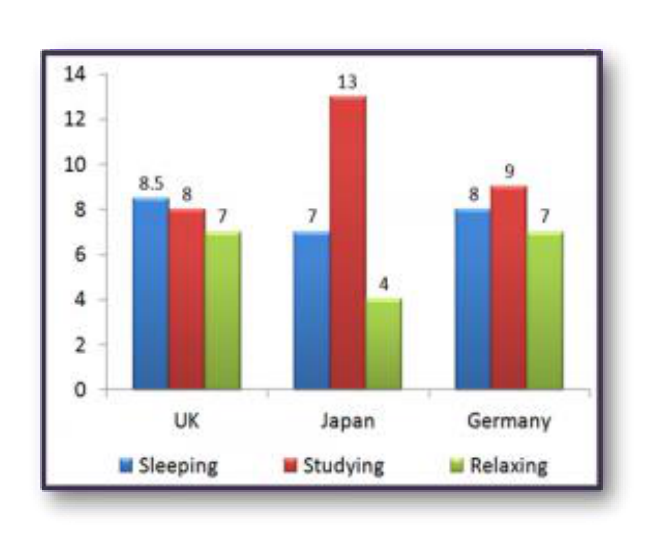
The bar chart shows the typical weekday for students in three different countries.
Summarise the information by selecting and reporting the main features, and make comparisons where relevant.
Student answer (Band 6.5)
The bar graph illustrates the amount of time spent on three different activities of weekdays by students in following countries : UK, Japan and Germany.
Overall, Studying was the most time consuming activity whereas time spent on relexation was the least for all three countries.
While taking a glance at bars for UK and Germany, they had followed a similar trend of time consumed by activites. Both the countries on average spent 7 hours for relaxation. The learners spent less more time on studying in germany which counts for 9 hours a day whereas the students in UK spent 8 hours. While students in UK spent half an hour more on sleeping over than 8 hours spent by students in germany.
Regarding Japan, studying was the activity which took the most amount of time counted for 13 hours a day wheras relaxation which was their least priority activity while spending their time. While people in Japan sleep for 7 hours a day which is the least time spent on the activity among all three countries.
AI examiner evaluation
| Criterion | Band |
|---|---|
| Task Achievement / Task Response | 7.0 |
| Coherence and Cohesion | 6.5 |
| Lexical Resource | 6.0 |
| Grammatical Range and Accuracy | 5.5 |
| Overall | 6.5 |
Task Achievement / Task Response: Band 7.0
You identify the main pattern that studying takes the most time and relaxation the least, and you make relevant comparisons between the countries. Several figures are reported accurately, including 13 hours of study in Japan, 9 in Germany and 8 in the UK, as well as the shared seven hours of relaxation in the UK and Germany. However, the overview overgeneralises: relaxation is not the least activity in Japan, since its four hours are below its seven hours of sleep. The Japan paragraph also leaves its relaxation figure unstated, and the comparison of sleeping times could be clearer by giving all three values. A more precise overview and fuller coverage of the key contrasts would strengthen the report.
Coherence and Cohesion: Band 6.5
The response has a clear overall shape: an introduction, an overview, a comparison of the UK and Germany, and a final paragraph on Japan. This gives the reader a sensible route through the information, and transitions such as “Overall,” “While,” and “Regarding Japan” help signal shifts. The UK–Germany paragraph also groups related figures effectively. However, some links are awkward or unclear, particularly “While taking a glance at bars for UK and Germany, they had followed a similar trend,” where “they” has an uncertain reference. The final paragraph does not connect Japan’s relaxation figure to the earlier overview, and some sentences repeat the same activity-by-country pattern. Use clearer topic sentences and more explicit comparisons to make progression smoother.
Lexical Resource: Band 6.0
You use a reasonable range of task-related vocabulary, including “time consuming,” “trend,” “activity,” and “priority,” and the meaning is generally clear. There are also attempts to vary expressions for time use, such as “spent” and “took.” However, several choices are inaccurate or unnatural: “time consumed by activities,” “spent less more time,” and “sleep for 7 hours” do not express the comparisons smoothly. Spelling slips such as “relexation,” “activites,” “wheras,” and “germany” also reduce control. Aim for precise chart language and reliable collocations, for example “hours devoted to,” “spent less time,” and “relaxation.” This would make the vocabulary more natural and accurate while retaining your useful range.
Grammatical Range and Accuracy: Band 5.5
You attempt a mix of simple and more complex structures, including a contrast with “whereas” and a subordinate clause beginning “While students in UK…”. The main comparisons can usually be understood, but some grammatical errors recur and occasionally make relationships difficult to follow. For example, “While taking a glance at bars for UK and Germany, they had followed…” has an unclear clause structure, and “Both the countries on average spent 7 hours” uses an awkward subject construction. Articles and prepositions are also inconsistent, as in “in following countries” and “in UK.” Check that each sentence has a clear subject and verb, and use parallel forms when comparing countries. More consistently controlled complex sentences would improve accuracy.
See this exact question answered at other band scores. The same prompt compared across bands.
Browse more IELTS Writing model answers or get your own writing scored by the same AI examiner.