Band 5.0 IELTS Writing Task 1 Model Answer
Overall Band Score: 5.0 · IELTS Academic Practice Accelerator · 2026-11-16
IELTS Writing Task 1 question
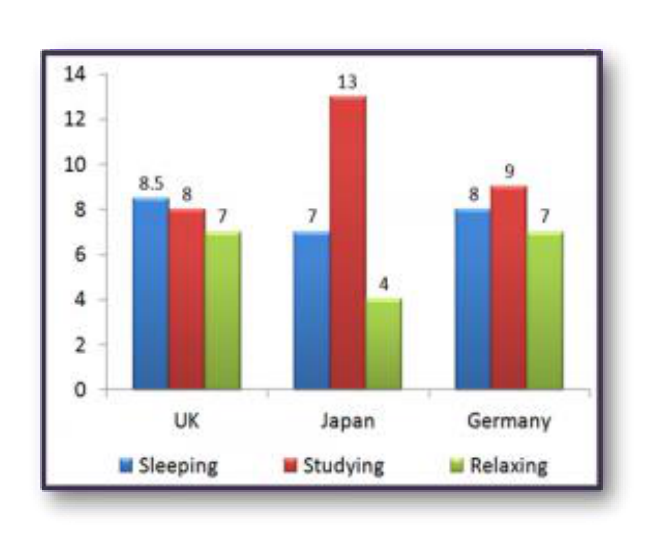
The bar chart shows the typical weekday for students in three different countries.
Summarise the information by selecting and reporting the main features, and make comparisons where relevant.
Student answer (Band 5.0)
The bar chart illustrates usual weedays of students performing three different type of activites in three different states.
Overall, students at Japan had the highest rates of studying compared with Germany and UK. figure for sleeping in all countires recorded different across in all countries. However, Japan had the lowest relaxation rates.
According to bar chart, In UK, students gave highesrt time to sleeping compared with other countries (8.5). The figure for studing at the Uk accounted for 8, while relaxing figures stood at 7. Japan had the lowest sleeping schedule for students recorded at 7, while the figure for studying had significantly high across in all countires (13). In addition, students from Japan found less relaxed compared with remained states.
Furthermore, Germany had most stable schedule for students. The figure for sleeping accounted at 8, while numbers for studying at Germany recorded 9. Consequently, numbers of students for relaxing
AI examiner evaluation
| Criterion | Band |
|---|---|
| Task Achievement / Task Response | 5.5 |
| Coherence and Cohesion | 5.0 |
| Lexical Resource | 5.0 |
| Grammatical Range and Accuracy | 5.0 |
| Overall | 5.0 |
Task Achievement / Task Response: Band 5.5
You identify the main contrast accurately: Japan records the highest study figure (13 hours) and the lowest relaxation figure (4), while the UK and Germany both show 7 hours of relaxation. You also include several relevant figures for sleeping and studying. However, the overview is partly unclear: “figure for sleeping in all countries recorded different” does not explain the pattern, and the claim that UK students spent the most time sleeping is inaccurate, since the UK figure of 8.5 is higher than Germany’s 8 and Japan’s 7, but this comparison should be stated clearly. The final sentence about Germany’s relaxation figure is unfinished. A complete overview and accurate reporting of all three categories would make the response more fully address the task.
Coherence and Cohesion: Band 5.0
The response has a recognisable structure, with an introduction, an overview, and paragraphs describing the countries. Sequencing the UK and Japan before Germany gives the reader a basic route through the data. However, progression is weakened by unclear or incomplete links between ideas. For example, “Consequently, numbers of students for relaxing” ends without completing the point, and “However” does not clearly connect the preceding sleeping statement to Japan’s relaxation figure. Some transitions, such as “According to bar chart” and “Furthermore,” are used mechanically rather than to show precise relationships. Grouping comparisons by activity, or completing each country’s three figures before moving on, would make the information easier to follow.
Lexical Resource: Band 5.0
You use some relevant task vocabulary, including “illustrates,” “accounted,” “figure,” and “relaxation,” and the reader can generally identify the activities being compared. However, the range is limited and several word choices or collocations are inaccurate, which sometimes makes the meaning difficult to follow. Examples include “usual weedays,” “students performing” activities, “highest rates of studying,” and “lowest relaxation rates”; the chart reports hours spent, not rates. Spelling errors such as “activites,” “studing,” and “highesrt” are also noticeable. Aim for precise, repeated-use terms such as “hours spent studying” and “the figure for relaxation,” and check spelling carefully.
Grammatical Range and Accuracy: Band 5.0
You attempt a few complex forms, including the overview contrast beginning “Overall” and the sentence comparing Japan’s sleeping and studying figures. However, the range is limited, and errors occur frequently enough to make some sentences difficult to interpret. Examples include “students at Japan had,” “figure for sleeping … recorded different,” and “the figure for studying had significantly high,” where sentence structure, agreement, or verb patterns are not controlled. The final clause, “Consequently, numbers of students for relaxing,” is incomplete. Practise building clear comparison sentences with a subject and verb, for example, “Students in Japan spent 13 hours studying, compared with 9 hours in Germany.”
See this exact question answered at other band scores. The same prompt compared across bands.
Browse more IELTS Writing model answers or get your own writing scored by the same AI examiner.