Band 6.0 IELTS Writing Task 1 Model Answer
Overall Band Score: 6.0 · IELTS Academic Practice Accelerator · 2026-11-17
IELTS Writing Task 1 question
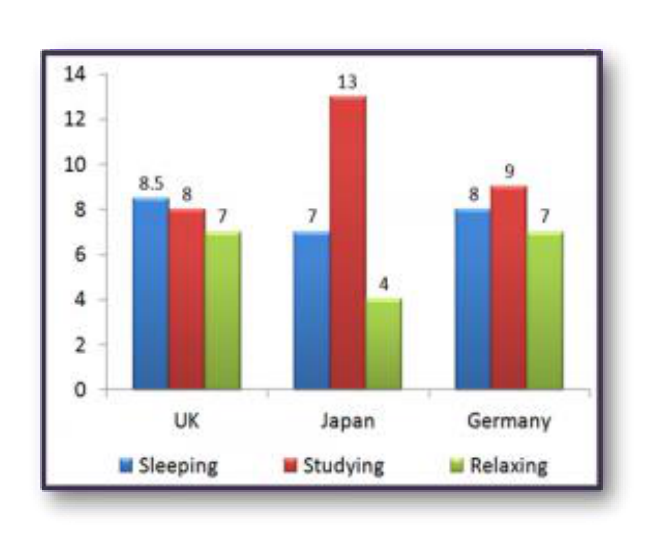
The bar chart shows the typical weekday for students in three different countries.
Summarise the information by selecting and reporting the main features, and make comparisons where relevant.
Student answer (Band 6.0)
The given bar chart compares the average number of hours students in UK,Japan and Germany spend sleeping ,studying and relaxing on typical weekdays.
Overall,students in japan and germany more dedicated towards study on weekdays,while those in UK spend slightly more time for sleeping than studying.Across all three nations they less accounted for spending time on relaxing.
To begin with,Japanese students spent significantly large part for studying on weekdays by 13 hours ,whereas UK and Germany dominates 8 and 9 hours for study respectively.
However,Japan invest their least time in sleeping by 7 hours compares other two nation UK and Germany on weekdays such as,8.5 and 8 hours.
Conversely, Japan display lowest figure throughout survey on relaxing on weekdays by 4 hours.which shows that they least attracted towards relaxation.In contrast,UK and Germany seems more interested in relaxasion on their leisure time.Moreover,both are on the same board by 7 hours investing for relaxing on the typical weekdays.
AI examiner evaluation
| Criterion | Band |
|---|---|
| Task Achievement / Task Response | 7.0 |
| Coherence and Cohesion | 6.0 |
| Lexical Resource | 5.5 |
| Grammatical Range and Accuracy | 5.5 |
| Overall | 6.0 |
Task Achievement / Task Response: Band 7.0
You identify the chart’s three activities and countries, and your overview captures the main contrasts: Japanese students study the most and relax the least, while UK students spend slightly longer sleeping than studying. The figures you report are accurate, including the study totals of 13, 8 and 9 hours and the shared seven-hour relaxation figure for the UK and Germany. This gives the response a clear, relevant account of the data. To make the summary more fully developed, compare the full pattern more explicitly—for example, Germany’s study time is only one hour above the UK’s, and its sleeping figure is also below the UK’s. Avoid interpreting the figures as preferences or dedication, since the chart reports time spent rather than motivation or interest.
Coherence and Cohesion: Band 6.0
The response has a clear overall arrangement: an introduction, an overview, and two paragraphs comparing the figures. The progression from study and sleep to relaxation is easy to follow, and linking expressions such as “Overall,” “However,” and “Conversely” help signal shifts. However, some connections are mechanical or do not express the relationship accurately. For instance, “However” introduces Japan’s sleeping figure without a clear contrast to the preceding sentence, while “Conversely” begins the relaxation comparison even though it is not a direct opposite. The final paragraph also repeats the idea that Japan has the lowest relaxation figure before giving the UK–Germany comparison. Use fewer, more precise transitions and group related comparisons together to make the progression smoother.
Lexical Resource: Band 5.5
You use a range of task-related vocabulary, including “average number of hours,” “significantly,” “lowest figure,” and “in contrast,” so the reader can understand the main comparisons. However, several word choices and collocations are inaccurate or unnatural, such as “more dedicated towards study,” “dominates 8 and 9 hours,” “invest their least time,” and “on the same board.” These choices sometimes make the intended meaning less precise, particularly because the chart shows time allocation rather than students’ attitudes. There are also spelling errors, including “relaxasion,” and inconsistent capitalisation of country names. Prefer straightforward, accurate reporting verbs and phrases, such as “spent,” “recorded,” and “the same amount of time,” and check spelling and capital letters carefully.
Grammatical Range and Accuracy: Band 5.5
You attempt both simple and more complex sentence forms, including a contrast clause beginning “whereas” and sentences using “while” and “which.” The overall meaning is generally recoverable, but some grammatical errors recur and reduce accuracy. For example, “students in japan and germany more dedicated” is missing a finite verb, and “Across all three nations they less accounted” has an incomplete verb construction. In “UK and Germany seems,” the plural subject requires a plural verb; “Japan display” also needs subject–verb agreement. Articles, plurals and sentence boundaries need attention as well, as in “other two nation” and the run-on punctuation in “4 hours.which.” Practise building complete clauses and checking agreement, articles and punctuation before submitting.
See this exact question answered at other band scores. The same prompt compared across bands.
Browse more IELTS Writing model answers or get your own writing scored by the same AI examiner.