Band 5.5 IELTS Writing Task 1 Model Answer
Overall Band Score: 5.5 · IELTS Academic Practice Accelerator · 2026-11-17
IELTS Writing Task 1 question
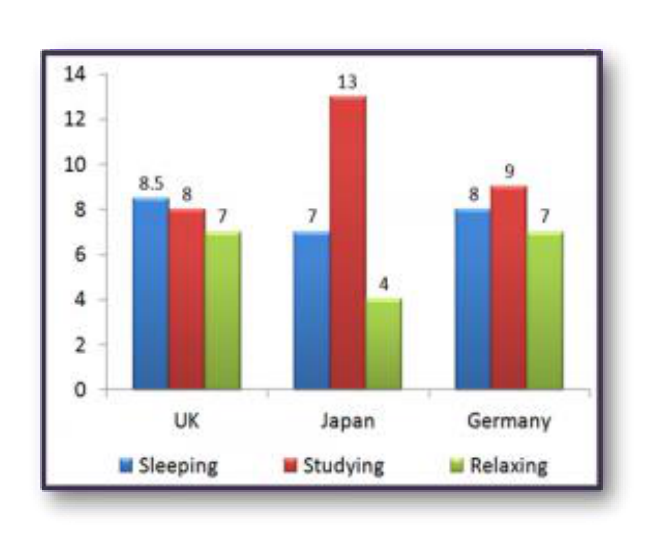
The bar chart shows the typical weekday for students in three different countries.
Summarise the information by selecting and reporting the main features, and make comparisons where relevant.
Student answer (Band 5.5)
The bar chart compares the data on typical weekdays for students in the UK, Japan, Germany.
Overall, the chart has divided into three categories are sleeping, studying and relaxing. Majority learners are studying and minority students are relaxing in weekdays.
In UK, the students has surged to 8.5 in sleeping and plummeted to studing has 8. and least number has 7 is Relaxing. Additionaly, the Japan has highest number in studing is 13 and lowest is 4 number of students are relaxing others has 7 number that is sleeping.
However, the Germany has slightly difference sleeping students are 8 members, studying 9 learners and 7 number in relaxing in the typical weekdays. Compare to all Japan has high level of students are interested in studying.
AI examiner evaluation
| Criterion | Band |
|---|---|
| Task Achievement / Task Response | 5.5 |
| Coherence and Cohesion | 5.5 |
| Lexical Resource | 5.5 |
| Grammatical Range and Accuracy | 5.0 |
| Overall | 5.5 |
Task Achievement / Task Response: Band 5.5
You identify the chart’s three activities and report several key figures accurately, including Japan’s 13 hours of studying and 4 hours of relaxing, as well as Germany’s 8, 9 and 7 hours. The comparison that Japanese students study the most is also a relevant main feature. However, the overview is unclear: “Majority learners are studying” does not accurately describe the overall pattern, since studying is not the largest category in every country. The UK figures are included, but the wording makes them difficult to interpret. The response also contains only 125 words, below the required 150, so the summary is underdeveloped. Add a clearer overview and explain the main contrasts across all three countries.
Coherence and Cohesion: Band 5.5
The response has a basic structure: an introduction, an overview, and country-by-country details. This gives the reader some sense of how the information is organised, and “However” signals a move to Germany. However, progression is not consistently clear. The overview’s claim about the majority studying is not developed, and the final comparison repeats the point about Japan rather than drawing together the main differences. Some linking expressions, such as “Additionaly” and “However,” do not clearly show the relationship between the ideas they connect. Grouping the figures into a more direct comparison—for example, contrasting Japan’s study time with the UK and Germany—would create a clearer overall progression.
Lexical Resource: Band 5.5
You use relevant chart vocabulary, including “categories,” “highest,” “lowest,” and “typical weekdays,” so the topic is generally understandable. However, the range is limited and several choices are inaccurate or unnatural for describing hours. “Surged” and “plummeted” suggest changes over time, whereas the chart compares countries; “students has surged to 8.5” is also an awkward way to report a figure. Phrases such as “8 members” and “interested in studying” do not accurately express hours spent on an activity. There are also spelling errors, including “studing” and “Additionaly.” Use precise reporting language such as “spent,” “recorded,” and “hours,” and check spelling and collocations.
Grammatical Range and Accuracy: Band 5.0
You attempt both simple and more extended sentences, but control is inconsistent, and errors sometimes make the comparisons difficult to follow. For example, “the chart has divided into three categories are” combines sentence patterns incorrectly, while “the students has” has a subject–verb agreement error. The sentence beginning “In UK” also lacks the article needed before the country name, and “plummeted to studing has 8” has an unclear grammatical structure. Most sentences rely on basic patterns, with limited accurate use of complex clauses. Practise forming clear comparison sentences with a subject, verb and measured activity—for example, “UK students spent 8.5 hours sleeping and 8 hours studying”—and check agreement, articles and sentence boundaries.
See this exact question answered at other band scores. The same prompt compared across bands.
Browse more IELTS Writing model answers or get your own writing scored by the same AI examiner.